A hanging piece is a piece that can be captured for free: it is attacked and nobody can recapture. Most players lose material this way far more often than through deep tactics. The fix is a short, repeatable check before every move, plus training that shows you where your own blind spots are. This guide covers the definition, the traps hidden behind it, the check itself, and how to practice.
TL;DR
- A hanging piece is attacked and has no defender, so the opponent wins it for nothing. A piece can also hang when it is defended but worth more than its attacker.
- Most hanging pieces come from tunnel vision, an out-of-date mental board and not counting defenders, not from lack of knowledge.
- Before each move, ask what the opponent threatens, which of your pieces are loose, and what your move stops defending.
- Before grabbing a free piece yourself, check for pins, bait and a stronger reply.
- The habit forms through repetition, so review your own lost pieces and drill the patterns behind them.
Table of Contents
- What a hanging piece is
- Is it truly hanging, or does it only look that way?
- Why you keep hanging pieces
- The pre-move check that works
- Before you take a free piece
- Hanging pieces in the opening
- A practice plan that builds the habit
- Train on your own games with ChessFlux
- Our perspective
- FAQ
- Sources
What a hanging piece is
The simplest definition: a hanging piece is attacked but not defended, so it can be captured for free. The terms “en prise” (attacked) and “loose piece” (undefended) describe the same family of situations.
A stricter, more technical version says that a piece other than the king is attacked by a legal capture and has no legal recapture defending it. That wording matters because “legal” does a lot of work. A defender that is pinned to its own king, for instance, does not really defend anything.
One more nuance: defended does not always mean safe. If a rook is defended by a pawn but attacked by a knight, you still lose the exchange. The rule of thumb is that a piece hangs whenever it can be lost without adequate compensation, whether or not a defender stands behind it.
Hanging versus blundering
The two words get mixed up. Hanging describes the state of a piece: it is unprotected. A blunder is the mistake that put it there, such as moving the only defender away or ignoring a threat. You can hang a piece without blundering (your opponent may simply not see it), and you can blunder without hanging anything (walking into a mating net).
Is it truly hanging, or does it only look that way?
Counting attackers and defenders is a good first pass, not a verdict. A piece that looks free can be bait, and a piece that looks defended can be undefended in practice. These are the cases to know:
| Situation | What it looks like | What is really happening |
|---|---|---|
| Pinned defender | Your piece has a guard | The guard cannot legally move, so the piece hangs |
| Overloaded defender | One piece guards two things | It can only keep one of them |
| Blocked line | A bishop, rook or queen “covers” a square | Another piece is in the way |
| Poisoned capture | An enemy piece is free to take | Taking it opens a fork, a pin or a mate |
| Defender removed | Everything was protected a move ago | An exchange just took the guard away |
For any defender, ask three things. Can it legally move, counting a pin against its own king? Is its path clear? And what does the recapture abandon, for example a second threat against your king or another piece? A recapture that leaves a rook en prise is not a real defense.
A piece can also hang without any immediate threat. A loose piece is simply one without protection, even if no enemy piece attacks it yet. Treat it as a warning: the opponent only needs one tempo to aim something at it.
Hanging is not the same as trapped
A hanging piece may still be able to run. A trapped piece has no safe square at all. A piece can be both, and that combination is usually fatal, so check the escape squares as well as the defenders.
Why you keep hanging pieces
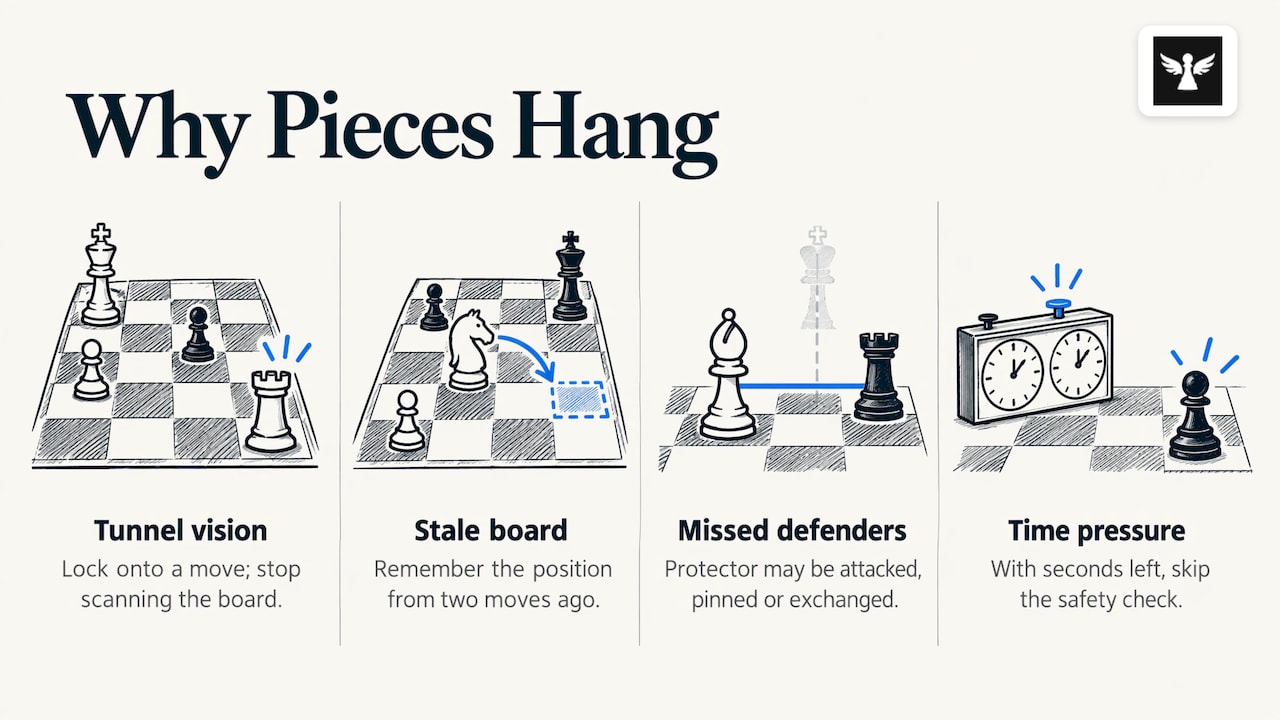
It is rarely ignorance. Players who know the definition perfectly still drop material. The research and coaching material on the topic points to the same few causes.
Tunnel vision. You find a move you like, lock onto it, and stop scanning the board. One coach calls this target fixation, a human problem rather than a chess problem: the same effect makes drivers steer into the obstacle they are trying to avoid. The attack you are building feels so convincing that you forget your own rook on a1 is loose.
An outdated mental board. You remember the position as it was two moves ago. A knight moved, a pawn advanced, a line opened, and you did not update the picture. This is especially common after a trade, because the exchange removed a defender you were counting on.
Not counting defenders. You see that your piece is protected and stop there, without checking whether the protector itself is attacked, pinned or about to be exchanged off.
Time pressure. With seconds left on the clock, the safety check is the first thing to go. Blitz and bullet players know this feeling: the move is played before the question is asked.
The scale of the problem is real. One reference page on the term says that leaving pieces en prise is the biggest single source of lost games below 1200. You do not need to be a beginner to recognize the pattern, but if you are, this is the single cheapest improvement available to you.
The pre-move check that works
The cure is structured, because your brain will not do it spontaneously. Here is a version that takes a few seconds once it is automatic.
- Read the last move. What did your opponent’s move change? Does it attack something, open a line or defend something new? Ask it every single move, not only when the position feels tense.
- Look for their forcing moves. Checks, captures (especially of the piece that just moved) and threats such as forks or an invasion on the seventh rank. One French-language coach reminds players that at lower levels the tactical gain is usually one or two moves deep, not a seven-move forced line. That is good news: a short, regular scan catches most of it.
- Name your loose pieces. List which of your pieces are attacked and which are undefended. Say it in your head, piece by piece.
- Check what your move leaves behind. Does the piece you are about to move currently guard something? Is the destination square covered by an enemy pawn or piece?
- Decide. Protect, move, trade, block or counterattack. If your intended move survives all of that, play it.
A classic method for tactical awareness works the same way in reverse: list every piece or pawn en prise and how it is protected, then list unprotected pieces even if they are not attacked, and look for forks, pins and skewers that could target them. Do it for both sides of the board. Your opponent’s loose pieces are as important as yours.
Do not forget the king and the pawns
Two oversights show up constantly. First, the king can capture, so a checking piece that is unprotected can simply be taken by the king. Second, pawns control squares diagonally. Many opening traps depend on a player ignoring pawn capture squares: if your opponent has pawns on c5 and e5, d6 is covered twice, and parking a piece there without looking is asking for trouble.
Before you take a free piece
Spotting your opponent’s hanging piece is only half the job. Free material is the oldest bait in chess. Before you grab, run a short checklist:
- Is it a trap? Does capturing open a line, deflect a defender or allow a fork, a pin or a mate?
- Is a nominal defender pinned? If so, the piece may be more loose than it looks, and a better capture might exist.
- Is there something better? A mating attack or a way to win even more material often beats the first free piece you see.
- What does the capturing piece do afterward? If your capturing piece lands on a square where it can be trapped or attacked, the “free” gain may cost you something equal.
- Are you in check? Remember the three ways out: move the king, block, or capture the checking piece.
If all of that is clean, take it. Hesitating over genuinely free material is its own mistake. The goal is not to be paranoid, only to look at checks, captures and threats for both sides before acting.
For a deeper method of working through forcing lines, our guide on chess calculation training lays out a practical routine, and the article on tactics beginners should learn first covers the patterns that most often follow a loose piece.
Hanging pieces in the opening
In the opening, the typical culprit is simple: the opponent’s last move attacked something and you did not notice. The question “What did that move change?” is the cheapest habit you can build.
The oldest example is also the clearest. After 1.e4 e5 2.Nf3, if Black plays 2…Qh4, the queen is attacked by the knight on f3 and White simply plays 3.Nxh4. Nobody at club level thinks they would do that, yet early queen sorties, pieces placed on squares covered by pawns and knights jumped to the rim lose material in exactly this way every day.
A few opening-specific situations deserve a habit of their own:
- The f2 and f7 squares. Early on, they are guarded only by the king. A piece that lands there with support can be a real threat, and a piece you leave undefended nearby becomes a target.
- Pieces developed without protection. A bishop on c4 or g5 that nothing guards can be hit by a pawn push, winning a tempo or the piece itself.
- Pawn grabs. Taking a pawn with a developed piece is often how a loose piece or a lost tempo appears. Check where the capturing piece ends up.
- Forgotten recaptures. After an exchange, count what is still defended. A recapture you assumed was legal might not be, because of a pin.
Knowing your opening lines well reduces these mistakes simply because you stop spending thought on the first ten moves. If you play positions you know, you make fewer blunders. Our guide on how to practice chess openings so they stick explains how to get there, and the detailed pages on the Sicilian Defense, Ruy Lopez, French Defense, Caro-Kann Defense and London System list the typical traps in each.
A practice plan that builds the habit
Reading about the check is not enough. The habit forms through repeated practice, usually after you have seen the same mistake three or four times in your own games. So the most useful training uses your own material.
Review every lost piece
After a game, find the move where you lost material and go back to the position just before it. Then decide which part failed:
- You overlooked the attacker.
- You misread how a piece moves, for example a knight jump.
- You forgot a line that had opened.
- You assumed a recapture was legal when it was not.
These are different errors and they call for different practice. Overlooking attackers needs scanning drills. Misreading movement needs board-vision exercises. Forgotten lines need slower play.
One week, one habit
Here is a plan you can follow over seven days, built around adding one question at a time:
- Day 1: before every move, name your loose pieces.
- Day 2: add the opponent’s checks and captures.
- Day 3: add “what does my intended move stop defending?”
- Day 4: pause before every automatic recapture.
- Day 5: review one lost game and find the first moment a piece became loose.
- Day 6: solve a set of short tactics puzzles, focusing on one-move and two-move captures.
- Day 7: play one slower game and use the full check on every move.
Short puzzles train the speed you need. If you can see “piece hanging in one or two moves” at a glance in puzzles, you will see it over the board. You can find puzzles by theme or by opening on our chess tactics training page. For a broader plan beyond this single habit, see our practical guide to improving at chess.
Use an engine as a second pair of eyes
After the game, an engine shows instantly where material was lost and what the safe alternative was. Our guide to analyzing chess openings with Stockfish explains how to use it without simply copying its moves, so that you understand why a square was unsafe.
Train on your own games with ChessFlux
Generic courses cannot know which of your pieces you leave loose. ChessFlux starts from your real games: it builds a personal repertoire from your last 100 games on Lichess or Chess.com, compares what you actually played with that repertoire, and points to the moves worth improving. That makes repetition targeted instead of random, and you get tactics puzzles by theme or opening to sharpen your scanning.
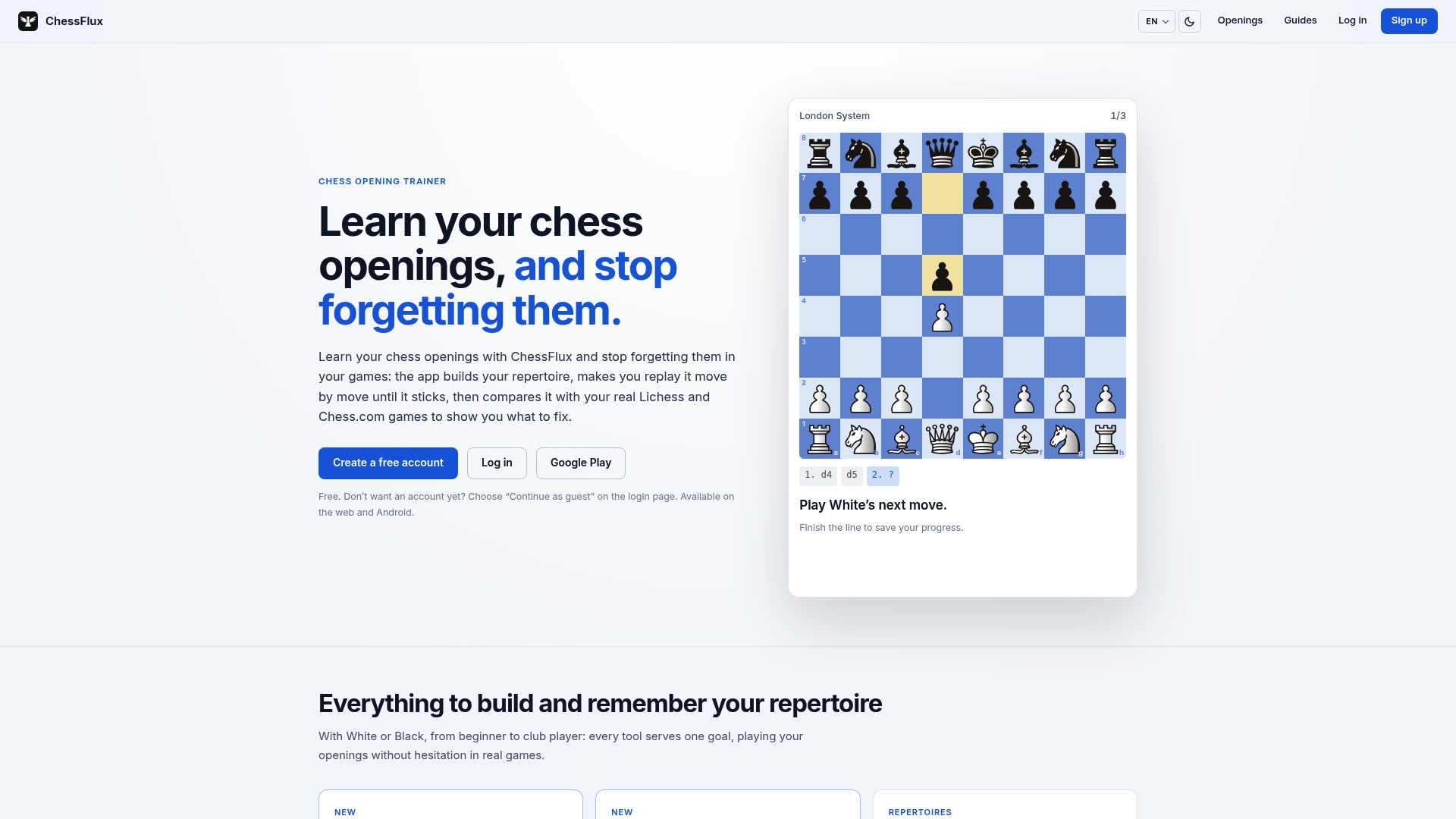
You can start with the free app and move to ChessFlux Premium when you want more puzzles, advanced training and extra customization. Begin on chessflux.fr, or read how to build a repertoire from your Lichess or Chess.com games and how the game debrief compares your openings with your repertoire.
Our perspective
Hanging pieces are a memory problem as much as a vision problem. When you have to think hard about move six of your opening, you have less attention left to notice that your bishop is loose. That is why we built ChessFlux around your own games.
We start from the last 100 games you played on Lichess or Chess.com, build a repertoire from them, and compare your real choices with it. You see where you leave the lines you know, and those are very often the moments where pieces start to drop. Targeted repetition frees up the attention you need for the safety check.
Our approach is designed to be measurable: you drill the lines you actually play, you solve tactics by theme or opening, and you can check a position with Stockfish when you want to understand why a square was unsafe. We think a beginner or intermediate player improves faster by fixing their own recurring mistakes than by collecting generic theory.
Rolf
FAQ
What is a hanging piece in chess?
It is a piece that can be captured for free because no friendly piece can recapture. A piece can also count as hanging when it is defended but worth more than the piece attacking it, since the trade still loses material.
How do I stop hanging pieces?
Build a short check you run before every move: what did the opponent’s move change, which of your pieces are loose, and what does your move stop defending. Then review your lost pieces after games and practice short tactics so that the scan becomes automatic.
Should I always capture a hanging piece?
If it is genuinely free, yes. First look at checks, captures and threats for both sides, and check whether a defender is pinned or the piece is bait. A forced mate or a bigger gain is sometimes available instead.
Is a hanging piece the same as a blunder?
No. Hanging describes the state of the piece, which is undefended. The blunder is the mistake that caused it, such as moving the only defender or overlooking a threat.
Why do I hang pieces more when I play fast?
Under time pressure the safety check is the first thing players skip. Tunnel vision also gets worse because you focus on your own idea. Practicing the check slowly until it is automatic is what keeps it alive at blitz speed.
Sources
- Lesson 11, Basic Tactics, Neels Hattingh
- Hanging Piece, ChessGrammar
- Stop Hanging Pieces: A Blunder-Check Routine, RaindropChess
- What does en prise mean?, Chess.PhD
- Mieux jouer sans (trop) calculer ?, Les échecs sans peine
- Cours 2: quels sont les éléments tactiques ?, Apprendre les échecs