To improve at chess, train a little every day on a few things that matter. Solve tactics, play slower games, review every loss, learn basic endgames, and study only the openings you actually play. Most players stall because they do the opposite: they play endless blitz, jump between openings and never look at their mistakes. This guide gives you a weekly plan, the reasoning behind it, and a way to measure whether your rating is really moving.
TL;DR
- Short daily sessions beat one long weekly session. Aim for about 30 minutes a day, five days a week.
- Split your time between tactics, a slower game, game review, endgames and openings. Tactics and review give the fastest returns at the start.
- Review your own games before you open an engine. Then keep one concrete lesson per game.
- Study openings from your real games, not from a generic course. Fewer lines, understood well, beat many lines half remembered.
- Judge progress over weeks, not over one evening of results.
Table of Contents
- Why most players plateau
- A weekly routine for beginners and intermediate players
- What to study at each level
- Tactics: daily, slow and with a purpose
- Review your games: alone first, then with the engine
- Openings: fewer lines, better understood
- Perspective: what we see from your real games
- Using Lichess and Chess.com as training tools
- Where ChessFlux fits in your routine
- How to measure your rating progress
- Mistakes that slow improvement down
- FAQ
- Sources
Why most players plateau
The pattern is familiar on Lichess and Chess.com. You play ten blitz games, lose three to a piece left hanging, feel annoyed, and play ten more. Nothing in that loop teaches you anything. Playing is necessary, but it only becomes training when you look back at what happened.
The discussions on the ranking pages say the same thing in different words. A player around 1300 describes results that swing wildly: a win against a 1700 one day, a loss to a much lower player the next. That swing is typical of a player whose tactics are decent but whose habits are not yet reliable. The fix is not a secret opening. It is fewer blunders, repeated over hundreds of games.
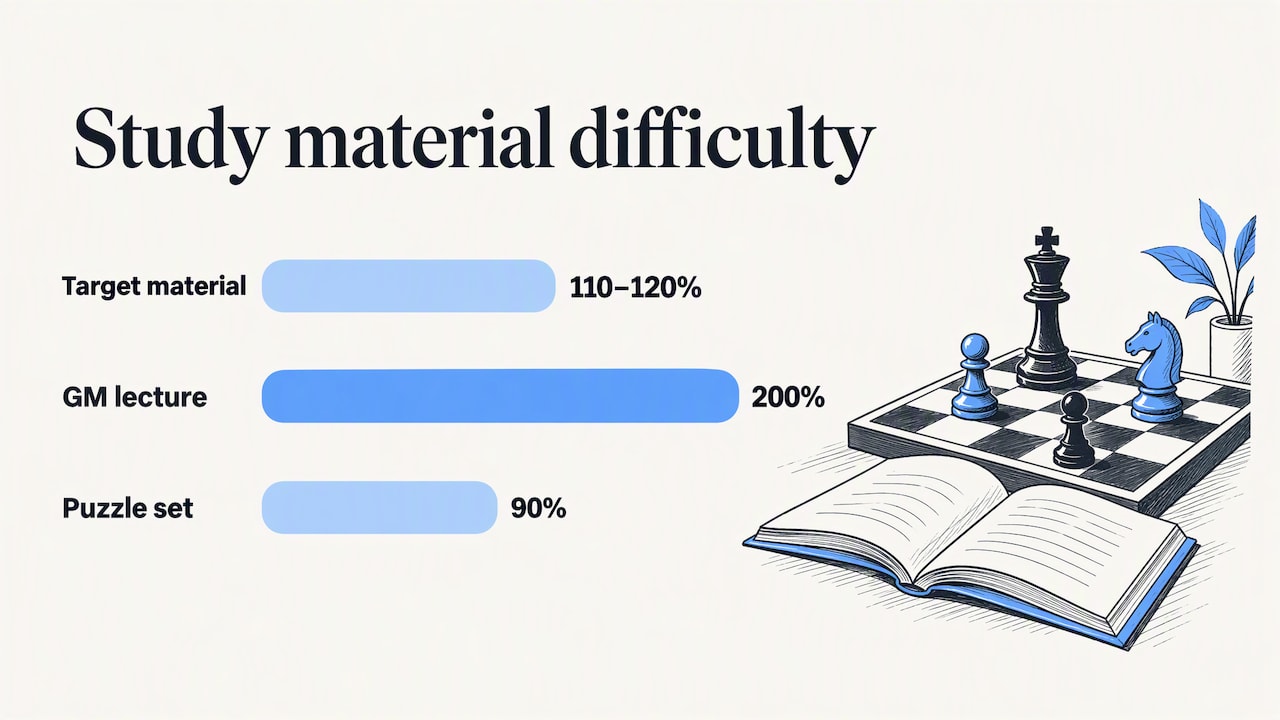
There is also the question of how you study. A US Chess article on how to study says training material should sit at roughly 110 to 120% of your current level: hard enough to stretch you, not so hard that you barely understand it. Watching a grandmaster lecture on a rare Sicilian line is 200%. Solving a puzzle set you get right 95% of the time is 90%. Aim in between.
A weekly routine for beginners and intermediate players
A French training guide by Mickaël Cailleau proposes a weekly routine for players between 800 and 1,400 Elo, with 30 to 45 minutes a day that mixes tactical puzzles, endgame study, a long-cadence game and game analysis. The same source argues that five short, focused sessions are better than one long one. Here is how we would lay that out.
| Day | Time | Focus |
|---|---|---|
| Monday | 30 min | Tactics: 10 to 15 puzzles, slowly |
| Tuesday | 30 min | Openings: review the lines from your last games |
| Wednesday | 30 min | Endgames: one basic position until you can win it every time |
| Thursday | 30 min | Tactics, then a short review of one old loss |
| Friday | 45 min | One long game (15+10 or slower) |
| Saturday | 30 min | Review Friday’s game, alone first, then with an engine |
| Sunday | Rest or light play | Casual games, no pressure |
This is a template, not a law. If you only have 20 minutes, keep the order of priorities: tactics, review, then everything else. What matters is that the routine is small enough that you actually do it in week six, not only in week one.
How fast will you see results?
The same French guide says that with structured training of about 30 minutes a day, most players notice a clear improvement within two to three months. Treat that as an encouraging estimate rather than a promise. Your starting point, your age, your sleep and how honestly you review your games all change the speed. What you can count on is that unstructured play produces much slower change.
What to study at each level
The priorities shift as you grow.
Below 800: stop giving away pieces
At this level, almost every game is decided by a blunder. The guide cited above recommends basic tactics, opening principles and elementary endgames. In practice:
- Before each move, ask what your opponent threatens, and what your move leaves undefended.
- Learn forks, pins, skewers and the back-rank mate until you see them without effort.
- Learn the three opening principles: control the center, develop knights and bishops, castle early.
- Learn to checkmate with king and queen, and king and rook, against a lone king.
The French Chess Federation also publishes a free beginner-friendly school program built around a four-year progression, though for now only its first level is available. If you teach children or are a parent, it is a good structured start.
800 to 1,400: build reliable habits
For this range the same source lists daily tactics, game analysis, endgames, positional strategy, opening study and management of your thinking time. The last one is underrated. Many club players lose on the clock or play the first ten moves in thirty seconds and then spend ten minutes on a simple move at move 25. Decide in advance where a game deserves your time: critical moments, such as a capture available to both sides, a pawn break or a king under attack.
Beyond 1,400: specialize
Once your tactics are steady, you gain more from targeting individual weaknesses: a bad record with Black against 1.d4, endgames with rooks, or positions where you have the bishop pair and do not know what to do. Your own game history tells you which of those it is. Guessing is slower.
Tactics: daily, slow and with a purpose
The top-ranking tip pages agree on one thing: practicing tactics daily is the fastest way to improve at the start. One page adds the caveat that matters: do not rapid-fire puzzles without pausing to analyze the ones you miss.
A useful method:
- Look at the position for a full minute before touching a piece. Find the checks, captures and threats for both sides.
- Calculate the whole line, including your opponent’s best reply, before you move.
- When you get one wrong, replay the correct line until you can explain it in a sentence.
- Come back to the missed puzzle three days later. If you fail again, it is a pattern you do not own yet.
Puzzles by theme help when you know your weakness. Puzzles linked to an opening you play are even better, because the same tactical motifs return in your own games.
Review your games: alone first, then with the engine
This is the habit that separates players who climb from players who repeat. The guide from Cailleau recommends reviewing a game first without help, then comparing with Stockfish on Lichess, and finishing with one concrete lesson. A French training dissertation reaches the same conclusion, describing game analysis as two steps: first your own reflection on what you were thinking, then computer verification to reveal tactical and strategic details you missed.
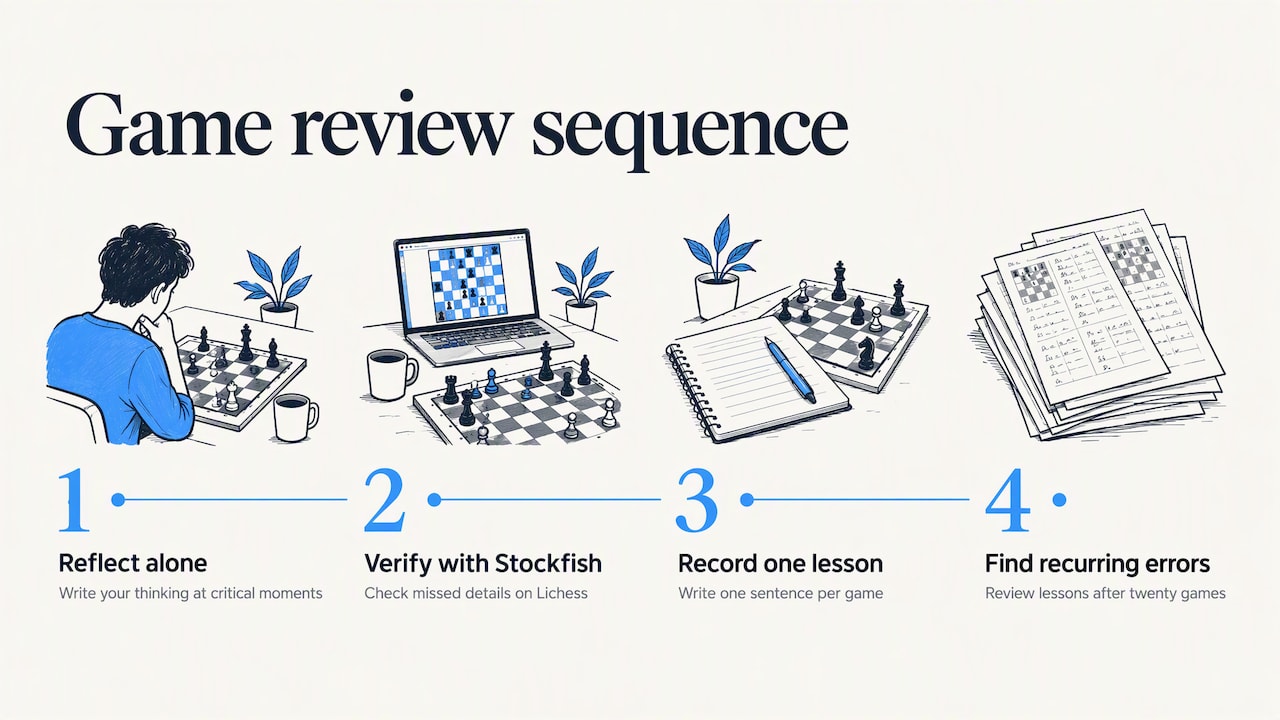
The order matters. If you turn on the engine immediately, you learn that move 17 was a mistake, but not why you played it. Writing down your thought process at critical moments shows whether the problem was calculation, a misjudged position or time pressure.
Keep the output small. One lesson per game, written in one sentence, for example: “I castled into an open file without checking the rook lift.” After twenty games you will have a list of recurring errors, and that list is your personal curriculum.
Openings: fewer lines, better understood
Openings are where many players overinvest, and where a bit of structure pays off. You do not need 20 moves of theory at 1000 Elo. You need to reach a normal middlegame without losing material, and to know the typical plans.
A French dissertation for the federation’s coaching diploma suggests that players with limited memorization capacity should concentrate on opening setups: logical systems with little theory, rather than highly theoretical variations. That is sound advice for most amateurs. A setup such as the Italian Game or the Queen’s Gambit gives you clear plans, and you can read our guides to the Italian Game and the Queen’s Gambit to see the moves, plans and traps in one place.
A simple opening process:
- Pick one reply to 1.e4 and one to 1.d4 as White’s opponent, and one main setup as White.
- Play them for at least fifty games before switching.
- After each game, check where you or your opponent left your preparation. Add that position to your notes.
- Understand each move by its idea. If you cannot say why a move is played, you will forget it as soon as your opponent deviates.
For the structure of a repertoire (trees, variations, what to include), our guide on how to build a chess opening repertoire goes step by step. And if you want to check a line yourself, you can analyze openings with Stockfish and read the evaluation with the ideas in mind, not just the number.
Perspective: what we see from your real games
We built our approach around one observation: the opening mistakes that cost you games are rarely the ones in a textbook. They are the ones you repeat in your own games, in positions you reach often. A generic course covers lines you may never face, and leaves untouched the one you keep losing in.
That is why we think the most efficient opening training starts from your last 100 games on Lichess or Chess.com. You see which positions you reach, where you leave your preparation and where your results drop. Then you drill those positions and nothing else. Review is the engine of improvement in every area of chess, and openings are no exception: the difference is that your game history can tell you what to review without the guesswork.
My advice if you take away one thing: do not memorize more, memorize what you actually play, and check it against your results.
— Rolf
Using Lichess and Chess.com as training tools
Both platforms give you most of what you need for free. Lichess, for instance, is a free, open-source site with engine analysis, puzzles, an opening explorer and Studies that let you organize and annotate games and repertoires. Chess.com offers a similar set of tools, some of them limited on its free tier.
A few practical uses:
- Slower time controls. Blitz rewards reflexes. A 15+10 game gives you time to apply what you study, and gives you better material to review.
- Opening explorer. After reviewing a game, look up the position where you left theory, see what stronger players chose, and add that move to your notes.
- Studies. Store your repertoire lines with comments on the plans, not only the moves.
The weakness of platforms is that they show you data, not a plan. They will not tell you which three positions to drill this week. That gap is where a dedicated training tool earns its place.
Where ChessFlux fits in your routine
ChessFlux is built for the opening and tactics slots of the weekly routine above. It builds a repertoire from your last 100 Lichess or Chess.com games, lets you memorize it move by move, and compares your real results with your repertoire to point out the moves to improve. You can also build variation trees, import PGNs and studies, solve tactics puzzles by theme or opening, and run Stockfish analysis on an opening. The free version covers the core features, and Premium adds options such as unlimited puzzles, advanced training and more customization.
If you want to see how it works, start with the guide to building a repertoire from your Lichess or Chess.com games, or try ChessFlux directly. To make the memorization stick, active training of your openings beats rereading notes, and the game debrief shows where your games leave your repertoire.
How to measure your rating progress
Rating is a lagging indicator. It moves slowly, it is noisy, and it differs from one platform to another, so a Lichess rating and a Chess.com rating are not the same number. Compare yourself only with yourself on the same platform and the same time control.
A few ways to keep the measurement honest:
- Use a rolling window. Look at your average rating over the last 50 games, not today’s result. A single bad evening can cost you 50 points and mean nothing.
- Track the cause, not only the number. Count your blunders per game in your reviews. If the count drops from three to one, the rating will follow.
- Track your puzzle accuracy on a fixed level, and the proportion of games where you leave your opening preparation with a worse position.
- Do not chase the rating itself. Players who protect their number stop playing riskier, instructive games, and play fewer of them.
If you play in French clubs and tournaments, your federation rating is a separate scale again, and it changes only with rated games, so it is slower still. Treat online ratings as a training gauge and tournament ratings as a verdict. Our page on tracking opening progress shows how to follow your results by opening, which is more informative than one global number.
Mistakes that slow improvement down
- Switching openings after two losses. You cannot judge a line in ten games.
- Tactics at speed. Fast puzzle streaks feel productive and teach little.
- Skipping endgames. Basic endgames convert half points into full points, and you meet them at every level.
- Reviewing only losses. Wins hide mistakes too, especially when your opponent missed your error.
- Studying for hours once a week. A shorter, regular habit builds memory and pattern recognition far better.
- Tilt play. Stop after two losses in a row. The third game is usually the worst.
FAQ
How can I get better at chess fast?
There is no shortcut, but there is an order of priority. Do tactics daily, play slower games, and review each loss before you use an engine. Most players who follow a regular 30-minute routine see clear progress within a few months.
How much should I train each day?
Thirty minutes a day is enough to make visible progress if you are consistent. Five short sessions a week work better than one long one. Increase the time only after the habit is solid.
Should beginners learn openings or tactics first?
Tactics first, with only the basic opening principles: develop your pieces, control the center, castle. Once you stop dropping pieces, pick one simple setup with White and one defense against each of 1.e4 and 1.d4, and learn the ideas behind the moves.
How do I increase my chess rating?
Reduce your blunders, because that is where most points are lost below 1400. Play slower games, review them, fix recurring errors, and judge your progress over a window of 50 games rather than from a single result.
Sources
- Comment progresser aux échecs : le guide complet
- How to Study Chess, US Chess
- École d’Échecs à la Française, FFE
- Choix et construction du répertoire d’ouvertures, mémoire DEFFE
- Méthodes d’entraînement, mémoire DEFFE