Chess calculation training is the deliberate practice of searching concrete moves and replies in your head, then judging the position you reach at the end. It improves with a repeatable thinking routine (candidate moves, forcing moves first, a calm comparison of final positions) and with exercises you solve without touching the pieces. This guide gives you that routine, the exercises that build it, and a four-week plan you can start tonight.
TL;DR
- Calculation is a search through moves. Pattern recognition only tells you where to search, so you need to train both separately.
- Before you calculate, list up to three candidate moves, starting with checks, captures and threats.
- Practise by solving positions without moving pieces, writing your line down, and only then checking the solution.
- Keep an error log. Most calculation mistakes repeat, and a log shows you which kind is yours.
- Use engines and online games after your own attempt, never instead of it.
Table of Contents
- What calculation is, and what it is not
- Step one: find candidate moves before you calculate
- Step two: calculate forcing lines accurately
- Step three: train visualization without moving the pieces
- Calculation exercises: how to solve them
- Calculation errors and how to log them
- Perspective: what we see when players calculate
- A four-week calculation plan
- Using engines and online games without losing the skill
- Turning your own games into training material
- FAQ
- Sources
What calculation is, and what it is not
Most players use the word “calculation” for everything that happens when they look for a tactic. It helps to split the process in two.
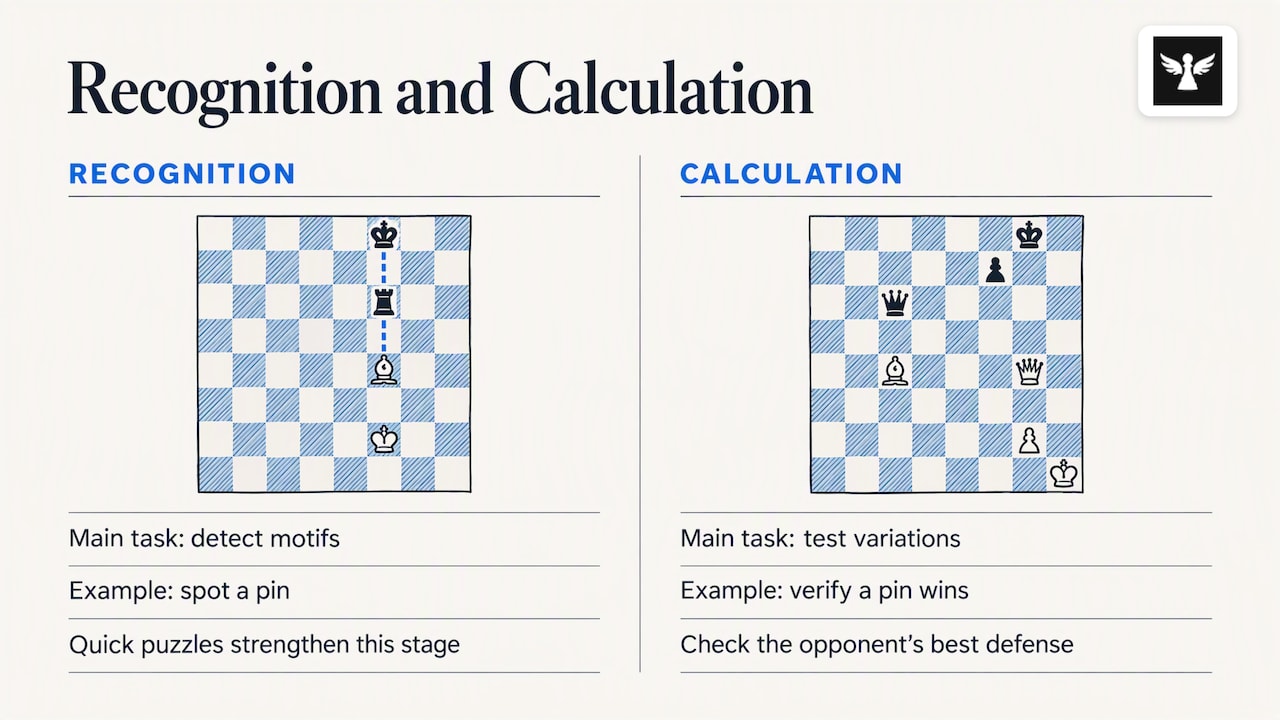
Research on how people solve chess problems describes a two-stage model: first you investigate the position and detect motifs, then you calculate variations to check whether those motifs can actually be exploited. Spotting a pin is recognition. Working out that the pin wins a piece after your opponent’s best defense is calculation.
This matters for how you train. If you only solve thousands of quick puzzles, you strengthen the first stage: you see the motif faster. That is valuable, and our guide to tactics training and puzzles covers it. But a motif you cannot verify is a trap in a real game. Many blunders happen because a player saw the idea, felt the thrill, and stopped searching before the opponent’s strongest reply.
Calculation also differs from evaluation. Evaluation says “this structure is better for White”. Calculation says “if I play Nxe5, he takes, I check on h5, and I win the bishop”. You need the second skill to reach the first with confidence, because the end of every line you calculate must be judged.
Step one: find candidate moves before you calculate
The most common calculation habit among club players is to fall in love with the first good-looking move and spend all their time proving it. The fix is to generate options first and calculate second.
A French-language training dissertation on improving calculation recommends observing the position before you start thinking, then actively looking for the moves or ideas that do not come to mind automatically. That second part is the hard one. Your brain serves up the obvious move for free. The useful candidate is often the quiet one you have to go looking for.
A simple order for listing candidates
A training handout from the Swiss coaching association ANCE suggests selecting three candidate moves and examining forcing moves first, using the EPM idea: checks (échecs), captures (prises) and threats (menaces). After those come prophylaxis, pawn breaks, thematic moves and known tactical patterns.
In practice, run this list without calculating anything yet:
- Checks. Every check, even absurd ones.
- Captures. Every capture, including ones that look like sacrifices.
- Threats. Moves that create a direct threat to mate, win material or trap a piece.
- Quiet moves. A improving move, a prophylactic move, a pawn break.
Write the three best on a scrap of paper if you are training at home. In a game you only hold them in your head, but the habit of naming them is what stops tunnel vision.
Why three and not ten
Listing every legal move wastes time and mental space. Limiting yourself to about three forces a first filter and leaves energy for depth. If you find that you routinely miss the winning move, the problem is not the number three, it is that your list lacks one category, usually quiet moves or the opponent’s resources. That is something your error log will reveal later.
Step two: calculate forcing lines accurately
Once you have candidates, start with the most forcing one. Forcing lines narrow the tree: after a check, your opponent has few legal replies, so you can calculate deeper with less effort.
Here is the method we recommend for each line:
- Write the line as a sequence, not a picture. “1.Nxf7 Kxf7 2.Qh5+ Ke7 3.Qxe5+” is easier to hold than a mental image of a board that keeps changing.
- Look for the opponent’s best reply at every move, not the one you hope for. Start with their checks, captures and threats too. This is the single biggest improvement for most players.
- Stop at a quiet position. Calculating to the end of a forcing sequence is only useful if you stop where the position is calm enough to judge: no pending captures, no checks, no hanging pieces.
- Judge the final position honestly. Count material, king safety, the activity of your pieces and whose move it is.
The French dissertation also advises comparing the final positions calmly rather than concluding from an emotional impression. The emotional impression is the sacrifice that feels brilliant, or the line that feels scary. Neither feeling is evidence. Compare the end positions the way you would compare two offers in a shop: side by side, one criterion at a time.
A worked example of the thought process
Imagine a middlegame where you have two attractive moves: a knight sacrifice that opens the king, and a quiet rook lift. Your first instinct is the sacrifice.
You list candidates: the sacrifice (a capture), a check you can see, and the rook lift. You calculate the check first: it loses a pawn for nothing, so it is discarded in ten seconds. You then calculate the sacrifice: the opponent can decline by moving the king, a reply you almost skipped. After that reply, your attack has no follow-up and you are a piece down. Finally, the rook lift: it creates a threat, your opponent has one sensible defense, and the resulting position is slightly better for you. You play the rook lift.
Nothing about this required a genius. It required a list, an honest search for the opponent’s best reply, and a comparison. The same position calculated with only the sacrifice in mind would have cost you the game.
Step three: train visualization without moving the pieces
Visualization is the ability to see the board after several moves without moving anything. Search queries about “chess visualization training” are common because it is the skill players feel they lack most. The good news is that it improves quickly with the right habit.
A calculation book from New In Chess explains the basic method: take positions from a book, hide the solution (the publisher suggests covering the moves with an opaque object), analyze without moving pieces, and only then check what the author gives. The same text stresses visualizing variations in your mind rather than pushing pieces around, because that is what you will have to do at the board.
Exercises that build visualization
Start small and grow the difficulty in steps:
| Level | Exercise | What it trains |
|---|---|---|
| 1 | Look at a diagram for 30 seconds, close your eyes, name where every piece stands | Holding a static position |
| 2 | Play a two-move line mentally and name the position at the end | Updating the board in memory |
| 3 | Solve a mate in two or three with no pieces moved | Short forcing lines |
| 4 | Solve a tactic that needs four to five plies, writing the line down | Depth with a written record |
| 5 | Take a complex position and compare two candidate lines to a quiet end | Comparing final positions |
Most beginners can skip level 1 after a few days, but do not skip level 4. Writing the line forces you to commit, and you cannot cheat by saying “I saw that” afterward.
If you want the pattern side of the skill covered too, our article on ten mating patterns to learn first gives you the shapes that make short calculations much faster: the more patterns you know, the less you have to calculate from scratch.
Calculation exercises: how to solve them
Good calculation exercises share three properties. They have a clear solution you can verify. They are hard enough that you cannot answer instantly. And they come from positions you do not recognize, so memory does not do the work.
Where to find the right positions
Any rich position can serve. Your own games are the best source because they contain the mistakes you actually make. Other sources are tactical puzzles, endgame studies, annotated master games and the exercise sections in calculation books. When you use puzzles, choose the harder ones and do not rush: ten puzzles solved slowly teach more than a hundred solved on reflex. If you use puzzles from a themed set (for example, only discovered attacks, or only tactics arising from a specific opening), you also learn the motifs that tend to occur in your own repertoire.
The solving routine
- Set a timer. Ten to fifteen minutes for a hard position is reasonable for most club players.
- Do not touch the pieces. Cover the solution.
- List candidates in the EPM order.
- Calculate each forcing line and write it down.
- Choose your move and note the final position’s evaluation in a few words.
- Check the solution. If you were wrong, find the exact move where your calculation diverged.
Step 6 is the one that makes the practice pay. Knowing the right answer teaches little. Knowing why your line failed teaches a lot.
Calculation errors and how to log them
The fastest route to better calculation is to understand your own mistakes. Most players make a small number of error types over and over. Keep a simple log, a notebook or a spreadsheet, with one row per error.
Useful categories:
- Missed reply. You did not consider the opponent’s strongest answer, often a quiet move or an intermediate check.
- Stopped too early. You ended the line while a capture or a check was still pending.
- Missed candidate. The winning move was never on your list.
- Visualization slip. You lost track of where a piece stood after a few moves.
- Misjudged end position. The line was right, but you counted the final position wrongly.
- Time or emotion. You rushed, or you committed because the line felt exciting.
After ten entries, count. If half your errors are missed replies, your training is clear: before accepting any line, force yourself to find the opponent’s three best answers. If you mostly miss candidates, spend more time on quiet moves and prophylaxis.
Perspective: what we see when players calculate
We build ChessFlux around real games, so we spend a lot of time looking at where players go wrong, and the pattern is consistent: calculation errors cluster around positions that the player has not seen before. In the opening, where a move is known, the player calculates little and plays confidently. The moment the opponent leaves theory, calculation has to start, and it starts from a worse place because the player is tired of recalling moves and unsure of the plans.
That is why we think calculation and opening knowledge are not rivals. A solid repertoire reduces the number of positions where you must calculate from nothing, and it saves your clock and your concentration for the critical moments. In the other direction, calculation habits let you punish an opponent who leaves the book, and keep you safe when you do. Players who work on only one of them plateau quickly.
Our advice is practical. Spend most of your training time on your own games, because they show you which positions you actually reach. Calculate the critical moments before you look at an engine. And be wary of any plan that promises faster calculation through volume alone: speed comes from clean method first.
If you want a wider plan for your development, our article on how to improve at chess shows where calculation fits among openings, tactics and endgames.
— Rolf
A four-week calculation plan
Consistency beats intensity. Three or four sessions a week of 30 to 40 minutes is enough for most adults with a job.
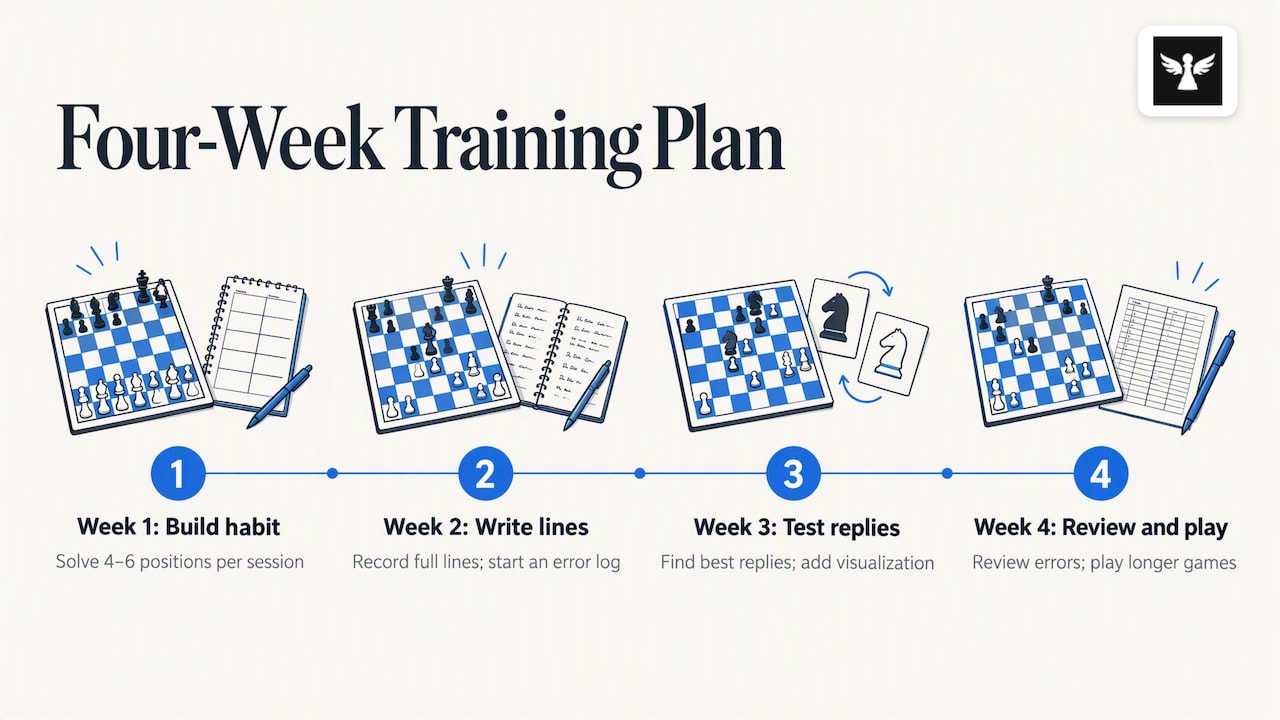
Week 1: build the habit. Solve four to six positions per session at a relaxed pace. Do the candidate list on every one, even the easy ones. Do not worry about accuracy yet.
Week 2: add the written line. Pick two or three harder positions per session. Write each line in full before you check. Start your error log.
Week 3: add the opponent’s reply. For every line, write the opponent’s best three replies at the first and second move. Include one session of visualization levels 3 and 4 from the table above.
Week 4: review and play. Review your log, pick the most frequent error type and run a session aimed at it. Play two or three longer games, and afterward mark the moments where you had to calculate. Compare your thinking with the analysis.
After four weeks, repeat with harder positions. The book from Quality Chess by Jacob Aagaard, Calculation, is described by its publisher as a way to help players think differently and make decisions more efficiently, which is a fair summary of what this routine aims for: a changed thinking process, not just more solved positions.
Using engines and online games without losing the skill
An engine is excellent at telling you whether you were right. It is bad at teaching you how to think, because it hands over the answer too early. Use it at the end of the process:
- Make your own attempt, with the line written down.
- Check the solution or run the engine on the position.
- Find the exact point where your line and the engine’s line diverge.
- Ask why: a missed reply, a missed candidate, a mistaken evaluation.
- Log it.
The same logic applies to your online games. Your recent games on Lichess or Chess.com are a free library of positions you actually reached. Review the moments where you spent a long time, or where the evaluation swung, and calculate them again from scratch before you open the analysis. If you want a structured way to look at opening positions with an engine, see how to analyze openings with Stockfish.
Turning your own games into training material
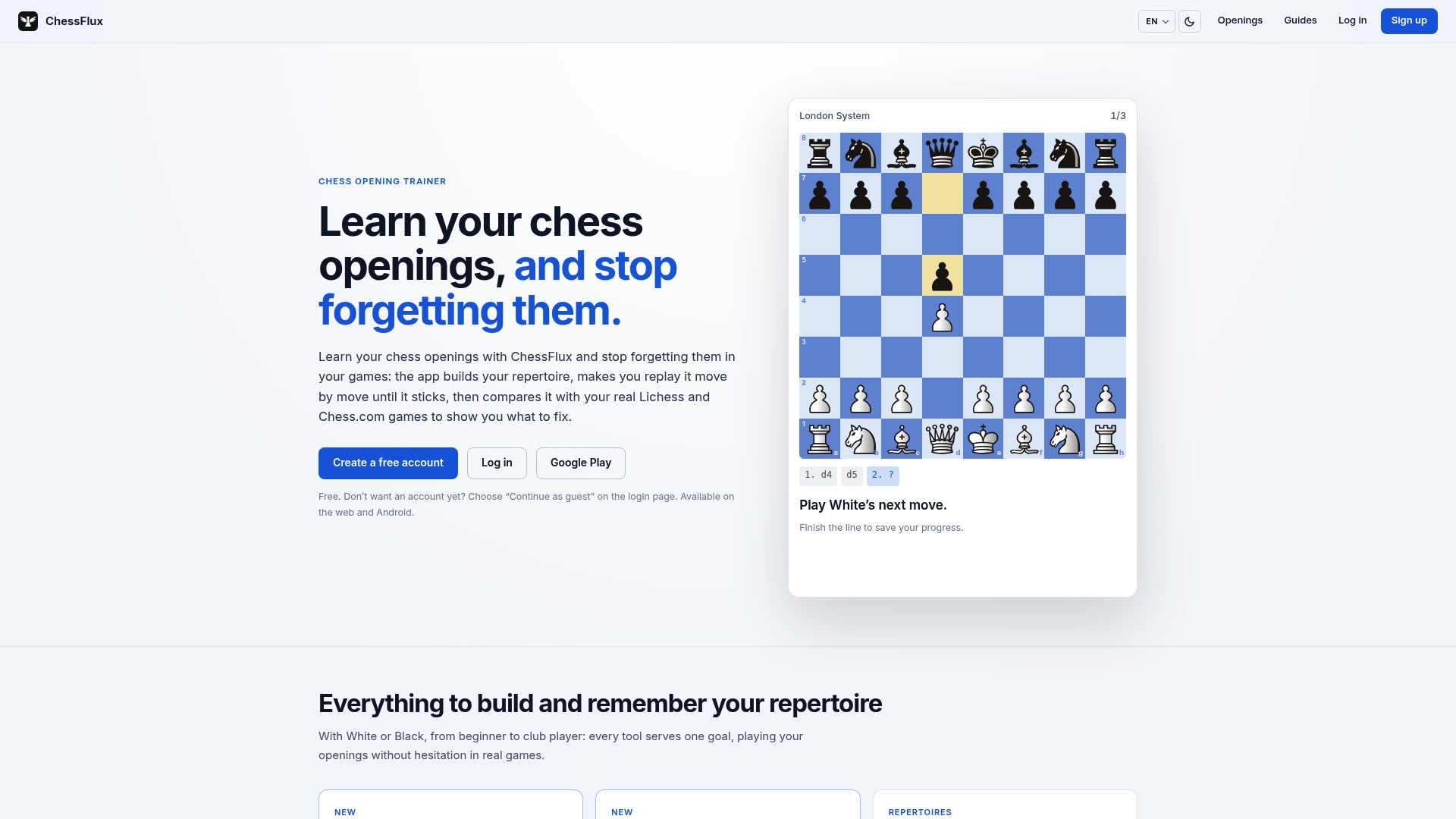
Calculation practice has more effect when it connects to the positions you reach. This is where our app helps. ChessFlux builds a repertoire from your last 100 games on Lichess or Chess.com, compares what you actually played to that repertoire, and points to the moves that need work. You also get tactics puzzles by theme or by opening, so the motifs you practise are the ones that show up in your lines.
The free version covers the core features, and ChessFlux Premium unlocks options such as unlimited puzzles, advanced training and additional customization. You can start from the ChessFlux home page, or read how to build a repertoire from your Lichess or Chess.com games first.
A practical way to combine the two: learn a line in your repertoire, then when you reach the first position where the theory ends, stop and calculate it yourself. That small exercise, repeated across your openings, is calculation training with real context.
FAQ
How long does it take to improve at calculation?
Most players notice a difference in their thinking process within a few weeks of consistent practice, especially in finding candidate moves and checking the opponent’s replies. Deeper visualization takes longer. Treat it as a skill built over months, and judge progress by the number of calculation errors in your log, not by rating alone.
Is solving puzzles enough to train calculation?
Puzzles mostly train pattern recognition if you solve them quickly. They become calculation training when you slow down, avoid moving pieces, write the full line and check the opponent’s best defenses before you submit. Choose harder puzzles and fewer of them.
How many candidate moves should I look at?
About three is a practical limit. Begin with checks, captures and threats, then add a quiet move. If you keep missing the best move, the fix is usually to add a category you tend to skip, not to add more moves.
Should I practise visualization with a board or without?
Both, in order. Start with a diagram and work in your head, and use a board only to verify. Training without moving pieces is what prepares you for a real game, where you cannot move anything while you think.
Can I use an engine while I train?
Use it after your own attempt, never before. Compare your line with the engine’s, find the move where they split, and write down why. That comparison is the lesson.
Sources
- Search Versus Knowledge in Human Problem Solving: A Case Study in Chess
- Améliorez votre calcul aux échecs (mémoire de formation)
- Approche des schémas d’analyse (ANCE)
- Calculation exercises book extract (New In Chess)
- Calculation by Jacob Aagaard (Quality Chess)