A mating pattern is a recurring arrangement of pieces that delivers checkmate: the same geometry of attacker, helper and trapped king, showing up in game after game. Learn the shape once and you stop calculating from scratch. You see it, check that it works, and play it. This guide covers the ten patterns worth learning first, the clues that tell you one is coming, and a practical way to make them stick.
TL;DR
- A mating pattern is a reusable picture: one piece gives check, the others take away every escape square.
- Start with back-rank mate, smothered mate, the Arabian mate, the kiss of death and the ladder mate, then add Anastasia’s, Boden’s, the hook, the double bishop and the epaulette.
- Look for three clues: a weakened king shelter, a king with no flight squares, and loose or poorly defended pieces.
- Learn each pattern from the game that produced it, not just the final position, and test yourself on puzzles.
- Check every candidate mate with one test: can the king move, block, or capture the checking piece?
Table of Contents
- What a mating pattern is, and why it matters
- The ten patterns to learn first
- Which one is the most common?
- How to recognize a pattern during a game
- How to remember them: a training method that works
- Where patterns come from: your openings
- Our perspective
- Put it into practice with ChessFlux
- FAQ
- Sources
What a mating pattern is, and why it matters
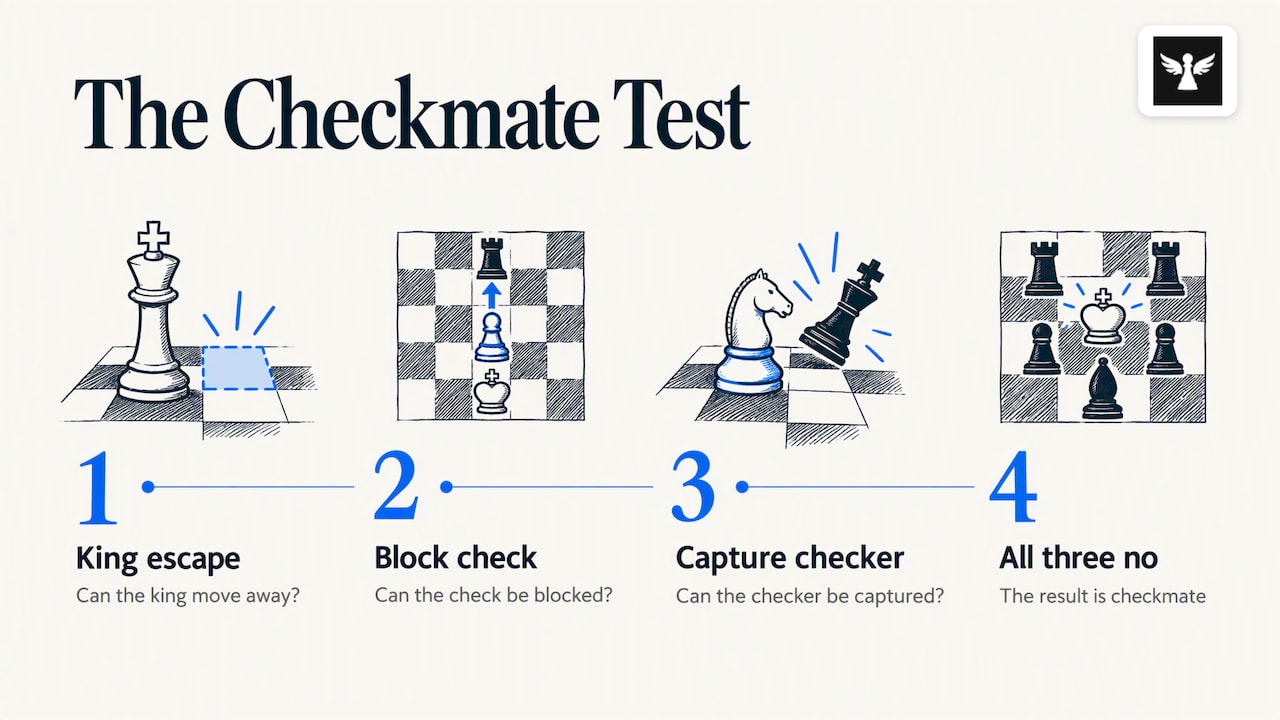
Checkmate is check plus a king that has no legal answer. A beginner curriculum from the Illinois Chess Association reduces the test to three questions: can the king move away, can the check be blocked, can the checking piece be captured? If all three answers are no, it is mate.
A mating pattern packages that test into a picture. Chess programmers describe the same idea from the machine side: pieces that are related can form a meaningful chunk recognized as a unit, which cuts the complexity of the position. Human players do exactly this. A strong player does not see a knight on f7, a queen on g8 and a rook on h8. They see “smothered mate” and stop counting.
This is why patterns pay off so quickly for beginners and intermediate players. Most games below master level are decided by a tactic, and most decisive tactics end in one of a handful of mates. Knowing them tells you what to aim for when you attack, and what to watch for when you defend.
The ten patterns to learn first
The order below goes from the most common to the more specific. For each, you get the idea, the typical setup and what to look for.
1. Back-rank mate
A rook or queen checks along the first or eighth rank while the king is trapped by its own pawns. The pawns that should shelter the king become its prison.
The Illinois curriculum teaches it with a simple example: with the black king on g8 behind pawns on f7, g7 and h7, and no defender on the eighth rank, 1.Rc8# ends the game. The same source warns that 1.Rc8+ is not mate if the defender still has a legal escape, a block or a capture. Always run the three-question test before you celebrate.
The defence is just as useful. The Grandmaster Codex recommends creating luft, an escape square, with a move such as h3 or h6. One pawn move early in the middlegame can save you many back-rank headaches.
2. Smothered mate
A knight gives check to a king that is boxed in by its own pieces. The king cannot move because every neighbouring square is occupied by friendly material, and nothing can capture the knight.
The classic model is Philidor’s Legacy. The Grandmaster Codex gives it as a practical smothered-mate model: Nh6+ (double check), a queen sacrifice on g8 that forces Rxg8, then Nf7#. The sacrifice is what creates the smothering. Remember the idea: you often have to give up material to take away the last flight square.
3. Arabian mate
The Arabian mate pairs a knight with a rook or queen. According to a course by Jean-Luc Abbet, the knight controls the escape squares while the long-range piece delivers mate on a square the knight also covers. In the usual picture, the king sits in the corner, the rook checks along the edge and the knight, two squares away diagonally, guards the rook and the king’s only other exit.
It is a pattern you can build on purpose: bring a knight to the right outpost, then look for a rook lift.
4. The kiss of death
Here the queen gives mate, protected by a minor piece or a pawn. The same Abbet course describes it as a coordination between the queen and a protecting piece, typically appearing in front of the king on f2, g2 or h2, or symmetrically on f7, g7 or h7.
It is simple, and that is the point. If your opponent’s king has castled and the pawn cover in front of it has been loosened, ask whether a queen can land next to the king with a defender behind it. The queen cannot be taken, so the king has nowhere to go.
5. Ladder mate
Also known as the lawnmower, staircase or rook roller, the ladder mate uses two major pieces working together to push the king to the edge of the board. One rook (or queen) cuts off a rank, the other checks on the next rank, and you alternate until the king runs out of room.
It is the first pattern most players meet because it appears in simplified endgames: two rooks against a bare king, or a queen and rook against an exposed monarch. It also shows up in the middlegame when both of your rooks reach open files.
6. Anastasia’s mate
A knight and a rook (or queen) hunt a king on the edge of the board. Picture the black king on h7 with its own pawn on g7. A white knight on e7 covers g8 and g6, and a rook on the h-file gives check. The pawn on g7 blocks the king, the knight takes the other squares, and the rook does the rest.
To get there you usually need an open h-file and a knight reaching e7, often with a capture or a sacrifice on the way.
7. Boden’s mate
Two bishops on crossing diagonals deliver mate to a king that has castled long and is surrounded by its own pieces. Typically a queen sacrifice on c6 opens the line, the pawn recaptures, and a bishop checks from a6 while the other bishop cuts off the remaining squares.
It is a good example of why bishop pairs are dangerous against a queenside-castled king.
8. Hook mate
A rook, a knight and a pawn work together. The rook delivers the mate, the knight protects the rook, and a pawn takes away the king’s last square. The “hook” is the knight and pawn gripping the king’s corner.
9. Double bishop mate
Two bishops on adjacent diagonals control a king on the edge, with the king hemmed in by its own pieces or by the board’s edge. It looks rare, but it comes up in endgames with bishops and in sharp middlegames where a queen has been traded off for positional gains.
10. Epaulette mate
The king’s two flanking squares are occupied by its own rooks or pieces, like shoulder pads, and a queen delivers mate down the file between them. It often appears after a defender has doubled rooks on the back rank and forgotten to keep an exit.
Which one is the most common?
Be careful with this claim. Abbet’s course states that the kiss of death is the most frequent mate among beginners. That is a teaching observation about beginner games, not a statistic across all chess. Programmers building mate detectors reach a similar conclusion in practical terms: the Chess Programming Wiki notes that simple, frequent mates, such as obvious back-rank and close queen mates and sometimes smothered mates, are the ones worth detecting with specialized pattern code.
So the honest answer is: back-rank mates and queen mates next to the king are the ones you will meet most at club and online level. The rest are rarer but more spectacular, and each one wins a game when it appears.
How to recognize a pattern during a game
Most players do not miss mating patterns because they do not know them. They miss them because they do not look. A few clues should make you stop and search.
Three signs of a combination
An article from Echecs & Stratégie lists the indicators that should push you to look for a combination: a weakened royal shelter, a king with no flight squares, and pieces that are undefended or insufficiently defended. If you see one of them, stop and calculate forcing moves: checks, captures, threats.
A radar centered on the king
French coach Kevin Terrieux suggested, in a FFE masterclass in April 2020, a “tactical radar” with a few questions: where is the king, which squares around it are weak or controlled, which pieces are attacked or unprotected, and are there alignments or badly coordinated pieces? Run it on every move where the position is open. It takes seconds and it catches both your opportunities and your opponent’s.
A quick checklist
- Has the enemy king castled, and have the pawns in front of it moved?
- How many flight squares does it have? Are any of them covered by my pieces?
- Which of my pieces can reach a square next to the king with protection?
- Can I remove a defender with a sacrifice or a capture?
- If I find a check, does the three-question test (move, block, capture) come back empty?
How to remember them: a training method that works
Reading a list of ten patterns is not training. The goal is to recognize them in 3 seconds on a real board with real distractions.
Solve, do not just read
Grandmaster Artur Yusupov’s training guide for his first Build Up Your Chess volume gives clear instructions: play through the examples on a physical board, spend at least five minutes on each diagram, and try to solve before looking at the answer. He also advises solving without moving pieces first, then trying again with the pieces for about ten minutes if needed, and writing down your variations.
That is slow work, and it is exactly why it sticks. Retrieval with effort beats passive review.
Learn the road, not only the destination
A final mating position is the last frame of a film. Study the full game that led to it: which move opened the file, which sacrifice removed the defender, which quiet move made the net. That is what you will need to reproduce. A pattern you only know as a diagram will not appear at the board, because the board never starts from the diagram.
Sort your puzzles by theme
Themed puzzles are the fastest way to turn a diagram into a reflex. Ten back-rank puzzles in a row teach you the feel of the pattern better than a long article. Our tactics training and puzzles guide explains how to practice by theme or by opening.
Where patterns come from: your openings
Mating patterns are not random. Many of them grow out of specific opening structures. The Italian Game aims pieces at f7, which is why kiss-of-death ideas and knight sacrifices on that square are so common there; our Italian Game guide lists the traps. In the Sicilian, open files and castled kings lead to rook and queen attacks, so the Sicilian Defense guide is worth a read if you play it with either colour.
The practical consequence: if you know your repertoire well, you know which mates are likely in your games. You can train those first. Our page on chess openings, variations and traps is a good starting point to find the structures you actually play.
Our perspective
We see the same thing again and again in the games players bring to ChessFlux: the mating pattern was available, but the player left the opening with a shaky structure or lost time on a move they had not learned. The attack comes from the opening, not from nowhere.
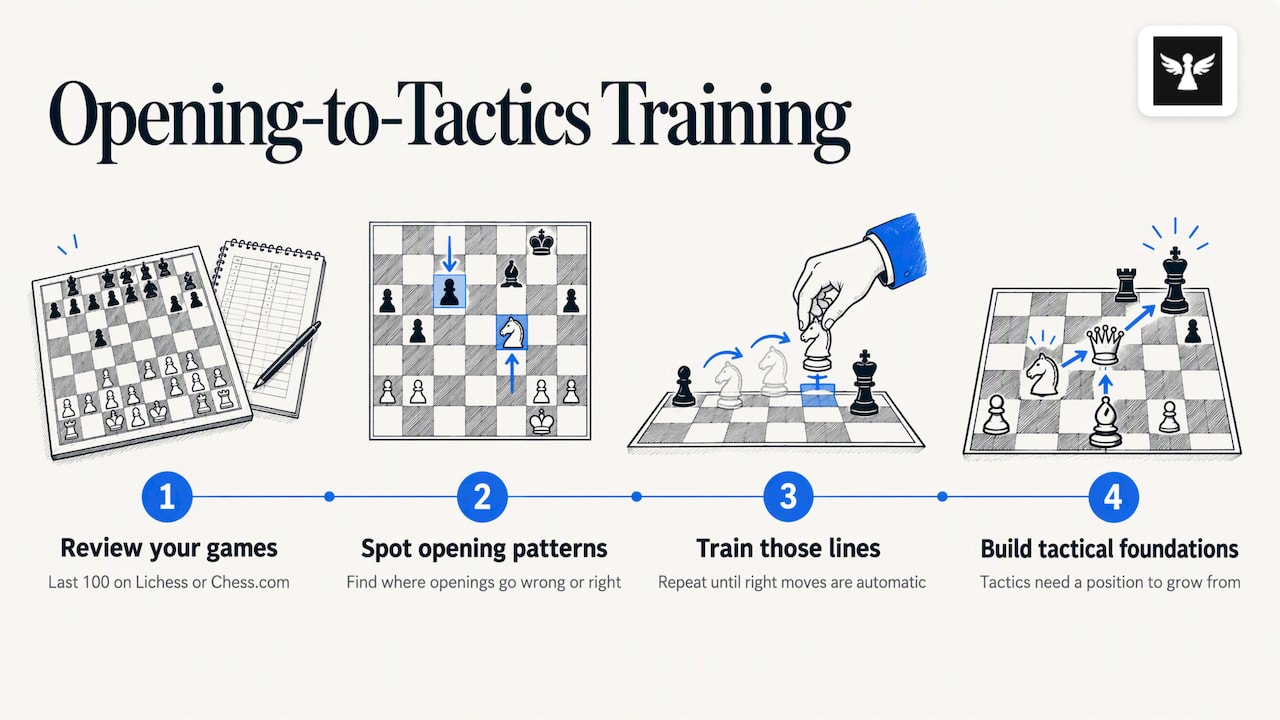
That is why we do not treat mating patterns as a separate subject. A back-rank mate follows from a castled king with no luft. A smothered mate follows from a king that retreats into the corner. Both start with how the opening was played. Our approach is to start from your own games, the last 100 on Lichess or Chess.com, see where your openings go wrong and where they go right, and train those lines until the right moves are automatic. Tactics then have a position to grow from.
Memorize the ten patterns above, but spend equal time on the openings that generate them. You will see more mates, on both sides of the board.
— Rolf
Put it into practice with ChessFlux
ChessFlux builds a repertoire from your last 100 games on Lichess or Chess.com, compares what you actually played against it, and shows you the moves to fix. The core features are free, and the app also includes tactics puzzles by theme or opening. A Premium subscription adds options such as unlimited puzzles, advanced training and extra customization; see the current details on ChessFlux. To start from your own games, read how to build a repertoire from your Lichess or Chess.com games, or how the game debrief compares your openings with your repertoire.
FAQ
What are mating patterns in chess?
They are recurring arrangements of pieces that produce checkmate, such as the back-rank mate or the smothered mate. Each one has a fixed logic: a piece gives check and the rest take away the king’s flight squares. Knowing them lets you recognize a win in seconds instead of calculating it from scratch.
What is the most common checkmate in chess?
No reliable statistic covers all games. Teaching sources say the kiss of death, a protected queen mate next to the king, is the most frequent among beginners, and back-rank mates are also very common at club level. Start with those two.
How do you checkmate a king using a mating pattern?
First find a check. Then test the three defences: can the king move, can the check be blocked, can the checking piece be captured? If the answer to all three is no, it is mate. Mating patterns tell you which pieces to bring to make those answers all negative.
How many checkmate patterns should I learn?
Ten is a solid start, as in this guide. Lists online go to 30 or more, but the extras are rare. Master the first ten through puzzles and your own games before adding more.
Sources
- Chunking, Chess Programming Wiki
- Mate at a Glance, Chess Programming Wiki
- Beginner & Intermediate Chess curriculum, Illinois Chess Association
- Chapter 11: Tactical Patterns, The Grandmaster Codex
- Milieu de partie, cours de Jean-Luc Abbet
- Checkmate pattern, Wikipedia
- Détecter une combinaison aux échecs, Echecs & Stratégie
- Masterclass FFE du 6 avril 2020 avec Kevin Terrieux
- Build Up Your Chess: The Fundamentals, Artur Yusupov