To practice chess openings well, build a small repertoire, learn the ideas behind each line, then drill the moves from memory until you can play them without hesitating. After that, check your real games to see where you leave your preparation. Reading a list of moves is not practice. Playing them from an empty board, getting corrected, and coming back to the weak spots is.
This guide covers the full loop: choosing what to practice, understanding it, memorizing it, testing it, and deciding what to train next. It also covers how often to practice and what to look for in an opening trainer.
TL;DR
- Start with one opening as White and one defense against each of 1.e4 and 1.d4 as Black, not a dozen openings at once.
- Learn the plans and typical positions first, then drill the moves. Moves without ideas collapse when your opponent deviates.
- Practice by recall: play the line from memory, note the gaps, fix them, repeat. Short, frequent sessions beat one long weekend of study.
- Use your own games as the syllabus. The lines you actually reach, and the moments you actually forget, are what to train.
- Databases and engines guide you, but check their suggestions against your level and style.
Table of Contents
- Choose what to practice before you practice it
- Learn the ideas first, then the moves
- Practice by recall, not by rereading
- Use your own games as the syllabus
- Use databases and engines without obeying them
- How often and how long should you practice?
- What to look for in an opening trainer
- Our perspective: practice what you actually play
- Turn your games into a training plan with ChessFlux
- A simple four-week start
- Common mistakes when practicing openings
- FAQ
- Sources
Choose what to practice before you practice it
Most opening frustration comes from practicing too much, not too little. A club player who knows twelve openings shallowly gets surprised in all of them. A player who knows three systems well gets surprised rarely, and knows what to do when it happens.
A sensible starting size for a beginner or intermediate player:
- One setup as White (for example, a system you can play against almost anything).
- One defense to 1.e4.
- One defense to 1.d4.
One chapter of a grandmaster-style training text goes the same way: master one opening as White and one as Black before adding more. That is a perspective, not a law, but it matches what most coaches tell club players.
Match the opening to your style
A French coach writing on training methods says a repertoire should take the player’s style into account and be coherent. Coherent means your openings lead to similar kinds of positions, so the ideas you learn in one help in the next. If you like quiet, solid development, a system such as the London System fits. If you prefer classical development and direct play in the center, the Italian Game is a natural choice. If you want a Black defense with clear pawn structures and a plan you can repeat, look at the French Defense.
The same coach suggests keeping two lines for a given variation: one to take risks and play for the win, and one more solid when a draw is acceptable. You do not need that on day one, but it is a good second step once your main lines feel comfortable.
The French Chess Federation’s Masterclass with Xavier Bédouin makes a freeing point: anyone can experiment with building a repertoire, aiming for a middlegame they enjoy playing. Enjoyment matters because you will practice what you like.
For a step-by-step method, see our guide to building a chess opening repertoire.
Learn the ideas first, then the moves
Memorizing twenty moves of theory feels productive. Then your opponent plays move six differently and you are alone in a position you never understood.
The coach quoted above is direct about this: players should understand the ideas underlying an opening rather than learn it by heart. The French federation’s coaching diploma thesis on repertoire building adds the practical form of that advice: to answer deviations, know the typical positions, meaning their strengths and weaknesses, good and bad pieces, and the recurring strategic and tactical themes, rather than a bare sequence of moves.
An article in US Chess reviewing a book on the French Defense makes a similar recommendation: learn an opening through its general characteristics and plans, and study annotated model games to see those ideas at work.
A checklist for understanding a line
Before you drill a variation, be able to answer these questions in your own words:
- Where do my pieces belong, and which pawn breaks do I want?
- What is the typical plan for each side in the middlegame?
- What are the two or three tactical traps that appear again and again?
- Which endgames does this structure tend to lead to?
If you cannot answer them, play through two or three complete model games in that opening first. The coach cited earlier recommends working on whole opening games rather than only theoretical lines, because games show what happens in the middlegame and endgame that follow.
Our opening guides and the pages on variations, plans and traps are written around exactly this: the idea behind each move, not just the move.
Practice by recall, not by rereading
Once you understand a line, memory takes over. The common mistake is to reread the same chapter. Rereading creates familiarity, and familiarity feels like knowledge until you sit at the board.
The better method is retrieval: ask yourself for the move before you see it.
The blank-board exercise
The writer Nate Solon describes a simple exercise: open a blank Lichess study or ChessBase file, enter your preparation from memory, note the gaps, then fill them using your reference material. Repeat later to review. It costs nothing, and it shows you precisely what you do not know.
A practical version:
- Pick one variation you want to know.
- On a blank board or empty study, play your side’s moves and enter your opponent’s most likely replies.
- Mark every spot where you hesitated or guessed.
- Open your notes or model games and fix only those spots.
- Come back in a day or two and do it again.
Flashcards and spaced repetition
The same logic powers card-based systems. Guido Flohr describes cards that show the position after the opening sequence: you try to recall the move, reveal the answer, then rate how hard it was. That rating lets the system bring back the forgotten variations more often than the easy ones.
This is the heart of any good opening trainer. You do not need to review everything every day. You need the lines you are about to forget to come back at the right time.
Play your lines against resistance
Flashcards test your memory in a fixed order. Real opponents do not cooperate. The French federation thesis recommends playing blitz games to test the opening in realistic conditions, then consulting books or databases whenever an unknown situation comes up. It also suggests playing through the moves alone, moving the opponent’s pieces as well, to examine the options on both sides.
Fast games are the cheapest lab you have. Every time you leave your preparation, write down the position and the move that surprised you. That note becomes your next practice item.
Use your own games as the syllabus
An opening you never reach is wasted effort. The most efficient training list is the one your own games produce: the positions you actually get, and the places where you actually go wrong.
The French Chess Federation’s 2019 Masterclass advice for post-game analysis is to analyze first without a computer, note the moves where you hesitated, then compare theoretical alternatives, grandmaster games and possible improvements in the opening. The point is to turn a played game into a lesson you can use, before the engine tells you the answer.
A short review routine after each game
- Find the first move where you felt unsure, even if the game went well.
- Check whether your opponent left your repertoire, or you left it.
- If you left it, was it a memory gap or a deliberate choice?
- Write the position and the correct move into your training list.
- Once a week, look for patterns: are the same two or three positions costing you?
The coach quoted earlier suggests a similar structure: create a database for each important opening variation, analyze a representative game, and add it to the database. Over months, you get a personal reference built from games that mattered to you.
This is the part that is tedious to do by hand, and it is where software helps most. More on that below.
Use databases and engines without obeying them
Opening explorers show how often each move is played and how it scores. They are very useful for deciding what to add to a repertoire. The French federation thesis advises using move performance statistics to orient your research, but not following database or engine recommendations blindly: check the ideas and their practical value.
Carlo Fortunati makes a related point in his article on thinking for yourself in the opening: compare recommendations, model games and statistics, explain your choices, and do not follow suggestions blindly.
Two cautions for club players:
- Statistics from master games reflect master-level play. A line that scores well at the top may demand precision you cannot yet supply, and the reverse is true too.
- An engine’s top move is sometimes a deep tactical point you will not understand or remember. A slightly less accurate move you grasp can serve you better over the board.
When you want to check a position, an engine is excellent for finding concrete refutations. Our guide on how to analyze chess openings with Stockfish shows how to ask useful questions of it, rather than just reading the evaluation bar.
How often and how long should you practice?
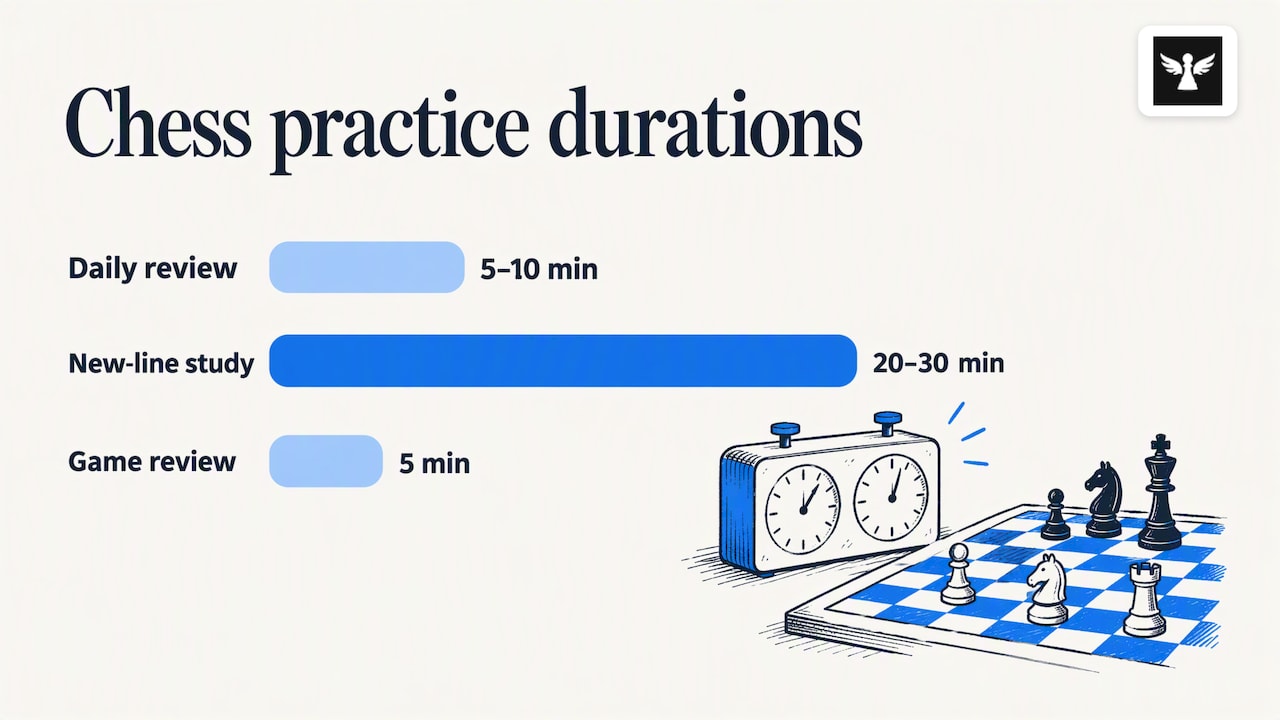
There is no official figure for this, so here is our experience-based recommendation rather than a rule.
Openings are only one slice of improvement. If you spend your whole study time on them, your tactics and endgames will not move. For most beginner and intermediate players, we suggest keeping openings to a modest share of your weekly chess work, in short, regular sessions:
- Daily, 5 to 10 minutes: review the lines your trainer says are due. Little and often beats a weekly marathon because recall fades between sessions.
- Once or twice a week, 20 to 30 minutes: study one new variation or model game, or run the blank-board exercise on a line you feel shaky about.
- After each serious game: spend five minutes on the opening phase only, and add what you find to your training list.
- Once a month: look at your results by opening and decide whether to deepen a line, replace it, or add one.
Two guardrails. First, add new material only when your existing lines are comfortable. Second, balance the rest of your time with tactics and endgames. Our practical plan to improve at chess shows how openings fit into a complete routine.
What to look for in an opening trainer
If you decide to use software, judge it against what the research above says works. Here are the criteria that matter:
| Criterion | Why it matters |
|---|---|
| Move-by-move recall with feedback | You must produce the move from memory, not just click through a line. |
| Spaced repetition | Forgotten lines return more often; solid ones do not waste your time. |
| Repertoire built from your own games | Training matches the positions you really reach, not a generic course. |
| Deviation detection | It shows where you or your opponent left your preparation in real games. |
| Variation trees and PGN import | You can bring in your existing files and cover several replies per move. |
| Engine check | You can verify a doubtful line without leaving the tool. |
| Tactics linked to your openings | You practice the typical shots that occur in your structures. |
| Progress tracking | You can see which openings improve and which still cost you points. |
Be wary of two extremes. A course that only shows you one fixed repertoire teaches moves without checking whether they fit your games. A blank tool that asks you to enter everything by hand is flexible, but the setup effort stops many players before they begin.
Our perspective: practice what you actually play
We built ChessFlux because we kept seeing the same pattern. Players study an opening carefully, then lose a game on move eight to a line they never prepared, while the lines they drilled never appear. The problem is not effort. It is aim.
That is why we start from your real games. ChessFlux builds a personalized repertoire from your last 100 games on Lichess or Chess.com, then compares what you actually play with what you intended to play. Where the two differ, it points to the moves worth improving. We think this is the most honest syllabus a player can have, because it is made of your own habits and your own opponents’ choices.
We also believe a trainer should not replace understanding. Memorized moves are scaffolding. The plans, the pawn structures and the typical tactics are the building. Use the tool to make recall automatic, and use model games and your own analysis to make the ideas yours.
Finally, we would rather you play fewer openings and know them well. Do not add a line because it looks fashionable. Add it because your games keep reaching it.
— Rolf
Turn your games into a training plan with ChessFlux
If you want the loop described above without the spreadsheet work, ChessFlux does the heavy lifting. You can start with the free version, which covers the core features, and move to Premium if you want unlimited puzzles, advanced training and more customization.
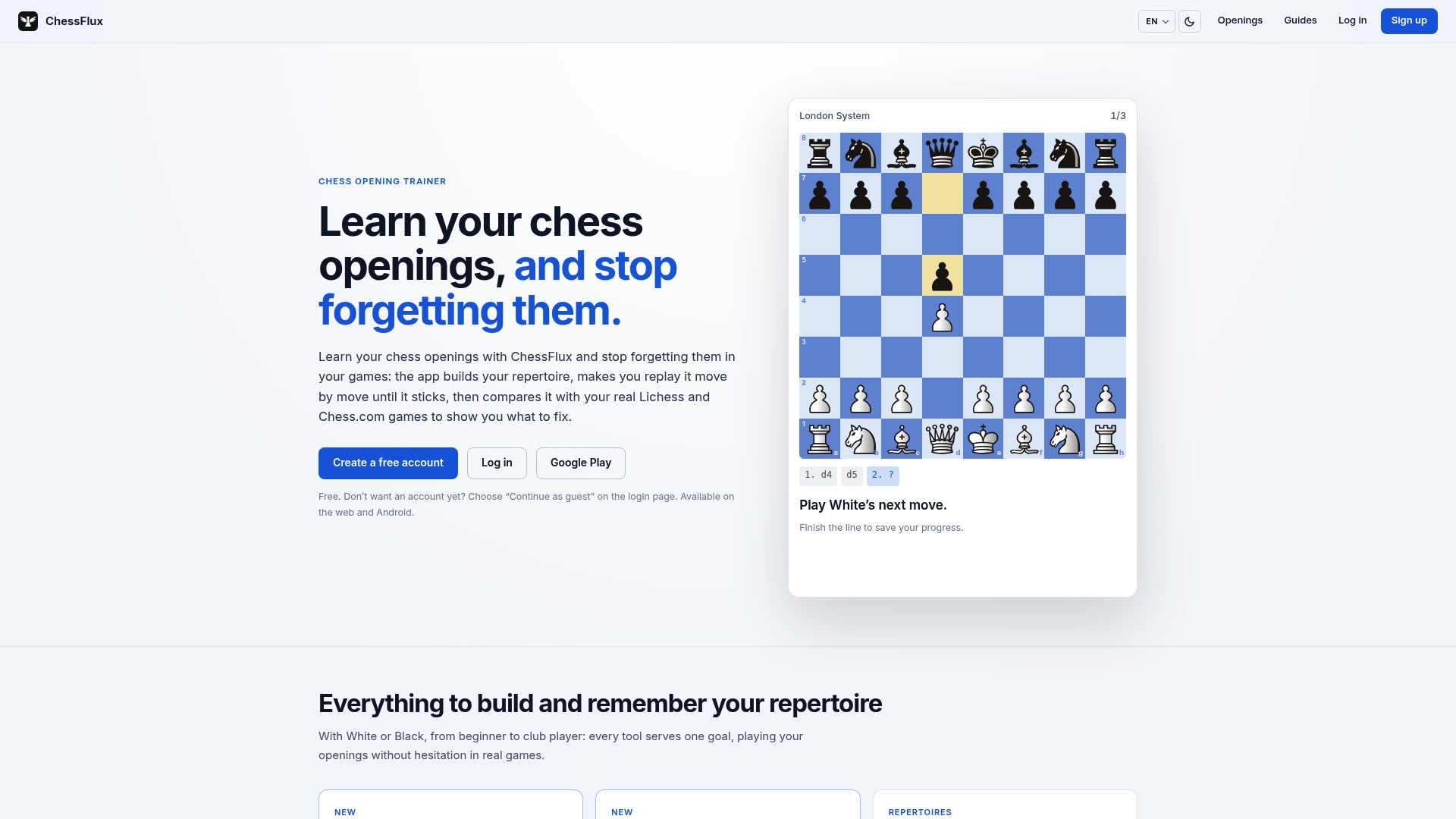
Here is what you can do with it:
- Build a repertoire from your Lichess or Chess.com games, or import a PGN you already have.
- Memorize openings with active training, move by move, with variation trees.
- Get a game debrief of your openings against your repertoire to see where you left your preparation.
- Track your opening progress over time.
- Practice tactics puzzles by theme or by opening, and check lines with Stockfish.
A simple four-week start
If you are not sure where to begin, here is a plan that fits the advice above.
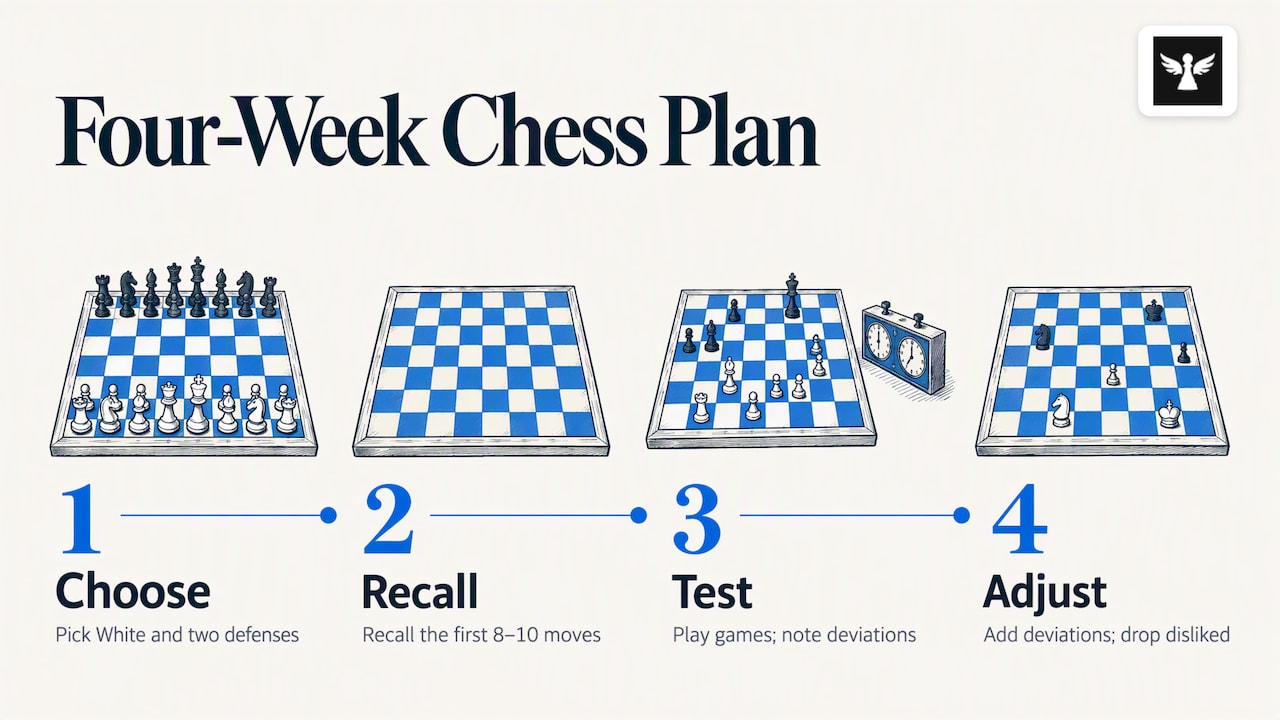
Week 1: choose. Pick one system as White and one defense each against 1.e4 and 1.d4. Play through two complete model games in each. Write down, in your own words, the main plan for each side.
Week 2: recall. Run the blank-board exercise on the first eight to ten moves of each line. Mark the gaps and fix them. Start short daily reviews.
Week 3: test. Play blitz or rapid games and stay in your repertoire as long as the opponent lets you. After each game, note where you or your opponent left the line.
Week 4: adjust. Look at the positions you collected. Add the two or three most common deviations to your repertoire. Drop any line that you simply dislike playing.
Then repeat. After a couple of months, you will have a repertoire that is small, tested and yours.
Common mistakes when practicing openings
- Memorizing too deep, too early. Twenty moves of a sharp line you cannot explain are worth less than eight moves you understand.
- Ignoring the opponent’s alternatives. For every move you play, list the two or three most likely replies and prepare an answer.
- Copying a grandmaster’s repertoire. It was built for their style, their level and their opponents.
- Never reviewing. Lines you learned a month ago and never touched since are probably gone.
- Skipping the rest of chess. A flawless opening followed by a missed tactic on move 18 still loses.
FAQ
What is the best way to practice chess openings?
Use recall rather than rereading. Play your line from memory on a blank board or in a trainer, note where you hesitate, fix those spots, and repeat on a schedule. Combine that with model games so you understand the plans behind the moves.
How many openings should a beginner learn?
Start with one setup as White, one defense to 1.e4 and one to 1.d4 as Black. That is enough to cover most of your games while you learn the typical plans. Add variations only when your current lines feel automatic.
Is an opening trainer better than a book or course?
They do different jobs. A book or course explains the ideas, and a trainer makes recall automatic through repetition. The strongest approach uses both, plus your own game analysis to decide what to train.
Should I trust engine and database recommendations?
Use them as a guide, not as an authority. Statistics and engine moves help you find candidates, but you should check that you understand a line and that it suits your level and style before adding it to your repertoire.
Can I build a trainer repertoire from my own games?
Yes. ChessFlux builds a personalized repertoire from your last 100 games on Lichess or Chess.com, and you can also import PGNs and studies. It then compares your real games to that repertoire to show the moves to improve.
Sources
- Méthodes d’entrainement (coach’s memoir, domloup.echecs35.fr)
- Choix et construction du répertoire d’ouvertures (DEFFE thesis)
- FFE Masterclass with Xavier Bédouin, 20 April 2020
- FFE Masterclass, 8 February 2019
- How to Really Learn an Opening, US Chess
- How to stop forgetting your openings, Nate Solon
- Practice Chess Openings with Anki Flashcards, Guido Flohr
- How to think for yourself in opening study, Path to Chess Mastery
- Opening Repertoire Expansion, chapter 29