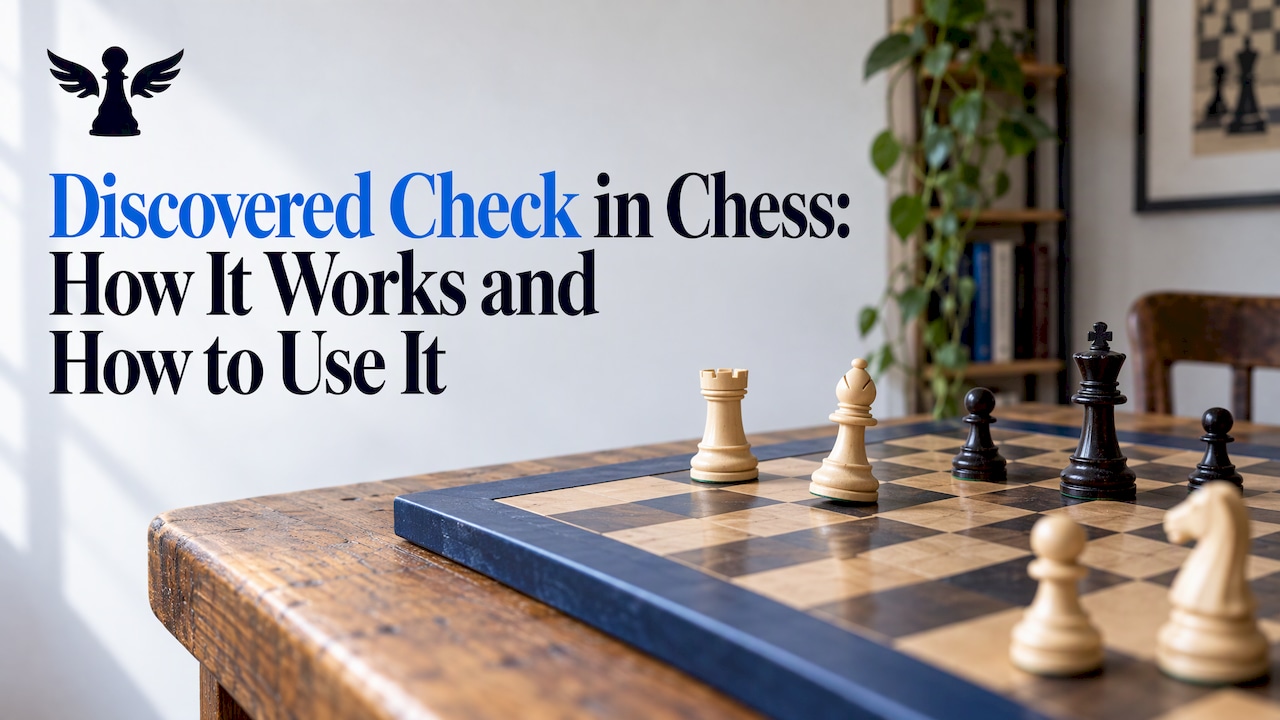
A discovered check is a check delivered by a piece that did not move. You move one piece out of the way, and the long-range piece behind it (a bishop, rook or queen) suddenly attacks the enemy king. Because the king must be dealt with immediately, the piece you just moved is free to do almost anything, including capturing the opponent’s best piece. That is why it is one of the most profitable tactics in chess, and why it sits right next to Boden’s mate in the patterns every improving player should know.
TL;DR
- A discovered check happens when you move a blocking piece and unmask a bishop, rook or queen that then checks the enemy king.
- The opponent has to answer the check first, so the moved piece can capture, threaten or even give a second check without being punished.
- If the moved piece also checks the king, it is a double check, and the only legal reply is a king move.
- Boden’s mate often arrives after a sacrifice that opens a diagonal, sometimes with a check along the way.
- Spot the pattern in your own games by looking at the piece that stays still, not the one that moves.
Table of Contents
- What a discovered check is
- Why it is so powerful
- Discovered check, discovered attack and double check
- How to respond to a discovered check
- The windmill: repeating discovered checks
- Boden’s mate and the discovered check
- Why you miss them (and how to stop)
- Practice with your own games
- Train it with ChessFlux
- Our perspective
- FAQ
- Sources
What a discovered check is
A check means a piece attacks the square where a king stands. In a discovered check, a piece steps off the line of a bishop, rook or queen, and that stationary piece now gives check. The opponent must resolve the check on the very next move, and often cannot also stop whatever the moving piece is threatening.
Three elements are always present:
- A long-range piece (the “battery” piece), which is a bishop, rook or queen.
- A blocker of your own color standing between that piece and the enemy king.
- The enemy king on the same line, whether file, rank or diagonal.
French-language chess sites describe it the same way: an attack by discovery involves a long-range piece, a piece blocking its path and a target on the same line, and the two-piece setup is called a battery. The back piece can only be a queen, rook or bishop, since those are the only pieces that act along an entire line. A knight jumps over obstacles, so it never needs to be unmasked.
Why it is so powerful
The force of the move comes from a simple rule: a player in check has no time for anything else. That gives the piece you move an enormous amount of freedom. It can:
- Capture something. It can take a pawn or a piece without any fear of being recaptured, because the opponent has to answer the check.
- Attack something bigger. It can land on a square that attacks a queen or rook. The king is in check, so the attacked piece cannot run, and you take it next move. This is the logic explained by the chess community.
- Give check itself. That turns the discovered check into a double check, which is even harder to meet.
- Set up mate. Sometimes the moved piece simply lands on a square that takes away the king’s last escape.
Here is how it looks in words, without needing a diagram. Imagine your rook sits on e1, your own knight on e5, and the enemy king on e8, with nothing else on the e-file. If your knight jumps to a square where it attacks the enemy queen, the rook on e1 now checks the king. Black must deal with the check, and then your knight takes the queen. The knight’s jump was the real threat, but the rook was the weapon that made it unanswerable.
Discovered check, discovered attack and double check
These three terms are easy to mix up, so here is a clean comparison.
| Term | What happens | Can the opponent ignore the second threat? |
|---|---|---|
| Discovered attack | Moving a piece uncovers an attack from a piece behind it, on any target | Yes, they pick which threat to meet |
| Discovered check | The uncovered attack targets the king | No, the check must be answered first |
| Double check | The moved piece also gives check, so two pieces check at once | No, and only the king can move |
The discovered check is a special form of the discovered attack, with the king as the target. A discovered attack on a rook or queen can be met by saving the target. A discovered check removes that choice.
The double check is the most violent version. It is a check from two pieces at once, usually when the moving piece checks while also uncovering another. You cannot block both lines or capture both checking pieces, unless the king itself captures one, so the king has to move. Aron Nimzowitsch is quoted on the same page with a line about even the laziest king fleeing wildly in the face of a double check.
One curiosity: in ordinary chess, a rare double check can also come from an en passant capture that opens two lines at once. You will almost never see it in a real game, but it explains why the rule is phrased the way it is.
How to respond to a discovered check
There are only three ways to answer any check, and the discovered version is no different. What changes is how few of them are usually available. According to the FIDE Laws as summarized by chess.phd, the check must be answered on this move, not the next one.
- Move the king to a square that is not attacked.
- Block the line by putting a piece between the checking piece and the king (this does not work against knights or pawns, and never against a double check).
- Capture the checking piece, if you can.
Against a discovered check, the piece that moved is not the one giving check, so capturing the checking piece usually means capturing the back piece, which is often shielded by its own side. Blocking is possible only if you have a piece that can reach the line. If it is a double check, only the king move remains.
Then comes the second question that decides the game: what did the moving piece just do? Before you reply, look at where it landed. If it attacks your queen, ask whether your king move can also save the queen (rarely) or whether you have a better way to meet the check, such as a block that also attacks something.
When it wins material
A discovered check wins material when the moved piece captures something undefended or attacks something more valuable than itself. It is strongest when your opponent’s king has few flight squares, because the answer is forced and easy to calculate. A good habit for the attacker is to list every candidate square for the moving piece and ask what it attacks from there. The best square is often not the first one you see.
When it leads to mate
If the king is boxed in by its own pieces, a discovered check can become mate directly. Often there is a preliminary sacrifice that drags a defender off the key line first. That brings us to the best-known mating pattern built on these ideas.
The windmill: repeating discovered checks
The most spectacular version is the windmill. One piece moves away and gives a discovered check, then returns with check again, picking up enemy material each time because the king is never given a moment to respond to anything else. It needs a very particular setup, usually a rook and a bishop or queen aimed at the king and at the opponent’s pieces, but when it appears in a game it tends to be decisive.
The lesson for defenders is the same as for attackers: when two of your opponent’s pieces line up toward your king with a blocker of their own in between, a discovered check is on the board even if no one has played it yet. One classic warning puts it plainly: discovered checks win games, for you or for your opponent, so be careful before letting your opponent get a double check on you.
Boden’s mate and the discovered check
Boden’s mate is a checkmate pattern in which two bishops on criss-crossing diagonals deliver the final blow. The king’s flight squares are blocked by its own pieces or covered by the bishops. Most often the king has castled queenside and is mated on c8 or c1. It is named after Samuel Boden, who played a famous early example against Schulder in London in 1853, although the same idea had appeared earlier in a game from Hamburg in 1844.
How does it connect to our topic? The mate is usually preceded by a sacrifice that clears the bishop’s diagonal, and sometimes the clearance itself comes with a discovered check. Both ideas share the same logic: you use a forcing move to make your opponent respond to one thing, while a quiet line opens behind it.
The original: Schulder against Boden, London 1853
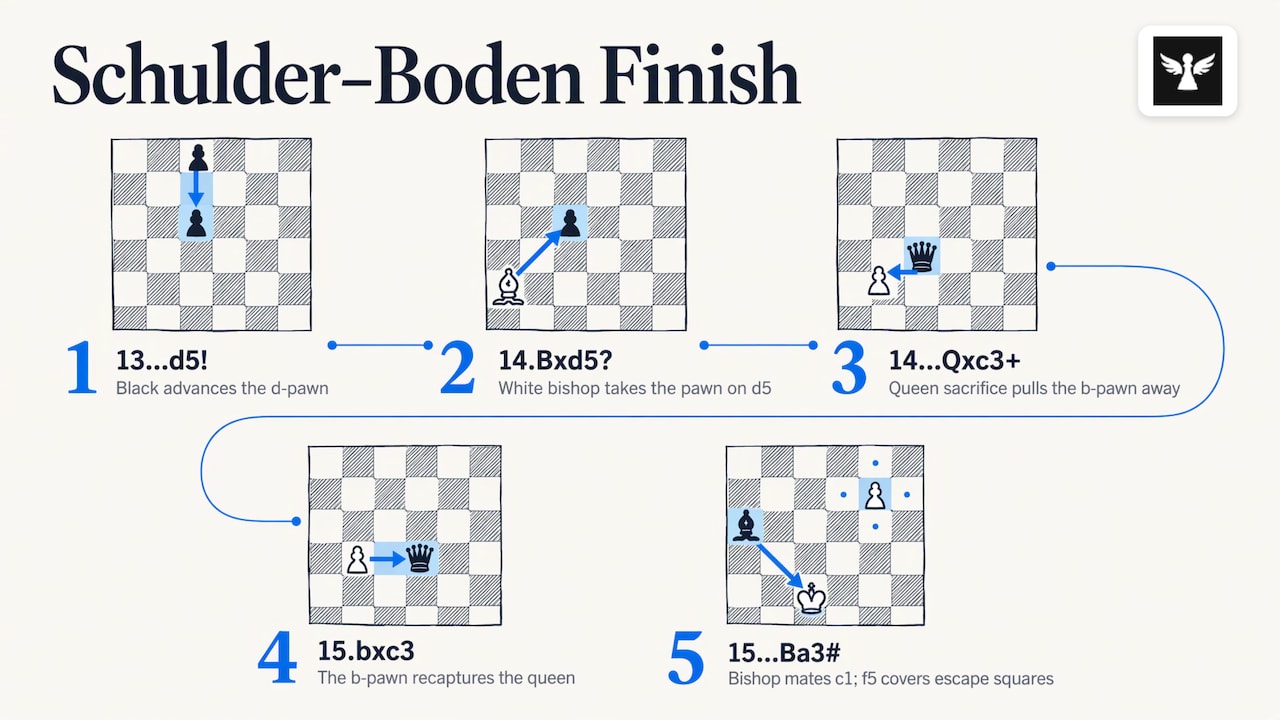
The game opened 1.e4 e5 2.Nf3 d6 3.c3 f5 4.Bc4 Nf6 5.d4 fxe4 6.dxe5 exf3 7.exf6 Qxf6 8.gxf3 Nc6 9.f4 Bd7 10.Be3 0-0-0 11.Nd2 Re8 12.Qf3 Bf5 13.0-0-0?, and then the finish, as recorded in the Boden’s mate article: 13…d5! 14.Bxd5? Qxc3+ 15.bxc3 Ba3#. Black sacrifices the queen on c3 to pull the b-pawn away, and the bishop on a3 mates the king on c1, with the bishop on f5 covering key squares. The same sequence is described in French on a rules site for chess games.
The Peruvian Immortal
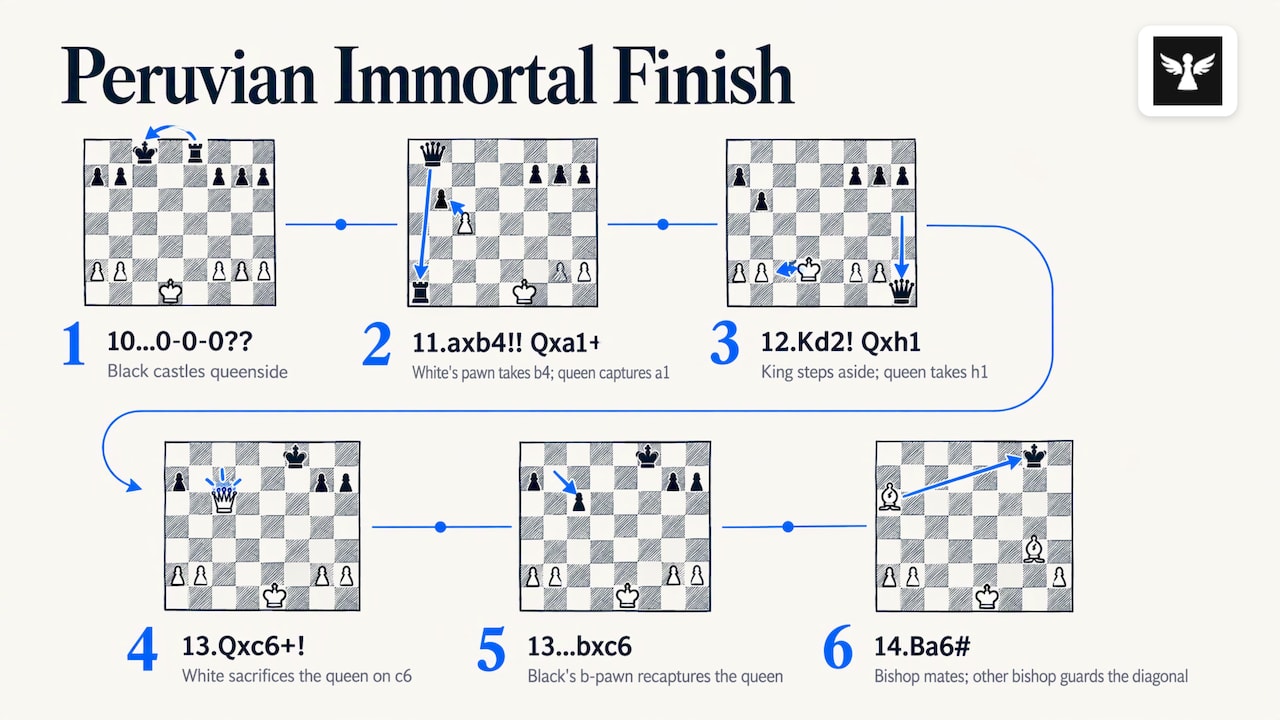
Perhaps the most famous example is the so-called Peruvian Immortal, Canal against NN in a simultaneous exhibition, Budapest 1934. The finish: 10…0-0-0?? 11.axb4!! Qxa1+ 12.Kd2! Qxh1 13.Qxc6+! bxc6 14.Ba6#. White gives up the queen to drag the pawn to c6, and the bishop on a6 delivers mate with the other bishop controlling the long diagonal. This is also the line given in the Wikipedia article, where you can find the full move list from move one.
The French Chess Federation’s beginner booklet uses the same idea: the Boden mate uses both bishops and is most striking when a queen sacrifice is involved. In its diagram, White plays 1.Qxc6+ and Black must recapture 1…bxc6, then 2.Ba6 is mate.
If you want to see this pattern next to nine others, our guide to chess mating patterns worth learning first lays them out in order of how often they appear.
Why you miss them (and how to stop)
Discovered checks are among the hardest tactics to see coming, because the threatening piece does not move. Your attention follows the piece that moves, while the danger comes from the one that stays put. A few habits help.
- Scan lines, not pieces. Before each move, ask which of your opponent’s bishops, rooks and queens point at your king, even through a blocker.
- Check your own king’s lines before moving a blocker. If you are about to move a piece that shields your king from a rook or bishop, you may be handing your opponent a discovered check.
- Look for batteries. When you see a rook and a queen or a bishop and a queen stacked on the same line, treat the line as loaded.
- Calculate forcing moves first. Checks, captures and threats come before quiet moves. Our guide to chess calculation training shows a method for it.
- Train your board vision. Seeing a diagonal through a blocker is a visualization skill, and simple visualization exercises improve it quickly.
In the opening, the same danger shows up as a trap. Many classic traps rely on a pinned or blocking piece moving away with a threat, so it is worth reading how opening traps work and how to avoid them.
Practice with your own games
Puzzles are the fastest way to wire the pattern into your eyes. Sort them by theme, solve discovered attacks and double checks until the first idea you consider is the unmasking move, then return to your own games to see where it happened or could have happened. After a game, the free game review method helps you find the moment a discovered check was available to either side.
A realistic routine: ten minutes of themed puzzles a day for two weeks, then one full review of a recent loss, marking each moment where a line toward a king was opened or closed.
Train it with ChessFlux
We built ChessFlux to make opening training personal. The app builds a repertoire from your last 100 Lichess or Chess.com games, lets you drill it move by move, and compares what you actually played with your repertoire so you can see where your openings let you down. It also includes chess tactics puzzles by theme or opening, so you can practice discovered checks and Boden’s mate patterns in positions from the openings you really play.

You can start with the free version, and Premium unlocks options such as unlimited puzzles, advanced training and more customization. See how to build a repertoire from your Lichess or Chess.com games, or start at chessflux.fr.
Our perspective
Most players learn discovered checks as a trick: a diagram, a solution, a nod. Then they forget it, because the pattern in a textbook never looks like the one in their own game.
We think the better way is to connect tactics to the openings you actually play. Many discovered checks and bishop mates grow out of specific structures: a king castled long, a bishop aimed down a diagonal, a pawn that has just moved. If you train those structures in the lines you reach again and again, the tactic stops being a surprise.
That is why ChessFlux starts from your real games. We build your repertoire from your last 100 games, show where you leave it, and let you practice the positions that actually come up, with puzzles by theme or opening and Stockfish analysis when you want to check an idea. Measurable progress comes from repeating the right positions, not from more random puzzles.
Rolf
FAQ
What is a discovered check in chess?
It is a check given by a piece that did not move. You move a blocker off the line of a bishop, rook or queen, and that piece now attacks the enemy king. The opponent has to answer the check first, which leaves the moved piece free to capture or threaten something.
Is a discovered check the same as a double check?
No. In a discovered check, only the unmasked piece gives check. In a double check, the moved piece also gives check, so two pieces attack the king at once. Against a double check, the only legal reply is a king move.
How do I defend against a discovered check?
You have the usual three options: move the king, block the line, or capture the checking piece. Which one works depends on the position, and a block or a capture is not possible against a double check. Before you reply, check what the moved piece is attacking, since that is the real threat.
What is Boden’s mate?
It is a checkmate delivered by two bishops on crossing diagonals, usually against a king castled queenside, with its escape squares blocked by its own pieces. It often follows a sacrifice that opens a diagonal, as in Schulder–Boden, London 1853, which ended with 15…Ba3#.
Can a discovered check win the game by itself?
Often, yes, because the opponent cannot answer the second threat. It usually wins a queen, a rook or a piece, or leads straight to mate. Even so, it depends on the position, so calculate the forced sequence before you play it.
Sources
- Check (chess), Wikipedia
- Double check, Wikipedia
- Boden’s Mate, Wikipedia
- Boden’s Mate, Gambiter
- Savoir Mater 3, DIFFE 2014 booklet of the French Chess Federation
- Attaque à la découverte aux échecs, echecsauroi.fr
- Moving a piece out of the way to check, Chess Stack Exchange
- Step 3, Stappenmethode
- Tactical Training excerpt, dokumen.pub
- Appendix 6, Tactics
- What is check in chess?, chess.phd