An opening trap is a short line that offers you something tempting, usually a free pawn or piece, and punishes you with checkmate or heavy material loss if you take it. Most traps at club and online level are not deep theory. They repeat a handful of patterns: early queen raids on f7 or f2, pins, forks and a defender that gets pulled away. Learn those patterns and you avoid most traps without memorizing hundreds of lines. Learn a few traps in openings you already play and you win games for free.
TL;DR
- A trap works because a natural-looking move (a free pawn, a quick development) hides a tactic. Your best defense is a habit, not a list.
- Before every capture, ask what the captured piece was doing, and count the defenders of f7 (or f2). Do not grab material with your king still in the center.
- Learn traps only in openings you actually play, together with the refutation and what to do if the opponent dodges.
- Traps catch beginners often, but not always: data from Lichess shows wide differences between one trap and another.
- Practice move by move on your own games so the right reply becomes automatic.
Table of Contents
- What an opening trap actually is
- The patterns behind most traps
- Five classic traps, move by move
- Quick reference table
- How to avoid opening traps without memorizing everything
- How often do traps really work?
- Setting traps yourself
- Online versus over the board
- Practice so the right move comes automatically
- Train on your own games with ChessFlux
- Our perspective
- FAQ
- Sources
What an opening trap actually is
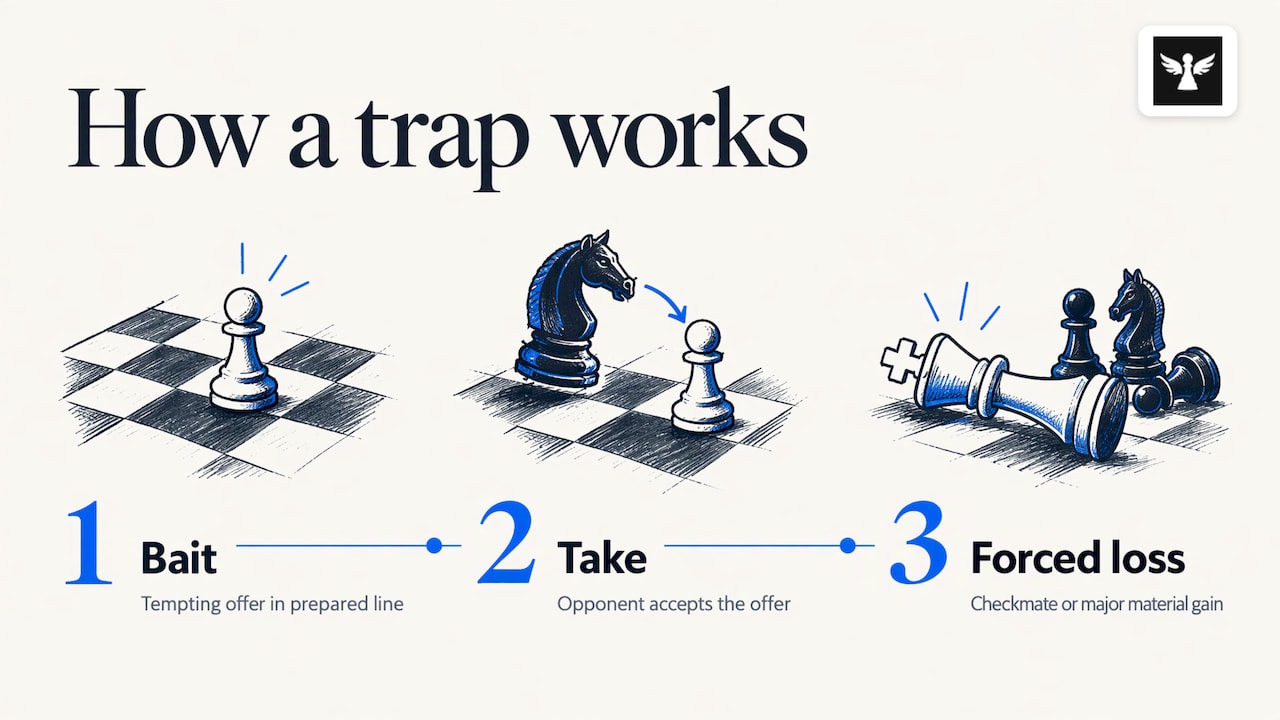
One chess training site defines a trap as a prepared line that offers the opponent something tempting where taking it loses by force, typically ending in checkmate or a major gain of material. Another lists three qualities of a good trap: the bait looks natural, the punishment is severe, and it arises from normal opening moves that opponents already play.
That last point matters for you. Because traps grow out of ordinary moves, you do not need exotic theory to fall into one. You just need to play a plausible move without checking what it allows.
Traps live in the opening because pieces are undeveloped and the king is not yet safe. Once both sides have castled and connected their rooks, the same ideas still exist, but they look like ordinary middlegame tactics.
The patterns behind most traps
The coach behind one popular beginner guide notes that most traps between 0 and 1600 are repeated patterns rather than deep theory: early queen tricks, pins, forks and moving a defender away. Here is how each looks on the board.
Early queen raids on f7 and f2
At the start, f7 (for Black) and f2 (for White) are defended only by the king. A queen and a bishop aiming at the same square can mate or win material at once. The danger signal is an early queen move with a clear target while your king is still in the center and you are behind in development.
Pins that make a capture illegal or losing
A pinned piece cannot really defend. Many traps rely on a piece that looks like it guards a square but is stuck in front of something more valuable.
Pulling a defender away
A sacrifice or capture drags the only guard of a key square off its post. After that, a check or a capture on the unguarded square decides the game.
Forks on weak squares
Knights love squares like c7 and f7 (and their mirror images on the other side). A forcing move that lands a knight there can fork king and rook, or king and queen.
Five classic traps, move by move
The lines below use standard English algebraic notation: N for knight, B for bishop, Q for queen, K for king, R for rook. A question mark marks a mistake.
1. Scholar’s mate (White’s four-move attack)
1.e4 e5 2.Qh5 Nc6 3.Bc4 Nf6?? 4.Qxf7#
The scholar’s mate is the best-known four-move checkmate. The pawn on f7 is guarded only by the king, and the queen backed by the bishop delivers mate. The mistake is 3…Nf6, which develops a piece and ignores the threat.
How to avoid it: after 2.Qh5, simply answer 2…Nc6 and then 3…g6, hitting the queen, or 3…Qe7 to guard f7. Develop with tempo against the queen instead of chasing it with random pawn moves.
2. Fool’s mate (Black’s two-move reply)
1.f3 e5 2.g4 Qh4#
This is the shortest possible game and it needs White to cooperate. It teaches one lesson that is worth keeping: pawn moves in front of your king open diagonals. The a7-g1 and h4-e1 diagonals are the ones to watch.
3. The Légal trap (White sacrifices the queen)
1.e4 e5 2.Nf3 d6 3.Bc4 Bg4 4.Nc3 g6? 5.Nxe5! Bxd1?? 6.Bxf7+ Ke7 7.Nd5#
The Légal trap ends in a mate by three minor pieces after a queen sacrifice. Black’s bishop on g4 pins the knight on f3 to the queen, so Black thinks 5.Nxe5 simply loses a piece to the pin. The knight leaves f3 anyway, and if Black grabs the queen the bishop and knights finish the job. The French-language site Les échecs en vidéo explains the same sequence: the trap punishes a relaxing move such as …g6 while the bishop sits on g4.
How to avoid it: do not pin a knight to a queen while your own king is undeveloped. If White plays 5.Nxe5, take the pawn with …dxe5 and the line does not work; the trap only wins if Black takes the queen.
4. The Milner-Barry gambit trap in the French Defense
In the Advance Variation of the French (1.e4 e6 2.d4 d5 3.e5 c5 4.c3 Nc6 5.Nf3 Qb6), White plays 6.Bd3 and lets Black take on d4. The greedy sequence is to take pawns on d4 with the knight and then the queen. When the black queen lands on d4, Bb5+ forces a reply and the queen is lost to Qxd4 on the next move, whichever way Black answers the check.
The lesson: a gambit pawn in the opening usually has a price. If you want a deeper look at this opening and its plans, see our guide to the French Defense: moves, variations, plans and traps.
5. The Winawer “poisoned pawn”
In the French Winawer (1.e4 e6 2.d4 d5 3.Nc3 Bb4 4.e5 c5 5.a3 Bxc3+ 6.bxc3 Ne7), White’s 7.Qg4 targets g7. Passive replies can lose the pawn, but the position is double-edged and Black has counterplay. This one is a real opening fight, not a cheap trick, so it shows the border between a trap and a legitimate line.
Quick reference table
| Trap | Opening | Who springs it | The mistake it exploits |
|---|---|---|---|
| Scholar’s mate | 1.e4 e5 2.Qh5 | White | Ignoring the f7 threat (3…Nf6??) |
| Fool’s mate | 1.f3 e5 2.g4 | Black | Weakening the king’s diagonal |
| Légal trap | Semi-Italian, …Bg4 | White | Taking the queen after 5.Nxe5 |
| Milner-Barry | French Advance | White | Greedy queen capture on d4 |
| Winawer poisoned pawn | French Winawer | White | Passive defense of g7 |
How to avoid opening traps without memorizing everything
You will never memorize every trap, and you do not need to. One site lists 47 named traps, another lists 95, and new ones appear in every opening. Instead, build habits.
Seven checks before you capture
The training site ChessDada suggests rules for avoiding traps that boil down to the following:
- Before every capture, ask what the captured piece was doing.
- Count the defenders of f7 (or f2).
- Do not grab material while your king is in the center.
- Watch what your capture opens up.
- Avoid early pawn moves that only chase pieces.
- Be suspicious of quiet queen moves.
- When you are offered a gambit pawn, aim to give it back rather than cling to it.
The ten-second scan
When the opponent plays something unusual, stop and scan for checks, captures, threats and loose pieces. One author recommends a calm scan like this whenever a move feels strange. A French-language guide gives three signals that a trap may be coming: an apparent sacrifice with no reason, an unmotivated forcing move, and the feeling that it is too easy. Any of the three means you calculate before taking.
Fall back on principles
If a move is new to you, spend thirty seconds asking only what it threatens. Then apply the basics: develop, fight for the center, castle and avoid creating weaknesses. That approach avoids most traps without any memorization.
Keep your own trap notebook
After each loss to a trick, write down three things: the position, the danger signal and the safe reply. A short list built from your own games is worth more than a hundred traps copied from a website, because the opponents in your games tend to play the same openings every week.
How often do traps really work?
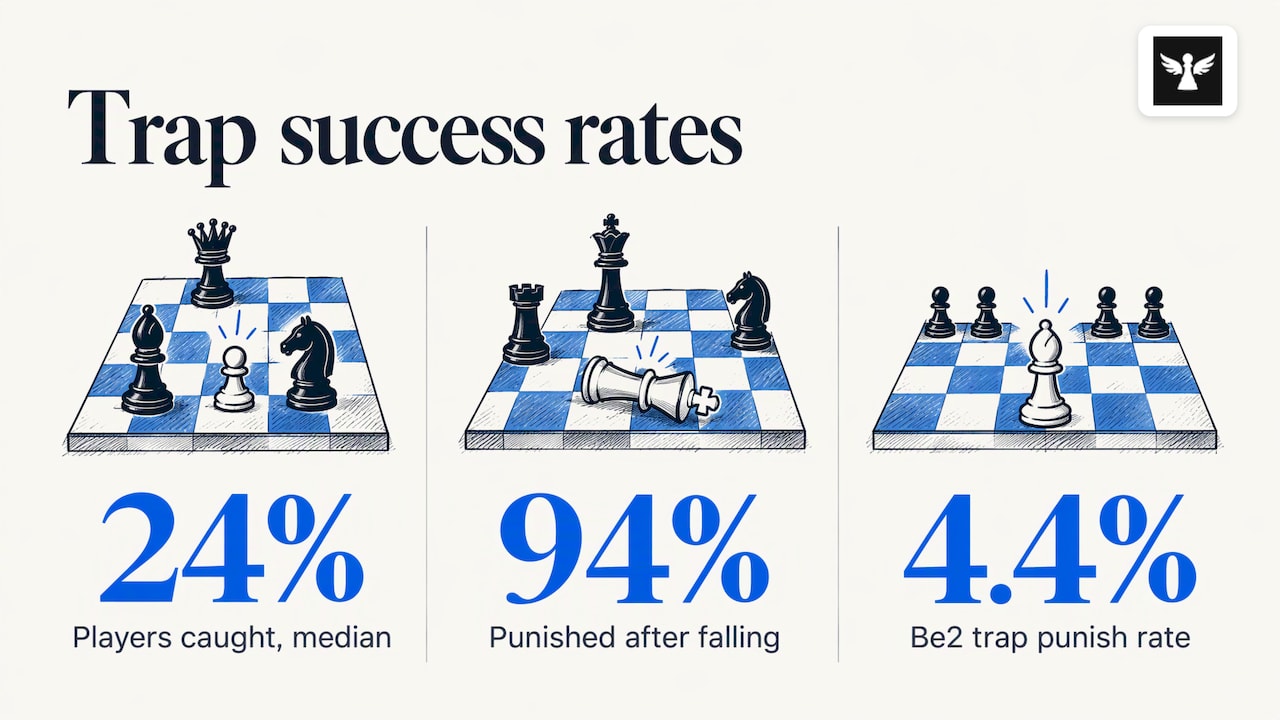
Traps are not magic. A study of 26 traps in Lichess data found that the median trap caught 24% of the players who reached it, and that once a player fell for one, the median punish rate was 94%. That means two things. A lot of players do avoid traps, and the ones who fall are punished almost every time. The data also shows outliers: the French Classical Be2 trap was caught very often but punished only 4.4% of the time, because the setter had to know the follow-up.
The practical conclusion is that a trap you cannot follow up is worth nothing. Which brings us to the other side of the board.
Setting traps yourself
Setting traps is fair play, as long as the move you choose is also a sound one. Three rules keep the trap useful:
- Choose traps from openings you would play anyway. A trap in an opening you do not know pulls you out of your own repertoire.
- Learn the refutation and the “why”. Knowing why the bait fails to work is what lets you play on if the opponent deviates. Training sites suggest practicing them move by move on an interactive trainer.
- Prepare for the opponent who declines. Know how to continue if the bait is refused. A trap that leaves you worse after a correct reply is a bad opening.
If you play the Italian Game, our page on the Italian Game covers the typical plans and the traps that arise from 3.Bc4. The same goes for the Ruy Lopez, where the knight on e5 and the pressure on c6 create their own tricks.
Online versus over the board
The patterns are the same in both settings, but you meet them differently. Online, especially in blitz and bullet, you play many more games per week against the same few openings, so traps you set or fall for repeat often. The clock also pushes you to move on instinct, which is exactly when a plausible capture gets played without a scan. Over the board, you have more time and a physical view of the position, and your opponents tend to be less predictable, so a long list of traps pays off less than the scan habit.
For that reason, the most useful list is not a book list. It is a list drawn from your own recent games.
Practice so the right move comes automatically
Reading a trap once does not protect you in a game. You need to see the position, play the right reply and repeat it until it is automatic. Our article on how to practice chess openings so they stick explains the approach, and the tactical side matters just as much: many traps are basic tactics in disguise. Start with chess tactics for beginners, and learn the mating patterns that traps use, since most of them end in one of those checkmates.
Train on your own games with ChessFlux
ChessFlux builds a personalized repertoire from your last 100 games on Lichess or Chess.com, then lets you drill it move by move. It compares what you actually played to your repertoire, so you see where your openings go wrong. You can also work on tactics puzzles by theme or by opening, and check lines with Stockfish. The core features are free, and Premium unlocks options such as unlimited puzzles and advanced training.
Start on ChessFlux, or read our guide to memorizing chess openings with active training.
Our perspective
We built ChessFlux on a simple observation: players do not lose to traps because they never saw them. They lose because the trap appears in a game, in a position they have not rehearsed, and the plausible move comes out under time pressure.
That is why we do not ask you to memorize a catalog. The app reads your last 100 games on Lichess or Chess.com, builds a repertoire from the openings you really play, and shows where your moves leave it. The traps that matter to you are the ones in your own games, so that is where we aim the training.
Our approach is to turn each of those moments into a drill: you replay the position, find the safe reply, and repeat until it is automatic. Add tactics puzzles by theme or opening, and Stockfish analysis for the lines you doubt, and a trap becomes a pattern you already know instead of a surprise.
Rolf
FAQ
What are the most common chess opening traps?
The most common ones at beginner and club level are scholar’s mate, the Légal trap, fool’s mate and the greedy pawn grabs in the French Defense. They all use the same ideas: an early queen attack on f7 or f2, a pin, or a defender pulled away. Learning the ideas covers more traps than learning any single line.
How do I avoid opening traps as a beginner?
Develop your pieces, castle early and count the defenders of f7 or f2 before you capture anything. When a free pawn or piece appears early, ask what the captured piece was doing and what the capture opens. If your king is still in the center, decline the gift and finish development first.
Should I learn traps or just solid openings?
Learn both, but start with solid openings and pick a few traps inside them. A trap from an opening you play anyway costs you nothing if the opponent avoids it. A trap from an opening you do not play distracts from your real repertoire.
What should I do when my opponent avoids my trap?
Continue with the normal plan of the opening. A good trap is built on a sound move, so declining it should leave you with a healthy position. That is why you should learn the refutation and the reason behind each trap, not just the bait.
Sources
- Common Chess Opening Traps to Know, ChessWorld
- 47 Chess Opening Traps to Win Fast, ChessDada
- Chess opening traps: complete list of 95 traps, Chess Trap Guide
- Chess Traps: Practice 32 Opening Traps, Chessmate
- Do chess opening traps work? 26 traps in Lichess data
- French Defense Traps, ChessLab Academy
- Les pièges d’ouverture aux échecs, Les échecs en vidéo
- What to Do When You Don’t Know the Opening, Chess Tournament Guide
- Scholar’s mate, Wikipedia
- Legal Trap, Wikipedia