Chess visualization is your ability to see a position, and the positions that follow from it, without moving a single piece. You train it by holding short lines in your head, replaying games from notation, and checking your mental board against a real one. Pattern recognition supplies the ideas and calculation checks them. This guide gives you exercises for each skill, a step-by-step calculation method, and a routine you can fit into a normal week.
TL;DR
- Visualization is the base skill: if you cannot hold the board in your head, your calculation breaks down after two or three moves.
- Train it in small doses: coordinates, short mental lines, and replaying games from notation, then checking against a real board.
- Pattern recognition comes from repeated tactical puzzles, ideally grouped by theme. A short “tactical radar” tells you when to calculate.
- Calculate in stages: stop at key positions, look carefully, then continue, instead of running one long line to the end.
- About 20 minutes, four days a week, beats one long weekend session.
Table of Contents
- Visualization, pattern recognition and calculation: three skills, one chain
- Exercises to hold a position in your head
- Train pattern recognition with a tactical radar
- How to calculate chess moves step by step
- A weekly routine you can keep
- Use your openings and your own games as training material
- Perspective
- Train on your own games with ChessFlux
- FAQ
- Sources
Visualization, pattern recognition and calculation: three skills, one chain
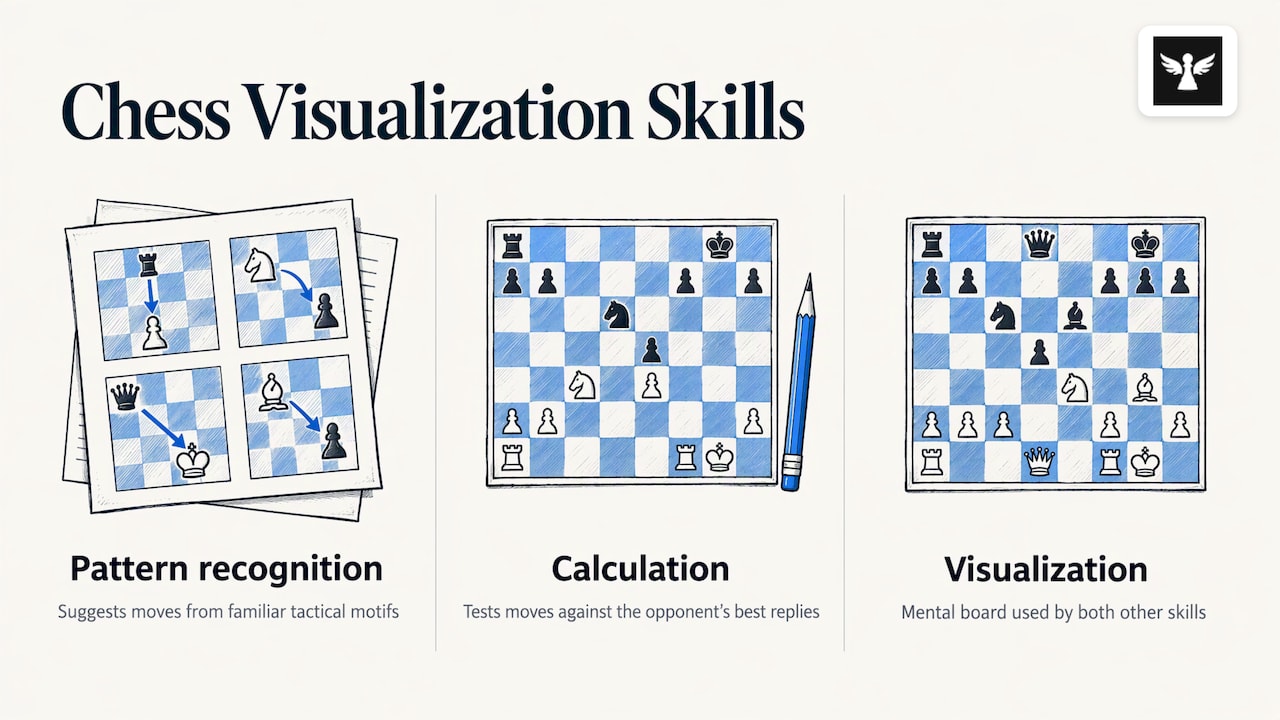
Players often lump these together, but they do different jobs.
Visualization is the mental board. It is the ability to picture where every piece stands after a sequence of moves, including pieces you have captured or moved three moves ago. Without it, every other skill below gets noisy.
Pattern recognition is fast and automatic. You see a king with weakened squares around it, or a rook and queen lined up, and a motif springs to mind. A French coaching memo on calculation describes this kind of intuition as quick and automatic, in contrast with calculation, which is deliberate, logical analysis.
Calculation is where you verify. The pattern says “there might be a fork here”. Calculation checks whether it works in this exact position, against this opponent’s best replies.
The chain runs like this: patterns suggest a move, calculation tests it, and visualization is the workspace both of them use. That is why weak visualization hurts so much. You can see the idea and still lose the thread two moves in, because you no longer know where your own knight went.
Exercises to hold a position in your head
These exercises need no software. A board, a notebook and a few minutes are enough. Start easier than you think you need to: the goal is accuracy, not speed.
Coordinates and diagonals
You cannot picture a board you cannot navigate. Name a square at random (for example f6) and say its color within a second. Then name the squares on a diagonal from it. Do this for two minutes. It feels childish and it removes a lot of hesitation later, especially when reading notation.
Knight and bishop routes
Pick two squares and find the shortest knight route between them in your head, then check on a board. Do the same with a bishop that must change diagonals. The knight is the hardest piece to visualize, so it is worth the extra reps.
Short mental lines from a diagram
Take a tactical position from a book or a puzzle set. Without touching the pieces, play a forcing line of three moves in your head: your move, the reply, your second move. Then write down the final position, piece by piece, and compare it with the real board. Lengthen the line to four, five and six moves only when your written positions are consistently right.
Two habits make this work:
- Say the position out loud or write it. “White king g1, rook f1, pawns f2 g2 h2” forces precision. A vague mental picture does not.
- Check, never assume. Each time you finish a line, verify it on a real board. A mistake you catch becomes a lesson. A mistake you miss becomes a habit.
Replay a game from notation
Open a game score, cover the moves, and reveal them one at a time. Play each move on an imaginary board, and every ten moves, describe where your queens and kings are before checking. Annotated master games work well because the moves have logic you can follow.
When you can do this for twenty moves without losing a piece, move to the next level: read the notation without a board in front of you at all, and try a short blindfold game against a friend or a weak engine. Many players find the first blindfold attempts humbling, and that is normal.
Visualize before you click
The easiest in-game version: during a longer game, calculate your candidate line to the end before touching the mouse or the piece. At the end of the line, ask yourself one question: “What is attacked, and by what?” If you cannot answer, your line was too long for your current visualization, so shorten it next time.
Train pattern recognition with a tactical radar
Patterns are stored through repetition. The more often you see a back-rank mate, a pin against the queen, or a discovered attack, the quicker the motif appears when it matters. Puzzles are the obvious tool, and two features make them far more effective: grouping them by theme, and solving them with a plan rather than by guessing.
A useful plan comes from a FFE (Fédération Française des Échecs) masterclass given by Kevin Terrieux. He presents a “radar tactique” to detect tactical moments before you start looking for candidate moves. The idea is to scan for:
- The king: holes near the king, squares that are controlled, mating themes.
- Loose or attacked pieces: anything undefended or under attack.
- Piece cocktails: awkward piece combinations that allow double attacks.
- Classic ideas: promotion, stalemate, perpetual check, a piece trapped with no escape.
The same masterclass reminds you that a tactical move is always a check, a capture or a threat. That gives you a quick filter: if none of your candidate moves does any of these, the position probably calls for a quieter plan, not a combination.
Use the radar on every puzzle, out loud if possible, before you move. After a few weeks the scan becomes automatic, and that automatic scan is exactly what pattern recognition is.
If you are just starting, learn a small set of motifs first. Our guide to chess tactics for beginners covers five patterns worth learning before anything else. When you are ready for volume, tactics training and puzzles by theme or by opening lets you repeat the same family of motifs until they stick.
Why repeating the same puzzles works
Solving a thousand new puzzles once teaches less than solving two hundred puzzles several times. The second pass is where recognition replaces searching. Keep a small set, redo it every couple of weeks, and watch how much faster you get. Time yourself on the repeat, not on the first attempt.
How to calculate chess moves step by step
Bad calculation is rarely a lack of intelligence. It is usually a lack of structure. Here are three methods from French-speaking coaches that you can combine.
Stop at key positions
The French memo on calculation describes Valeri Beim’s approach: calculate up to a key position, stop and look carefully, then calculate to the next one. You do not run a single twelve-move line from start to finish. You break it into chunks, and at each stop you re-read the board fresh. This is where visualization training pays off: each stop is a position you must hold accurately.
The same memo cites Jacob Aagaard’s principle that before thinking, you must learn to see, and Martin Weteschnik’s “status examination”. For every piece, ask what its current status is: attacked, defended, pinned, immobile. Then ask how that status affects the other pieces.
List, Analyze, Judge, Compare
International Master Sébastien Luce is credited with the L.A.J.C. method. It works in four steps:
- List your candidate moves mentally, without analyzing them. Go in order: checks first, then captures, then direct attacks, then maneuvering moves.
- Analyze each candidate in that same order.
- Judge each variation on its own, as if the others did not exist.
- Compare the variations and pick the best move.
The discipline here is separation. Most calculation errors come from mixing steps: you start analyzing the first move you see, fall in love with it, and never list the others.
Reason before you calculate
A second FFE masterclass, from 4 May 2020, notes that students rated 1000 to 1600 are “always calculating and rarely reasoning”. The remedy it stresses is reading the position carefully first: find the targets (a king in difficulty, pawn structure problems, weakened squares, unprotected pieces) and remember that your opponent has plans and your own position has weaknesses too. Calculation then becomes a tool to reach a goal, not a way of avoiding thinking.
For a longer walkthrough with worked positions, see our practical method for chess calculation training.
Common calculation mistakes
- Calculating only your own moves. Write down your opponent’s best reply at every step, including the unpleasant ones.
- Forgetting a piece that moved earlier in the line. This is a visualization failure. Shorten the line, or re-describe the position at each stop.
- Stopping on a capture. If your line ends right after you win a piece, check whether the opponent has a check or a recapture next.
- Going deep too early. First see whether the position even contains a forcing idea. If the radar finds nothing, calculate less and plan more.
A weekly routine you can keep
A routine matters more than the perfect exercise. Here is a starting point for a beginner or intermediate player, built around 20 minutes on four days.
| Day | Focus | What to do |
|---|---|---|
| 1 | Visualization | Coordinates for 2 minutes, then 5 to 6 short mental lines from diagrams, written out and checked |
| 2 | Pattern recognition | A themed puzzle set, using the radar before each move |
| 3 | Calculation | Two or three hard positions, using L.A.J.C. and writing your lines down |
| 4 | Review | Replay one of your own games from notation and mark where your mental board slipped |
To measure progress without fancy tools, keep a simple log with three numbers per week: how many mental lines you got right out of those attempted, how long a repeated puzzle set took compared with last time, and how many tactical mistakes you made in your own games. Progress shows up as longer lines you can hold, faster repeats and fewer blunders, usually before it shows up in your rating.
After a month, extend your mental lines by one move. After three months, try the notation replay without a board. Our broader plan in how to improve at chess shows where this routine fits next to openings, endgames and game review.
Use your openings and your own games as training material
Openings are the cheapest visualization training you have, because the positions repeat. When you know a line well, you can picture the position after ten moves without effort, and that comfort carries into the middlegame, where the typical plans and tactical motifs of your openings keep coming back.
Two habits turn opening study into board-vision practice:
- Recite the line from the starting position, in your head, before you play it on the board. If you stumble at move eight, that is where your memory or your picture is weak.
- Review the positions where you left your preparation. The first move where you were on your own is usually where the tactical errors begin.
Your own games are the second source. Go through a recent loss, stop before each critical moment, and try to find the tactic or calculate the line yourself before you look at the engine. Our guide on how to review your chess games for free walks through this, and analyzing openings with Stockfish helps you check the lines you saw.
Perspective
We built ChessFlux on a simple observation: most players do not lose games because they never studied. They lose because what they studied does not match what they actually play. The positions you reach on Lichess or Chess.com are not the ones in a generic course.
That is why we start from your real games. The app builds a repertoire from your last 100 games, then trains you move by move on the lines you actually meet. When you can replay a variation from memory, you are holding a board in your head, and that is visualization practice in its simplest form.
Then we compare your real results with your repertoire, so you see where your preparation fails in practice. Add themed puzzles on the motifs those openings create, and pattern recognition and calculation get trained on positions that matter to you, not on random exercises. That is how we think improvement becomes measurable.
Rolf
Train on your own games with ChessFlux
If you play on Lichess or Chess.com, ChessFlux can build a personalized opening repertoire from your last 100 games and drill you on it move by move, so the positions you practice are the ones you actually reach. You can also work on tactics puzzles by theme or by opening, and run opening analysis with Stockfish. The core features are free, and a Premium subscription unlocks extras such as unlimited puzzles and advanced training.
Start on chessflux.fr, or read how to build a repertoire from your Lichess or Chess.com games first.
FAQ
How long does it take to improve chess visualization?
Most players notice a difference in a few weeks of short, regular practice, for example 20 minutes four days a week. The first sign is usually that you can hold one more move in a mental line than before. Progress varies from player to player, so track your own numbers rather than comparing yourself with others.
Is visualization the same as calculation?
No. Visualization is holding the position in your mind, while calculation is the analysis you perform on that mental board: candidate moves, replies and evaluation. Good calculation depends on good visualization, which is why training the first helps the second.
How can I improve pattern recognition quickly?
Solve puzzles grouped by theme, repeat the same set several times, and scan the position with a checklist before each move. The radar of king, loose pieces, piece cocktails and classic ideas turns a vague feeling into a repeatable habit.
Do I need to play blindfold chess to get better?
No. Full blindfold games are a demanding extra, not a requirement. Short mental lines, notation replays and calculating a line completely before you move are enough to build most of the benefit for club play.
Can my opening repertoire help with tactics?
Yes. Each opening produces recurring structures and motifs, so knowing your lines well means you see familiar tactical ideas in familiar positions. Training your repertoire and your puzzles together makes both stick.
Sources
- Améliorez votre calcul aux échecs (French calculation memo, 2023)
- FFE masterclass of 6 April 2020 with Kevin Terrieux
- FFE masterclass of 4 May 2020: Visualisation, Imagination, Créativité
- Méthode d’analyse L.A.J.C.