A chess game review replays your game move by move with an engine such as Stockfish, grades each move, and shows you where the game turned. You can do it for free: paste a PGN or import the game from Lichess or Chess.com, run the analysis, and read the evaluation graph, the mistakes and the best moves the engine suggests. The harder part is what comes after. This guide shows how to run a review, how to read it, and how to turn it into opening work that actually changes your results.
TL;DR
- A free review needs only the game’s PGN. Lichess accepts pasted text or an uploaded file, and requesting the computer analysis there requires an account.
- Focus on the evaluation swings: blue is a good move, orange an inaccuracy, red a mistake. The three best engine lines show what you should have played.
- Review your first 10 to 15 moves separately. Opening errors repeat across games, so they are the cheapest to fix.
- A single review shows one game. Patterns only appear across many games, and that is where a repertoire built from your own games helps.
- Engine output is a diagnosis, not a lesson: you still have to remember the correction and drill it.
Table of Contents
- What a chess game review actually gives you
- How to import your game for review
- How to read the report without drowning in numbers
- A worked example: reviewing a game you lost in the opening
- Using a review to find and fix opening mistakes
- The limits of a free game review
- From one game to a training plan
- Our approach at ChessFlux
- Try it on your own games
- A practical checklist for every review
- FAQ
- Sources
What a chess game review actually gives you
Every free review tool is built on the same idea. An engine evaluates the position after each move, compares what you played with what it considers best, and labels the difference. What you get back usually includes:
- A move list with grades: good moves, inaccuracies, mistakes and blunders, often with an accuracy percentage for each side.
- An evaluation graph showing who stood better at each moment, so you can see the exact move where the game swung.
- Best moves and alternatives: the engine’s top choices for a position, with the lines that follow.
- A summary of how many errors of each type you made.
The tools differ in the details: some run Stockfish in your browser with no signup, others run it on a server and ask you to log in. The method you use to read the results is the same either way.
Free does not mean limited in the way you might fear
The engine itself is open source and strong, which is why unlimited free analysis exists at all. The real limits are different: depth of analysis on slower devices, a daily cap on server requests on some sites, and, above all, the absence of any link between one game and the next. The review tells you what went wrong in this game. It does not tell you that you have gone wrong in the same Sicilian line five times this month.
How to import your game for review
You need the game in a form the analyzer can read. In practice that means one of three routes.
Option 1: paste the PGN
PGN is the standard text format for chess games. On Chess.com, open the finished game, use the share or download option and copy the PGN. On Lichess, the same option sits under the game’s share and export menu. Then paste it into the analyzer of your choice.
Lichess has its own import page for pasted PGN text or uploaded files, which gives you a game you can step through. Asking for a computer analysis on top of that requires a Lichess account, which is free.
Option 2: import by username or game link
Most browser-based analyzers let you type a Chess.com or Lichess username and pick a recent game, or paste the game URL. This saves the copy and paste step and is the fastest route if you review often.
Option 3: load a position from a FEN
If you only want to study one critical position, a FEN string describes it in a single line. This is useful when your opponent leaves the known theory at move 9 and you want to understand why the position is good or bad without replaying the whole game.
If your goal is to use these games for opening training rather than a one-off check, our guide to importing a PGN from Lichess or Chess.com walks through the export steps for both sites.
How to read the report without drowning in numbers
The first time you open a review, the amount of data is overwhelming: percentages, colored symbols, lines of engine moves. Here is a reading order that works.
Step 1: look at the evaluation graph
The graph shows a line moving above or below zero. Above zero favors White, below zero favors Black. Look for cliffs: moments where the line drops sharply. Those are the moves to study. Everything in between is noise for the purpose of a first pass.
Step 2: understand the evaluation number
Positive scores favor White and negative scores favor Black. As Europe Échecs explains, a value around 1.00 corresponds roughly to a pawn’s worth of advantage and 3.00 to a piece, with the usual caution that the number is an engine estimate and not a verdict. A score of +0.3 is a small edge you can easily lose or keep; +3.0 is a position that is usually decided if you play sensibly.
Step 3: learn the color code
In the report described by the same source, blue marks a good move, orange an inaccuracy and red a mistake. The variations panel lists the engine’s three best moves, which is where you find what you should have played. A useful habit: before you click the best move, pause and try to guess it. That one second of effort is where most of the learning happens.
Step 4: separate blunders from inaccuracies
Inaccuracies cost a little; mistakes cost real evaluation; blunders usually lose material or the game. Spend your time on the blunders and mistakes. Chasing every orange move leads to hours of review and no change in how you play.
Step 5: ask why, not just what
The engine tells you that Nf3 was better than Bd3. It does not tell you why. For each red move, write one sentence: “I missed that the knight was undefended” or “I forgot the plan in this structure.” That sentence is the actual lesson, and it is what you can recognize next time.
A worked example: reviewing a game you lost in the opening
Imagine you played White in a rapid game, reached move 12 and found yourself two pawns down with no compensation. Here is how a good review goes.
- Find the first big swing. The graph shows the evaluation falling from +0.4 to -1.8 at move 9. Everything before that was fine.
- Look at what you played. You castled early. The engine’s top line prefers a pawn break that you never considered.
- Check whether it was theory or a surprise. Did your opponent play a known line? If the opponent’s moves match a well-known variation, your problem is repertoire knowledge, not tactics.
- Write the lesson. “In this line, I must play the central break before castling.”
- Decide what to drill. Add the position to your repertoire and repeat it until the correct move is automatic.
Notice that step 3 is where an ordinary review ends and opening training begins. That separation matters, as the next section shows.
Using a review to find and fix opening mistakes
Most amateur games below master level are decided by tactical errors, but the opening decides what kind of position you play and how much time you have. Opening errors have a special property: they repeat. If you misplay a line once, you will probably meet it again, because you will keep choosing the same system and opponents will keep choosing the same replies.
Look at your first 12 moves in every game
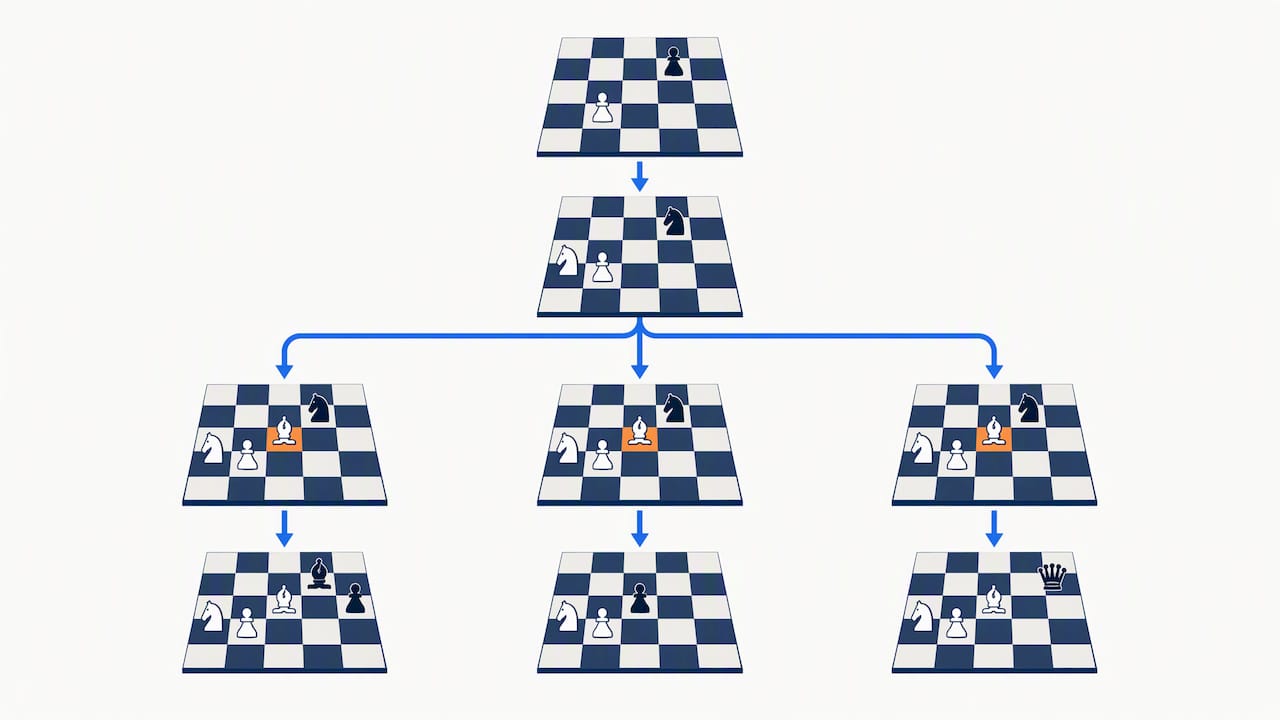
For each game you review, mark the move where your position first worsened by a clear margin. If it happens in the first 10 to 15 moves, tag it as an opening problem. After ten games, the tags usually cluster: one or two lines are responsible for most of your early losses.
Distinguish three kinds of opening problems
- You left your prepared line and improvised. The fix is memorization.
- You followed your preparation but did not understand it, so you went wrong at the first deviation. The fix is learning the plans, not only the moves. Our guide to chess openings, variations, plans and traps is written for this problem.
- You had no preparation against a particular reply. The fix is to add a line to your repertoire.
Check the engine’s line against a human sense of the position
Stockfish may recommend a move that is correct but impossible to remember or play without calculating deeply. For openings, prefer the move that is close to best and fits your understanding. A repertoire you can actually remember beats a perfect one you forget at move 7.
If you want to go deeper on this, our walkthrough on analyzing chess openings with Stockfish shows how to set up the engine for opening positions in particular.
The limits of a free game review
Free review tools are good at what they do. It helps to know what they do not do, so you can fill the gaps yourself.
| What a free review does well | What it does not do |
|---|---|
| Finds tactical blunders you missed | Tells you why you keep repeating the same mistake |
| Shows the engine’s best line | Adapts to your level or your style |
| Grades every move consistently | Connects one game to the next |
| Costs nothing and takes a minute | Makes you remember the correction |
| Works on any game you have a PGN for | Builds a training plan |
Two more cautions. First, engine evaluations at very high values are less meaningful in practice: once a position is +8, it is won, and whether it is +8 or +12 does not matter to your learning. Second, a single game is a small sample. An opening that went badly in one game may be perfectly fine, and you may have lost because of a time scramble on move 30. Do not rebuild your repertoire from one result.
From one game to a training plan
The real gain comes from turning reviews into habits. A simple weekly routine:
- Play and save. Play your games as normal, and keep the longer ones, since they are richer to review.
- Review the two or three games that hurt the most. Not all of them. Quality beats volume.
- Log the opening errors. A simple note: opening name, move number, what you played, what was better.
- Look for the repeat. If a line shows up twice, it goes onto this week’s study list.
- Drill it actively. Reading the correction once is not enough. Play it from the starting position until you can produce it from memory.
- Test it. Next week, check whether your results in that line improved.
The weak link in this routine is step 3 to 5. It is manual, easy to skip, and it needs a long memory for positions. That is exactly the part that can be automated.
Our approach at ChessFlux
We built ChessFlux around the gap between reviewing a game and actually learning from it. Instead of asking you to export games one by one, ChessFlux builds a personalized repertoire from your last 100 games on Lichess or Chess.com. It then compares what you really played with what your repertoire says, and flags the moves where you drifted or lost ground. You can read more about how this works in our game debrief guide, which explains how your openings are measured against your repertoires.
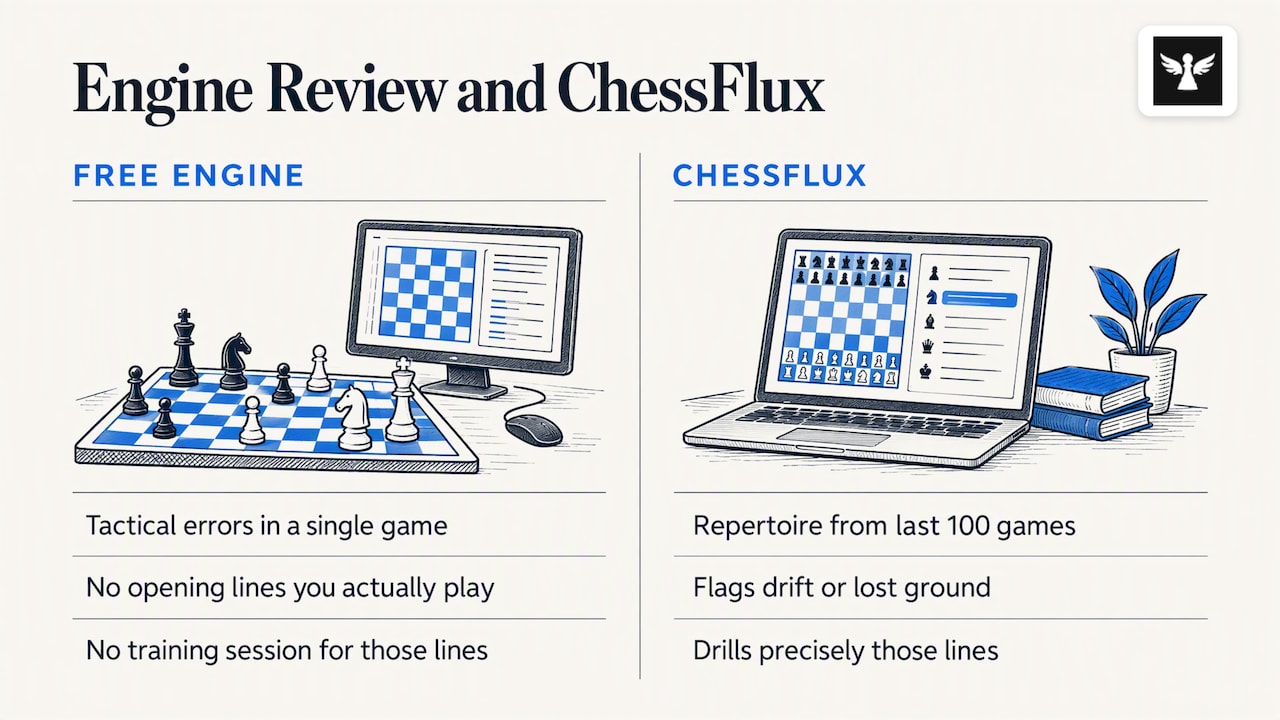
We do not think you should stop using a free engine review. It is the right tool for tactical errors in a single game. What we add is the layer that engines do not provide: which opening lines you actually play, where you score badly, and a training session that drills precisely those lines until they stick. The same app lets you build variation trees, import PGNs and studies, solve tactics puzzles by theme or opening, and run Stockfish analysis on an opening.
Our experience is that players improve fastest when review and training are the same loop: play, spot the pattern, repeat the correction, measure again. A review that ends with a list of red moves is a good start. A review that ends with a session you can do tomorrow morning is what changes your rating.
— Rolf
Try it on your own games
ChessFlux has a free plan with the core features, and a Premium subscription that unlocks options such as unlimited puzzles, advanced training and additional customization. The easiest way to see whether it fits is to connect your Lichess or Chess.com account and look at the repertoire it builds from your recent games. Start from the ChessFlux home page, or read how to build a repertoire from your Lichess or Chess.com games first.
A practical checklist for every review
Keep this short list next to your board. It keeps a review to about fifteen minutes.
- Did I look at the evaluation graph first?
- Where was the first move that cost me more than an inaccuracy?
- Was it in the opening, the middlegame or the endgame?
- Did I guess the engine’s move before clicking it?
- Can I state the lesson in one sentence?
- Is there a line I need to add to my repertoire or drill?
- Have I seen this mistake in an earlier game?
If you answer the last question “yes” more than once, you have found your next study topic. For a structured approach to that topic, our guides on chess openings cover the main systems with plans and typical traps.
FAQ
Can I review a chess game for free without creating an account?
Yes, several browser-based analyzers run Stockfish on your own device and need no signup. On Lichess, you can paste a PGN or upload a file to get a game you can browse, but requesting the computer analysis there requires a free account, according to its import page.
What is the difference between an inaccuracy, a mistake and a blunder?
They are levels of evaluation loss. An inaccuracy costs a small amount, a mistake costs a clear advantage, and a blunder usually throws away material or the game. Exact thresholds vary from one site to another, so compare grades within one tool rather than across tools.
Is the engine always right?
No. It is very strong, but its numbers are estimates, and its best move may be unrealistic for a human to find or remember. Use it to locate errors and understand tactics, then choose moves that fit your style and your repertoire.
How many games should I review?
Quality matters more than quantity. Reviewing two or three lost or close games a week, thoroughly, teaches more than skimming twenty. For openings, though, you need a larger sample to spot repeated problems, which is why looking at your last 100 games is more informative than any single one.
How do I turn a game review into opening improvement?
Tag the first big evaluation drop in each game, group the ones that happen in the opening, and drill the correct moves until you play them without thinking. Then check later games to see whether the same line still causes trouble.