The best chess tactics practice is short, regular and aimed at your own mistakes: learn a few core patterns one at a time, solve puzzles slowly and completely before you move, then mix the patterns and check them against your own lost games. Below you will find the patterns to start with, a method for solving a puzzle, a realistic daily plan and a way to make your training match the games you actually play.
TL;DR
- Start with three patterns: the fork, the pin and the skewer. They come up constantly and feed most bigger combinations.
- Solve each puzzle fully in your head before touching a piece. Speed comes later.
- Practice a little every day rather than a lot once a week, and train one pattern at a time before mixing them.
- Replay games where you lost material and ask which pattern you missed. That tells you what to practice next.
- Pick puzzles you solve most of the time, not ones that make you guess.
Table of Contents
- What chess tactics are, and why they decide most games
- The patterns to learn first
- How to solve a tactics puzzle, step by step
- How often and how long to practice
- Choosing the right difficulty
- Practice with your own games
- Making patterns stick in real games
- Where openings and tactics meet
- Our perspective
- Train tactics on your own games with ChessFlux
- FAQ
- Sources
What chess tactics are, and why they decide most games
A tactic is a short, forcing sequence of moves that wins something concrete: material, a checkmate or a clearly better position. Tactics are not tricks. They are recurring patterns, and the same geometry shows up from one game to the next.
That is the good news for anyone practicing. A French master’s thesis on calculation training, written for a national coaching diploma, presents patterns as schemes that come back from game to game, and argues that repeating them regularly reduces the amount of calculation you need and improves your accuracy (Améliorez votre calcul aux échecs). In plain terms: the more patterns you recognize on sight, the less you have to work out from scratch over the board.
At beginner and intermediate level, most games are decided by one side missing a tactic, not by deep strategy. If you want to see where your own games turn, our guide to reviewing your chess games for free shows how to find those moments.
The patterns to learn first
Do not try to learn thirty patterns at once. A French chess retailer’s guide for beginners recommends starting with three: the fork, the pin and the skewer (called enfilade in French), because they appear often and form the base of more complex combinations (La Boutique Échecs).
| Pattern | What it does | What to look for |
|---|---|---|
| Fork | One piece attacks two or more targets at once | Knights near the enemy king and queen, undefended pieces on the same color |
| Pin | A piece cannot move without exposing a more valuable one behind it | Bishops and rooks lined up with a king or queen |
| Skewer | A valuable piece is attacked and must move, exposing a piece behind it | Kings and queens on an open line with a rook or bishop behind |
Then add these
Once the first three feel automatic, the classification used by the French site Les Échecs en vidéo suggests moving on to discovered attacks, discovered check, double check and the weak back rank. After that come the mechanisms behind combinations: attraction, deflection, overloading and removing the defender (Les Échecs en vidéo).
Here is a simple way to picture the second wave:
- Discovered attack: you move one piece and unmask an attack from another. The moved piece often makes its own threat, so the opponent faces two problems.
- Double check: two pieces give check at once. The only answer is a king move, which makes it a favorite for mating attacks.
- Back-rank weakness: a king trapped behind its own pawns can be mated by a rook or queen on the first or eighth rank.
- Deflection and overloading: you force a defender away from its job, or give it more jobs than it can handle.
One idea behind many tactics
The author of an online primer on tactical elements argues that most tactics are variations on the double threat: you create two problems at once and your opponent can only solve one (The Double Threat). It is a useful lens. When you look at a position, ask yourself where one move could make two threats.
If checkmate patterns are your weak spot, start with 10 checkmates to learn first. They overlap with tactics and make a good warm-up.
How to solve a tactics puzzle, step by step
Most people solve puzzles by guessing: move something, see if the app says “correct,” try again. That feels productive and teaches little. A Stack Exchange answer on solving puzzles makes the same point, recommending a shift from guess-and-check to recognizing concepts first, which saves time and narrows the number of moves you need to analyze (Chess Stack Exchange).
Here is a routine that puts that into practice:
- Scan the forcing moves. List every check, capture and direct threat for both sides. The French thesis cited above recommends exactly this kind of systematic sweep of checks, captures and threats before you play in a real game.
- Name the motif. Is a king exposed? Are two pieces undefended? Is something pinned? Putting a name on it narrows your search.
- Calculate the full line. Follow your idea until the position is calm, including the opponent’s best replies, not only the one you hope for.
- Only then move. If you cannot find the solution after a real effort, look at it, then replay it on the board and find what you missed.
- Review the pattern. Ask what clue in the position pointed to the answer. That clue is what you will recognize next time.
Checking your answer
A puzzle that says “correct” after your first move is not proof you saw the whole line. Before confirming, make sure you can state the final position and why the opponent’s alternatives fail. If you cannot, treat the puzzle as unsolved. Our article on chess calculation training goes deeper into the visualization needed for this.
How often and how long to practice
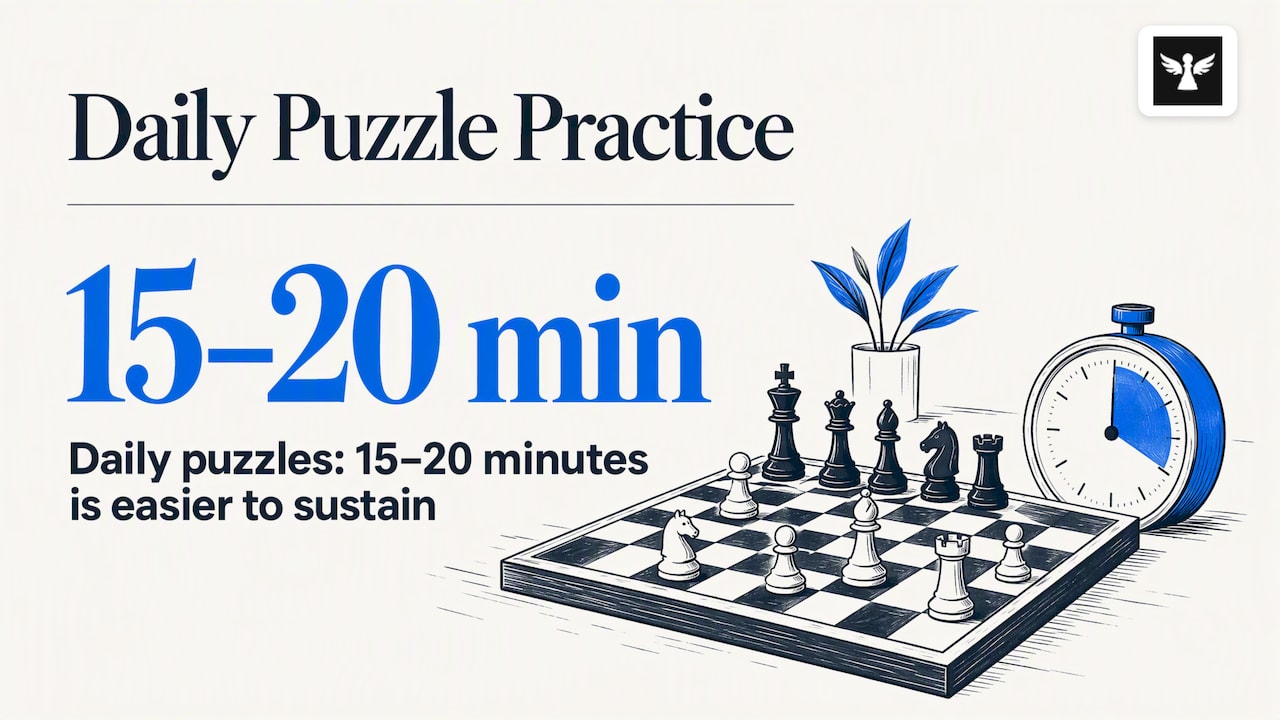
Short and daily beats long and rare. A common recommendation in beginner material is about 15 to 20 minutes of puzzles a day, which is easier to sustain than a weekend cram session. That is a coaching rule of thumb, not a measured law, so adjust it to your schedule. What matters is that you can keep doing it for months.
The French calculation thesis explains why regular work pays off: tactical exercises develop pattern recognition, accuracy, endurance, imagination, visualization and calculation, and the author recommends regular practice (Améliorez votre calcul aux échecs). Several of those skills, such as endurance and visualization, only grow with repetition.
If you want a structured French-language resource aimed at players working toward about 1500 Elo, Philippe Joussim’s Objectif 1500 tactical training guide is available as a PDF from Chess Teaching.
A sample week
| Day | Focus | Time |
|---|---|---|
| Monday | One pattern only (for example forks), slow solving | 20 min |
| Tuesday | Same pattern, a new set of positions | 20 min |
| Wednesday | Second pattern (pins) | 20 min |
| Thursday | Mixed set of the patterns you have learned | 20 min |
| Friday | Replay a recent loss and find the missed tactic | 20 min |
| Weekend | One longer game at a slow time control, then review | 30 to 45 min |
This is a template, not a prescription. If you only have ten minutes, do ten minutes. A missed day is not a failure; a missed month is.
Choosing the right difficulty
Difficulty is where many players quietly go wrong. Puzzles that are too easy flatter you without teaching anything. Puzzles that are far too hard push you back to guessing.
A practical rule: aim for puzzles you solve correctly most of the time, but only after real thought. If you are getting nearly all of them in seconds, step up. If you are failing most of them and the solutions feel arbitrary, step down and go back to a single pattern. Most puzzle sites rate each puzzle the way they rate players, so a puzzle rated near your own level should be a fair challenge.
Some signs it is time to progress:
- You recognize the pattern within a few seconds and spend your time verifying the line.
- Mixed sets no longer surprise you.
- You start spotting the same motifs in your own games before your opponent plays them.
And signs to ease off:
- You are clicking moves just to see the result.
- You cannot explain a solution after seeing it.
- You are tired. Tactical vision drops fast, so stop and come back tomorrow.
Practice with your own games
Generic puzzles teach general patterns. Your games tell you which patterns you miss. A French retailer’s guide suggests replaying your games, especially those where you lost material, and asking whether a fork, a pin or a skewer could have been foreseen or avoided (La Boutique Échecs).
A simple loop:
- After each game, find the moment you lost material or the evaluation swung.
- Write down the motif (fork, pin, back rank, overloaded defender).
- Count which motif appears most often over ten games.
- Spend the next week of puzzles on that motif.
You will usually find one or two patterns account for most of your blunders. Fixing those is worth more than another hundred random puzzles. For the full routine, see our practical plan to improve at chess.
Making patterns stick in real games
Knowing a pattern in a puzzle app and seeing it in a game are different skills. The French thesis offers a clear sequence: link the name of each motif to its geometry, solve positions regularly, and review your mistakes afterward. Work on one isolated motif first, then move on to mixed exercises. In your games, run a systematic sweep of checks, captures and threats before every move (Améliorez votre calcul aux échecs).
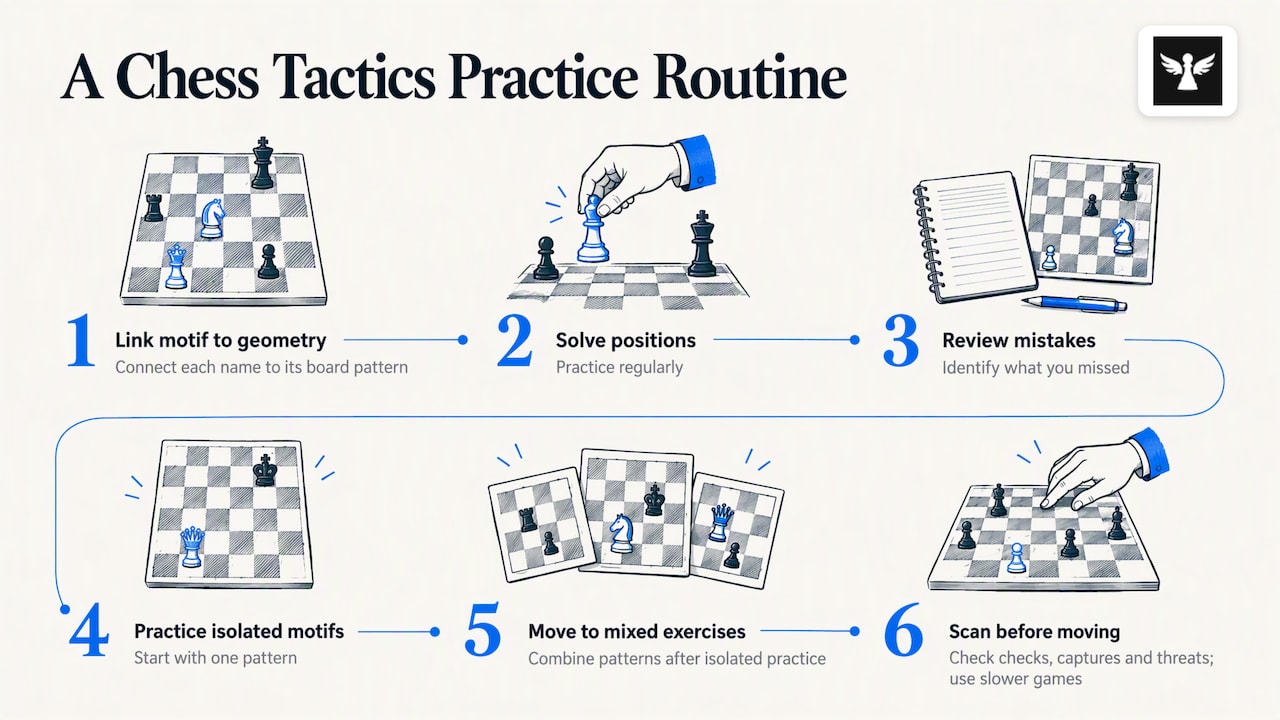
The retailer’s guide adds a point about time: favor a slower time control while you are learning, so you have room to run that sweep (La Boutique Échecs). Fast blitz games reward reflexes you have not built yet.
Useful tactical ideas to spot winning moves
People often search for chess “tricks.” Real ones are habits of looking, not secrets:
- Look for loose pieces. An undefended piece is a target for forks and double attacks.
- Check the king first. Forcing moves against the king give you tempo.
- Ask what your opponent’s last move left undefended. Every move changes the defense somewhere.
- Check your own safety before attacking. Before you launch an idea, make sure your own back rank and loose pieces are covered.
Where openings and tactics meet
Tactics do not appear from nowhere. Many of them grow out of opening structures: a pinned knight on f3, an exposed queen, a king stuck in the center. Knowing your opening lines means you recognize the tactical themes that come with them. If you play the Ruy Lopez, the pin on c6 is a recurring theme (Ruy Lopez moves, plans and traps). In the French Defense, the tension around the d4 and e5 pawns creates its own set of shots (French Defense guide). And if you want your lines to stay in memory, our article on practicing chess openings so they stick covers it.
Our perspective
We built ChessFlux on a simple observation: most players practice tactics and openings in the abstract, then lose games for reasons that have little to do with what they practiced.
That is why we start from your real games. ChessFlux builds a personal repertoire from your last 100 games on Lichess or Chess.com, compares what you actually played against that repertoire, and points to the moves that need work. Tactics should follow the same logic: the puzzle that helps you most is the one that targets the motif you keep missing.
For this reason, we offer tactics puzzles you can filter by theme or by opening, so your practice connects to the positions you reach over the board. A fork puzzle from your own Sicilian lines is worth more to you than a random one.
Our goal is measurable progress: fewer repeated mistakes, patterns recognized faster, and lines you remember under pressure.
Rolf
Train tactics on your own games with ChessFlux
ChessFlux is a freemium app. The core features are free, and a Premium subscription unlocks options such as unlimited puzzles, advanced training and additional customization. You can solve tactics puzzles by theme or by opening, build a repertoire from your recent Lichess or Chess.com games, and analyze openings with Stockfish.
Start with our page on chess tactics training and puzzles, or open ChessFlux and connect your account to see where your games leak material.
FAQ
How long does it take to get better at tactics?
It depends on your starting point and how consistently you practice. Most players notice that they spot basic forks and pins faster after a few weeks of daily work. Deeper calculation takes months, because it relies on repetition. Track progress by how many tactics you catch in your own games, not only by puzzle scores.
Should I do puzzles fast or slow?
Slow, at least at first. Solving a puzzle fully in your head builds the calculation you need in a game, while rushing encourages guessing. Once patterns feel automatic, you can add timed sets to build speed. Keep the slower sessions in your routine as well.
Which tactic should a beginner learn first?
The fork, the pin and the skewer. A French beginner’s guide recommends them as the first three because they appear so often and support more complex combinations (La Boutique Échecs). Add discovered attacks and back-rank mates next.
Are puzzles enough, or do I need to play games too?
You need both. Puzzles show you the pattern with the answer guaranteed to exist, while games force you to find out whether a tactic is there at all. Play regular games at a comfortable time control, then review them for missed tactics.
Can I practice tactics tied to my own openings?
Yes, and it is an efficient way to train. Tactical themes repeat inside each opening, so practicing puzzles linked to the lines you play prepares you for the positions you actually reach. ChessFlux lets you filter puzzles by opening for this purpose.
Sources
- Améliorez votre calcul aux échecs (mémoire DEFFE1)
- Fourchette, clouage, enfilade : les 3 tactiques à maîtriser en premier
- Tactiques d’échecs, Les échecs en vidéo
- The Double Threat, The Elements of Tactics
- What is the best way to solve chess puzzles? (Chess Stack Exchange)
- Objectif 1500, entraînement tactique (Chess Teaching)