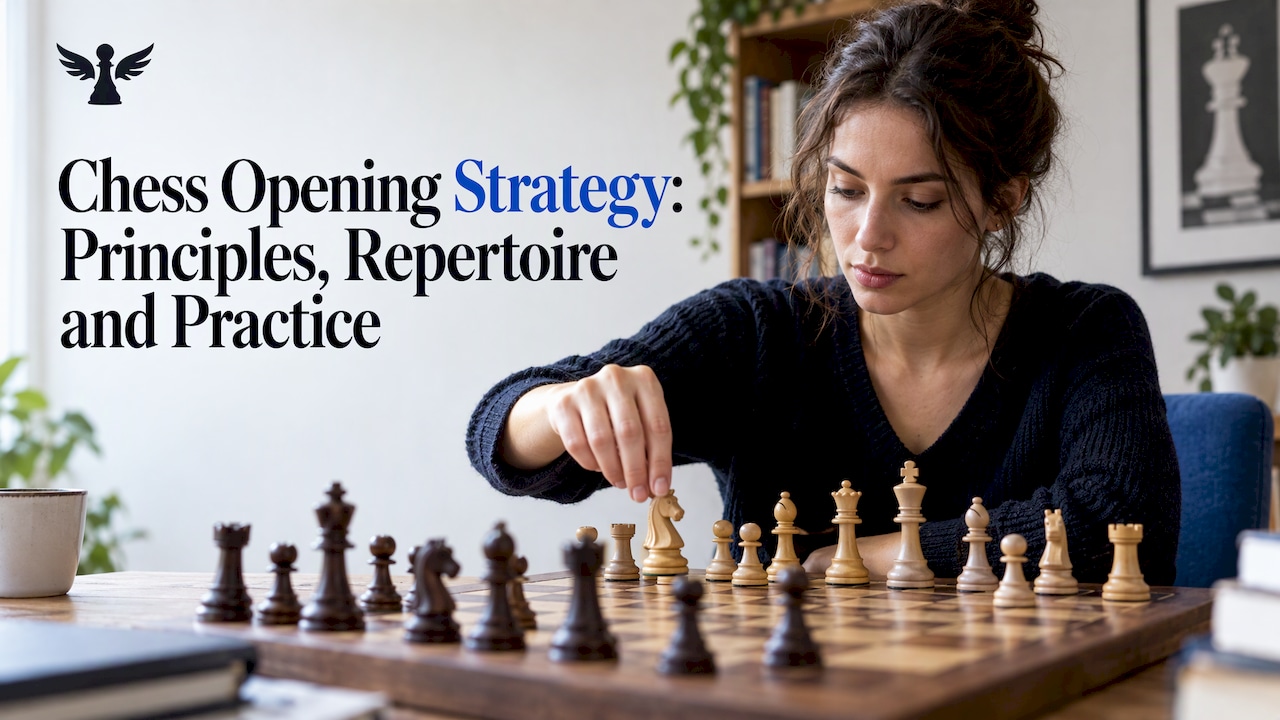
Good opening strategy comes down to three jobs: fight for the center, bring your pieces into play, and get your king safe. Then you add a small repertoire you actually understand and review your own games to fix what goes wrong. This guide shows how to do each one, in the order that saves you the most study time.
TL;DR
- Aim for the center, develop knights and bishops, castle early: these three ideas cover most of what an opening needs.
- Below roughly 1500 Elo, a minimal repertoire (one answer to 1.e4, one to 1.d4, a simple setup with White) is enough, and the time saved goes to tactics.
- Memorize ideas first and moves second: know why each move is played, and the sequence becomes much easier to recall.
- Review your own games, without an engine first, to find the opening mistakes that cost you points.
- A repertoire built from your real games targets the lines you actually meet.
Table of Contents
- What an opening is supposed to achieve
- A move-by-move routine for beginners
- Openings with clear plans for beginners
- Building a repertoire for White and Black
- Remembering moves while understanding the strategy
- Opening mistakes to avoid
- Analyzing your own opening play
- Perspective: why we build repertoires from real games
- Put it into practice with ChessFlux
- Balancing openings with the rest of your chess
- FAQ
- Sources
What an opening is supposed to achieve
The opening is not a contest of memory. It is the phase where you set up your army so that the middlegame goes well. French grandmaster Manuel Apicella, in a Fédération Française des Échecs masterclass, sums up the aims: develop pieces toward the center, bring out knights before bishops, castle quickly to protect the king, avoid bringing the queen out too early, and connect the rooks to finish development.
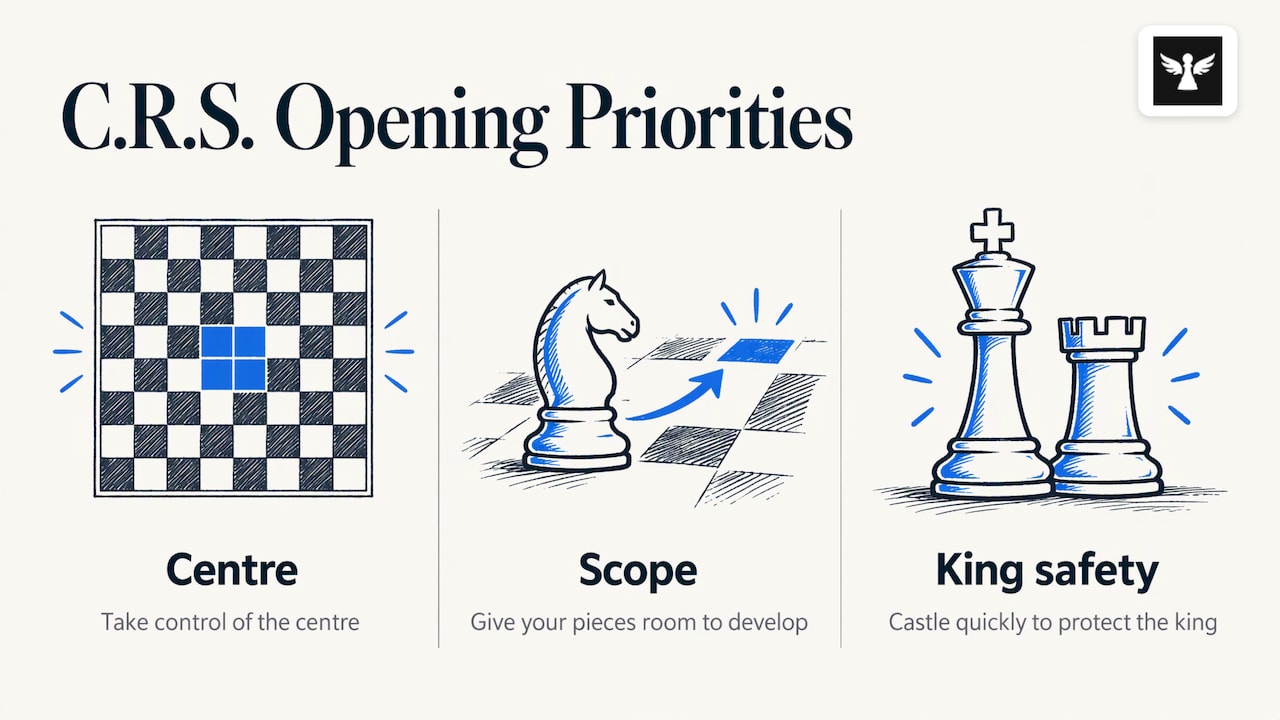
Coach Philippe Dornbusch condenses the same thinking into a mnemonic, C.R.S.: Centre (take it), Rayonnement (give your pieces scope, following Tarrasch’s precepts) and Sécurité du roi. Whichever formula you prefer, the content is identical.
Control the center
The central squares e4, d4, e5 and d5 let your pieces reach both wings quickly. A pawn on e4 or d4 claims space and opens lines for your bishop and queen. You can also control the center from a distance with pieces, which is the idea behind many modern setups. What matters is that you contest the center on purpose, not by accident.
Develop with purpose
Every move in the opening should either bring a new piece into play or support something that does. Dornbusch’s practical advice for beginners, from his guide to mastering openings, is to limit yourself to two pawn moves at most at the start, develop knights and bishops first, give every pawn a purpose, secure the king, and avoid moving the same piece several times without a serious reason.
A simple self-check before each move: which of my pieces is still doing nothing? If the answer is “several”, a pawn grab or a second queen move is probably the wrong choice.
Make your king safe
Castling does two things at once: it tucks the king behind pawns and brings a rook toward the center. Beginners lose a surprising number of games by leaving the king in the middle while the position opens. As one coach puts it in a list of beginner errors, the simplest rules are to control the middle, develop, and castle. The same author adds the necessary nuance: look at what your opponent’s last move threatens before you follow the rules automatically.
A move-by-move routine for beginners
Principles are only useful if you can apply them at the board. Here is a routine that works for most games below intermediate level.
- Move 1: play a central pawn (1.e4 or 1.d4 with White; a central reply with Black).
- Moves 2 to 4: bring out both knights, then the bishops, toward the center or toward the opponent’s king side.
- Moves 4 to 7: castle, usually on the king side.
- Moves 7 to 10: connect the rooks, put them on open or semi-open files, and bring the queen out only when it has a target.
- Every move: ask what your opponent’s last move threatens and whether it breaks one of your plans.
The last step is what separates a player who knows the principles from one who survives with them. An opponent who hits a pawn, pins a knight or opens a file forces you to adapt. Principles are the default, not a script.
Openings with clear plans for beginners
You do not need a long list. You need a few setups whose plans you can state in one sentence. Here are four widely played ones.
| Opening | Typical first moves | Core idea |
|---|---|---|
| Italian Game | 1.e4 e5 2.Nf3 Nc6 3.Bc4 | Quick development, pressure on f7, later d4 prepared by c3 |
| London System | 1.d4, then Bf4, e3, Nf3, c3 | A solid, repeatable setup with White against many replies |
| Queen’s Gambit | 1.d4 d5 2.c4 | Challenge Black’s center and fight for space |
| French Defense | 1.e4 e6 | A solid pawn chain, with Black counterattacking the white center |
The Italian Game, also called Giuoco Piano, starts with 1.e4 e5 2.Nf3 Nc6 3.Bc4 and is popular because its aims are easy to read: central control, fast development, early attacking chances. The push d4 is normally prepared with c3.
If you prefer a setup that looks similar in many games, the London System is a good example: its moves, plans, variations and traps are laid out on one page, so you can see the structure you are aiming for before you play it.
Why the same few openings are enough
The DEFFE thesis on choosing and building an opening repertoire cites John Watson’s idea of cross-pollination: if your openings lead to similar types of positions, the preparation you do for one theme helps in another, and you will master those themes better because you meet them more often. A coherent repertoire is not just easier to memorize. It is easier to understand.
Building a repertoire for White and Black
The same thesis says a repertoire should fit the player: your level, the type of position you are comfortable in, and the time you can give to study. That means no universal “best” repertoire exists. There is a best one for you.
For most players below 1500 Elo, the French site Les échecs en vidéo suggests keeping opening work to the principles (center, development, king safety) plus a minimal repertoire:
- one answer to 1.e4,
- one answer to 1.d4,
- one color as White, with two or three lines against each main defense.
The time you save is better spent on tactics. This is practical advice: a rook-winning fork you spot on move 12 is worth more than ten extra moves of theory you do not understand.
A simple way to choose
- Pick a style. Do you like open, tactical positions or closed, strategic ones? Choose openings that lead to what you enjoy.
- Pick one system per situation. One setup against 1.e4, one against 1.d4, one first move as White.
- Check what you actually face. The lines your opponents play against you matter more than the ones in a book. Your last games show them.
- Keep it small until it is stable. Add a second line only when the first one is automatic.
You can see how a structured repertoire with variation trees is organized in our guide to building a chess opening repertoire.
Remembering moves while understanding the strategy
Pure memorization breaks the moment your opponent deviates. Understanding is what lets you improvise. Here is how to combine both.
- Attach a sentence to every move. “Bishop to c4 aims at f7.” “c3 prepares d4.” If you cannot write the reason, you do not know the move yet.
- Learn structures, not only lines. The same pawn structure shows up after different move orders. Learn the plans for it once.
- Recall actively. Cover the move and play it from memory rather than rereading a list. Active retrieval is what makes the line stick. We go deeper in how to practice chess openings so they stick and in a method to learn chess openings that lasts.
- Repeat at spaced intervals. Review a line the next day, then a few days later, then a week later, rather than five times in one evening.
- Learn the first deviation. The most valuable moment in a line is the point where opponents most often leave it. Know your answer there.
Opening mistakes to avoid
These are the habits that cost games at beginner and intermediate level.
- Moving the same piece repeatedly. Each extra move with one piece is a tempo your opponent uses to develop. Dornbusch’s advice on openings is explicit on this point.
- Bringing the queen out early. The queen becomes a target and you lose time chasing around. Masterclass guidance lists it among the basic rules.
- Neglecting the king. Leaving it in the center while lines open is a common route to a quick loss. The beginner mistakes article also warns against weakening the king with careless pawn moves.
- Following rules blindly. Castling into an attack or developing while a pawn hangs ignores the opponent’s last move. Always check the threat first.
- Memorizing without understanding. If you remember twelve moves but not why, you will be lost on move thirteen.
- Falling for known traps. Many beginner games end in a standard trick. Learn how they work in our guide to opening traps in chess and how to avoid them.
Analyzing your own opening play
The fastest source of improvement is your own games. French master Sylvain Ravot recommends, in a FFE masterclass, analyzing all your slow games, spotting errors and their causes, proposing better moves, analyzing first without a computer and using it only last. For the opening, he advises noting the main theoretical alternatives and drawing up a short summary.
A simple post-game process:
- Write down, right after the game, where you felt the game turned.
- Find the first moment you left your plan or your preparation.
- Look for a better move yourself.
- Only then check with an engine and note what you missed.
- Add the lesson to your repertoire or your list of mistakes.
The advice to think before the engine is also central to a Q&A with Artur Yusupov: he suggests writing down what you thought happened, analyzing alone, and only then turning on the computer, because training your own ability to find good moves matters more than the engine’s concrete knowledge. For a step-by-step method, see our guide to chess game review, and for engine checks see how to analyze chess openings with Stockfish.
A worked example
Suppose you play the Italian Game as White and notice in five losses that you answer an early …Nxe4 by moving your queen out. The pattern is clear: one line, one recurring problem. You analyze it yourself, find a calmer development move, check it with the engine, and then drill that exact position until the reply is automatic. That is one fix, found in one evening, that applies to every future game with that opening.
Perspective: why we build repertoires from real games
We think most opening advice fails for one reason: it is generic. A course tells you what masters play, but you lose games in the lines your opponents choose, not the ones in the course.
That is why ChessFlux builds a personalized repertoire from your last 100 games on Lichess or Chess.com. You do not set everything up by hand. Your real games show which openings you reach, where you leave your preparation and which moves cost you points.
We then compare your play with your repertoire and target the moves that need work, so your training time goes where it improves results. Add variation trees, PGN and study imports, tactics puzzles by theme or opening and Stockfish analysis, and you get a single loop: play, review, drill, repeat.
We believe progress in the opening should be measurable. If you can see which lines you now play correctly and which you still miss, you know your study is working.
Rolf
Put it into practice with ChessFlux
If you want to turn these principles into a repertoire you can actually remember, ChessFlux gives you a free app and a Premium subscription. It imports your recent Lichess or Chess.com games, builds your repertoire, and trains you move by move on the lines you really play. Beginners can start with the free features, and Premium adds options like unlimited puzzles, advanced training and more customization.
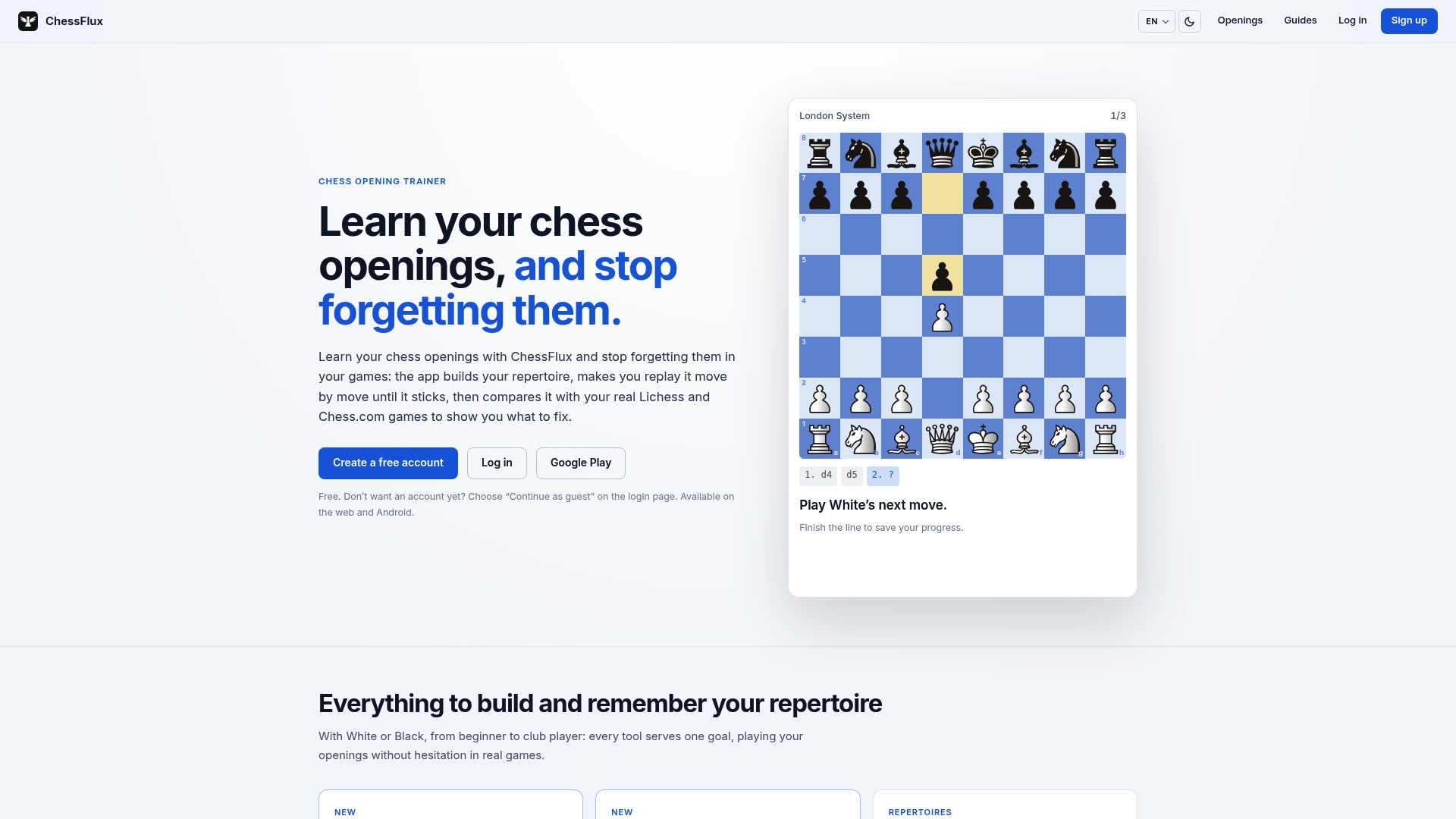
Start on the ChessFlux homepage, see how to build a repertoire from your Lichess or Chess.com games, or learn how to memorize openings with active training. When you want to sharpen tactics too, there is chess tactics training with puzzles.
Balancing openings with the rest of your chess
Opening study should not crowd out everything else. Apicella divides chess principles into opening, middlegame and endgame, and notes that opening principles are already familiar to relatively experienced players. That is a cue: once the principles are in place, the gains come from elsewhere.
A sensible weekly split for an improving amateur:
- a short daily session of tactics,
- one or two sessions of repertoire recall,
- one slow game, played and reviewed carefully,
- a little endgame and middlegame study.
For a wider plan, our article on how to improve at chess covers the full picture, and our opening guides go opening by opening.
FAQ
What is the most important opening principle?
There is no single one, but the trio of center, development and king safety covers most positions. If you can only remember one habit, check what your opponent’s last move threatens before you play your own. Principles help only when they fit the position in front of you.
How many openings should a beginner learn?
Very few. A common French recommendation for players under about 1500 Elo is one answer to 1.e4, one to 1.d4 and a short line set with White. Learn the ideas behind them well before you add anything new.
Is it better to memorize lines or understand ideas?
Both, in that order. Start with the plan behind each move, then practice recalling the moves actively. Understanding lets you handle a surprise, and memory makes your good moves fast.
Should I use an engine to check my openings?
Yes, but after you have thought for yourself. Experienced coaches advise analyzing your game alone first and turning on the computer last, so that you train your own judgment and not only collect the engine’s answers.
How can I find the openings I actually need to study?
Look at your recent games. The openings you reach most often and the points where you leave your preparation are your priorities. Importing your last games into a tool that builds a repertoire from them makes this quick.
Sources
- Masterclass FFE, 8 May 2020, GMI Manuel Apicella
- 10 principes pour les ouvertures aux échecs, Echecs & Stratégie
- Maîtriser les ouvertures pour les débutants, Echecs & Stratégie
- Choix et construction du répertoire d’ouvertures, DEFFE thesis
- Comment progresser aux échecs, Les échecs en vidéo
- Masterclass FFE, 8 February 2019, MF Sylvain Ravot
- Q&A with Artur Yusupov, Quality Chess, 2013
- Avoid These Mistakes Beginner Chess Players Make
- L’ouverture Italienne aux échecs : le guide complet