The fastest way to learn chess openings is to pick a small repertoire, understand the plan behind each line, then drill only the positions that actually come up in your own games. Memorizing long variations you never reach is the most common waste of study time. A short, well-chosen repertoire that you understand, review regularly and correct after every bad game will do more for your results than a stack of theory you forget within a month.
This guide walks through that method step by step, for beginners and intermediate players: how to choose, how to study, how to memorize, and how to use your own games as the syllabus.
TL;DR
- Choose few openings, matched to your level, your style and the time you really have. Grow the repertoire slowly instead of switching often.
- Learn the ideas first (pawn structures, piece placement, typical plans), then the moves that serve them.
- Alternate study with practice games, then go back and check the lines that went wrong.
- Review in short, regular sessions, and test yourself by recalling a line without looking at it.
- Let your last games tell you what to study: the positions you reach and the moves where you leave your preparation.
Table of Contents
- Start with ideas, not move lists
- Choose a small repertoire that fits you
- A study loop that works
- How to memorize openings and keep them
- Use your own games as the syllabus
- Our perspective
- A simple weekly routine
- Common mistakes to avoid
- Try it on your own games
- FAQ
- Sources
Start with ideas, not move lists
A move list without a reason behind it breaks the first time your opponent deviates. The player who knows why a knight belongs on f3 or why a pawn break is coming can find a sensible move in a position they have never seen.
Grandmaster Andy Soltis, quoted in a US Chess review of a book on the French Defense, argues that you should first get a clear verbal description of what the opening is trying to do, and focus on words and ideas before moves. Annotated games help for the same reason: they show the plans in action without burying you in variations.
A French thesis on building an opening repertoire, published by the French chess MOOC, gives the same advice: learn the ideas and plans of an opening through verbal descriptions and commented games, play it in practice games, then check the theory of the lines that gave you trouble before going deeper.
In practice, before you memorize anything, be able to answer these questions in a sentence or two:
- Where do my pawns want to go, and which pawn breaks matter?
- Where do my pieces belong, and which ones do I want to trade?
- Where does my king go, and when?
- What is my opponent trying to do, and how do I slow it down?
If you cannot answer them, you are not ready to drill the moves. Read an annotated game in the opening, play through it with a board, and write your answers in your own words. Our chess opening guides and the page on variations, plans and traps are built around this idea-first approach.
Choose a small repertoire that fits you
The first real decision is which openings to learn. The French thesis cited above says the choice should reflect your level and experience, your style, the kinds of positions you understand and enjoy, the time you can devote to study, and your capacity to memorize. It also advises enriching a repertoire gradually rather than changing it too often.
That last point matters more than it looks. Every time you drop an opening, you throw away the understanding you built. A line you have played fifty times, even a slightly dubious one, usually serves you better than a fashionable line you have played twice.
How big should it be?
There is no official number, so treat this as our practical suggestion rather than a rule:
| Your situation | A workable repertoire | Depth to aim for |
|---|---|---|
| Beginner, a few hours a week | One setup as White, one answer to 1.e4 and one answer to 1.d4 as Black | Principles first, then a handful of moves per line |
| Improving player, regular training | One main line as White plus a backup, two or three defenses as Black | Main lines plus the common side-variations you meet |
| Intermediate, several study sessions a week | A fuller tree for each color, with answers to the moves your opponents actually play | Deeper lines, plus the plans that arise when you leave theory |
The thesis adds that beginners should concentrate on opening principles, development, the center and tactics, and move to more complex openings as they progress. Time is part of the choice too: a sharp opening with many forced lines demands more upkeep than a solid setup with clear plans.
Match the opening to the positions you enjoy
If you love open tactical positions, a quiet system built on slow maneuvering will bore you and you will stop studying it. If you dislike memorizing long forcing sequences, avoid openings where one inaccurate move loses on the spot. Ask yourself after a few games whether you liked the positions you got. That answer is worth more than any ranking of “best openings for beginners”.
You can see which openings you actually play by looking at your recent games. We cover how to turn that into a structured plan in our guide to building a chess opening repertoire.
A study loop that works
Most players study in one direction: read, memorize, hope. A better routine is a loop.
- Learn the idea. Read a short description or an annotated game of the opening.
- Learn a few moves. Only the main line and the one or two most common deviations.
- Play it. Use practice games and fast games where a loss costs nothing. The French thesis recommends testing openings in blitz.
- Check what went wrong. Consult a book or a database when you meet an unfamiliar position. Look specifically at the lines that gave you trouble.
- Go deeper. Only now add more theory, and only where your games show a need.
This is the same cycle US Chess describes: study, play low-stakes games, verify the problem lines, then study more deeply. The review also points out that forgetting or misplaying a variation in a real game helps you remember it afterward. A mistake is not a failure of the method. It is the method working.
The thesis also recommends studying reference games and doing tactical exercises drawn from your own openings. Tactics from your openings are especially useful because they train the patterns that decide those exact positions: the sacrifice on f7, the fork after a pawn grab, the pin on the e-file. Our tactics training and puzzles can be filtered by theme or by opening for this purpose.
Reading model games the right way
A model game is not a story to enjoy once. Use it like this:
- Play it through on a real or digital board, not just by scrolling.
- Stop at each of the first 10 to 15 moves and predict the next one.
- Note the move where the game leaves the “book” and what each side is aiming for afterward.
- Write one sentence summarizing the plan for each side.
Conceptual study of games, with attention to recurring patterns and the logic of positions, is a systematic way to absorb an opening. It is slower than copying a list of moves, and it sticks far better.
How to memorize openings and keep them
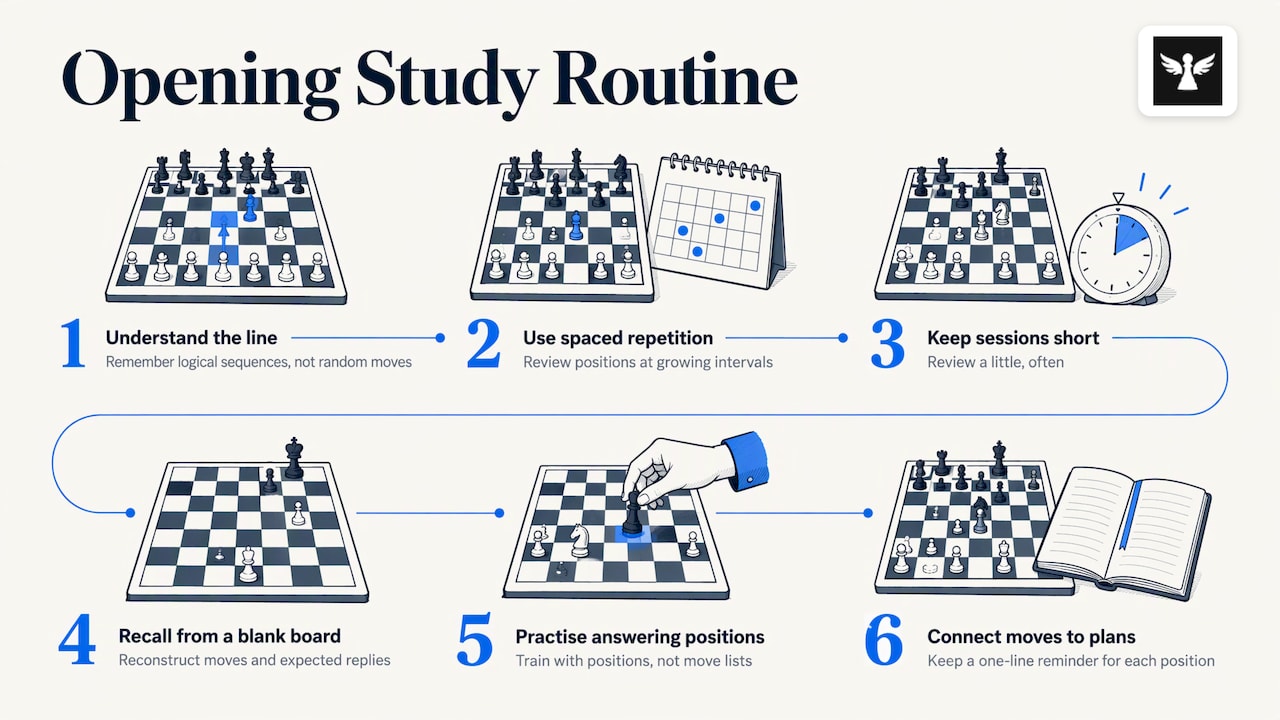
Once you understand a line, memorization becomes much easier, because you are remembering a logical sequence and not random moves. Still, you need a method to make it last.
Understand before you repeat. Spaced repetition, which means reviewing a position at growing intervals, works best on lines you already understand. If you drill something you do not understand, you are only storing a pattern that collapses when your opponent varies.
Review a little, often. Short daily sessions beat one long weekly cram. If your daily review keeps growing until it eats your whole study time, you are adding lines faster than you can retain them. Slow down, and add new material only when the review queue is under control.
Recall from a blank board. Close the course, set up the starting position, and try to reconstruct a line from memory, both your moves and the replies you expect. Then compare with your notes, an engine or a study to find the gaps. The gaps are exactly what you should drill next.
Memorize move by move, in context. Train the line as a sequence of positions you have to answer. That is what happens in a real game: you see a board, not a list. If you want a deeper routine, see our article on how to practice chess openings so they stick.
Link moves to plans. For each position in your repertoire, keep a one-line reminder of the plan. When you forget the exact move, the plan often points you to it.
Use your own games as the syllabus
The most efficient shortcut in opening study is to stop guessing what you need. Your games tell you.
Look at your last 50 to 100 games and answer three questions:
- Which openings do I actually reach, as White and as Black?
- At which move do I leave my preparation, and what did my opponent play?
- In which lines do I lose points, either on the board or on the clock?
You will usually find that a small number of positions account for most of your trouble. A rare sideline you prepared for hours never appears, while a common move order you never studied shows up every week. Study that one.
Doing this by hand is tedious, which is why most players never do it. ChessFlux automates it: the app builds a personalized repertoire from your last 100 games on Lichess or Chess.com, compares what you really play with that repertoire, and points to the moves to improve. You can read how that import works in our guide to building a repertoire from your Lichess or Chess.com games and how the game debrief compares your openings with your repertoires.
To check a line more deeply, an engine helps, as long as you use it to understand and not just to copy. Our page on analyzing chess openings with Stockfish explains how to read the evaluation and ask why a move works.
Our perspective
Most opening advice starts from the wrong place. It starts from a list of “the best openings” and asks you to memorize them. But the opening that matters most is the one that shows up in your games next week.
That is why we built ChessFlux around your real games. We think the best repertoire is not the most fashionable one but the one that fits the positions you reach, and that grows from the mistakes you actually make. Building it automatically from your last 100 games on Lichess or Chess.com removes the setup work that makes many players give up after two evenings.
We also believe in training move by move, with targeted repetition on the positions where your results show a weakness, instead of generic courses that treat every player alike. When your practice follows your own data, progress becomes something you can measure: lines you used to miss become lines you play without thinking.
Understanding still comes first. Use the app to drill, but read the plan behind each line, and play it often. That combination is what makes an opening yours.
Rolf
A simple weekly routine
Here is a template you can adapt. It assumes about three to four hours of chess study a week; scale it down if you have less.
- Session 1, ideas (about 45 minutes): Read one annotated game in the opening you are learning and write the plan for each side in a sentence.
- Session 2, lines (about 30 minutes): Add a few new moves to your repertoire, only along main lines and the common deviations.
- Sessions 3 and 4, review (10 to 20 minutes each): Drill the positions you struggle with and do one blank-board recall of a line.
- Play (several fast games): Use your repertoire, with no pressure on the result.
- Session 5, debrief (about 30 minutes): Open the games, find where you left your preparation, and list two or three lines to fix next week.
The rhythm matters more than the exact numbers. If you want to fit openings into a broader plan with endgames, tactics and game review, our weekly chess study plan shows how, and the article on how to improve at chess covers the bigger picture.
Common mistakes to avoid
- Learning too many openings at once. Depth in a few lines beats shallow knowledge of many.
- Switching after one bad result. A single loss is rarely a verdict on an opening. Check the game first.
- Memorizing past the point where you play. Prepare the lines you reach, not the ones you might reach in a tournament someday.
- Ignoring the middlegame. An opening is a way into a position. If you do not know what to do once the theory ends, your preparation is only half done.
- Copying engine moves blindly. An engine tells you what is best, not why. Ask why, and write the answer down.
- Skipping tactics. Most opening disasters are tactical, so train patterns that occur in your own lines.
Try it on your own games
If you play on Lichess or Chess.com, you can skip the manual setup. ChessFlux builds a personalized repertoire from your last 100 games, lets you train it move by move, and shows where your real games depart from it. The core features are free, and a Premium subscription unlocks extras such as unlimited puzzles, advanced training and more customization.
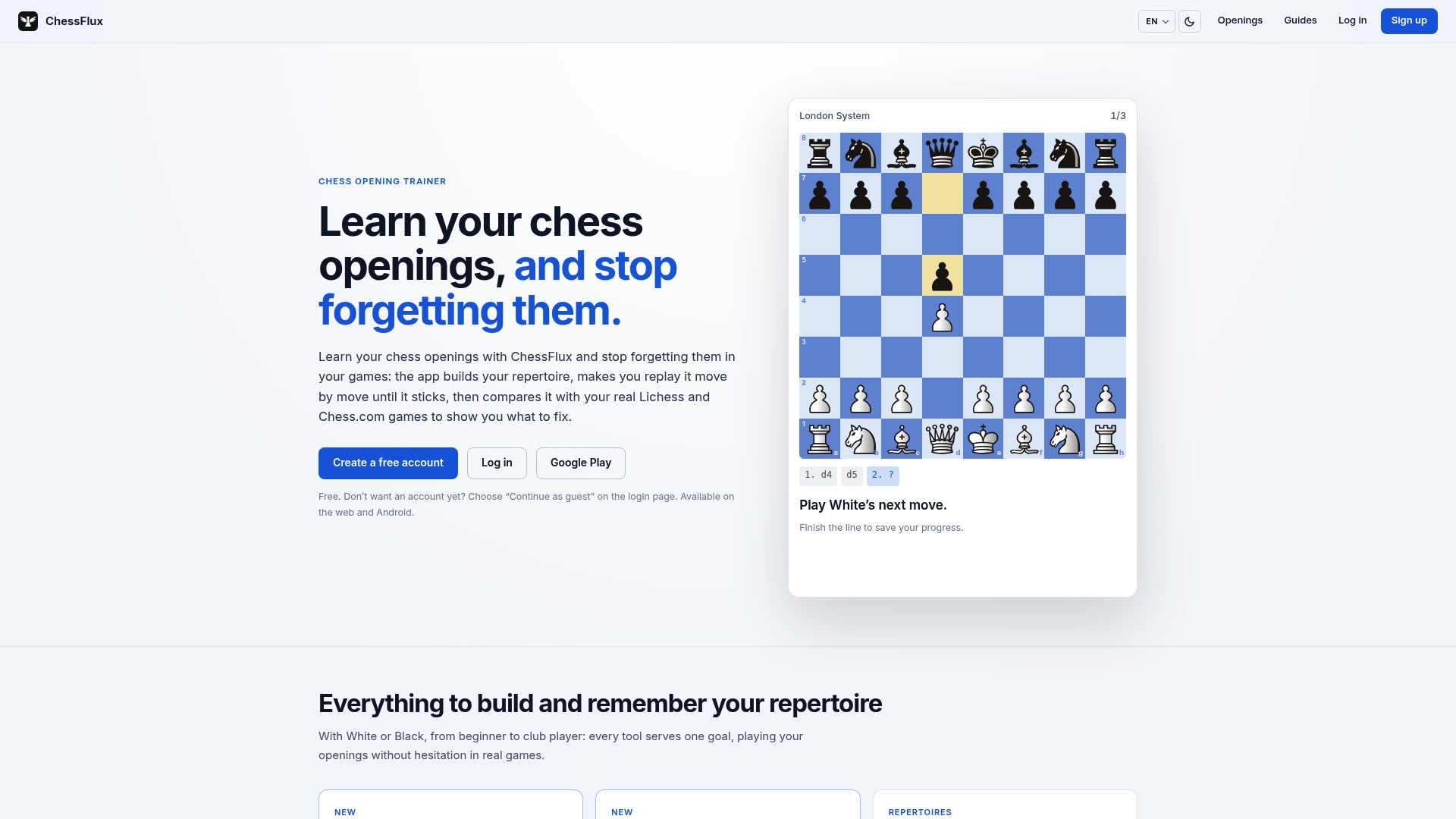
Start with your own games on ChessFlux and see which openings deserve your next study session.
FAQ
How many chess openings should a beginner learn?
As few as you can manage: one setup as White, and one answer each to 1.e4 and 1.d4 as Black is a sensible start. Concentrate on development, the center and tactics before deep theory. You can add variations to the same openings as you improve, which is what the French research on repertoire building recommends instead of changing openings often.
Should I memorize moves or understand the ideas?
Understand first, then memorize. A clear verbal description of what the opening is trying to do, plus a few annotated games, gives the moves a purpose. Repetition is far more effective once the ideas are clear, and it lets you find a good move when your opponent leaves the book.
How long does it take to learn an opening?
It depends on your time, your memory and how deep you go. You can learn the basic plan and the main line of an opening in a few sessions, but it usually takes many practice games before it feels natural. Expect to keep refining it as you find the lines that trouble you.
How do I remember openings I keep forgetting?
Review in short, regular sessions, and try recalling a line from a blank board before checking your notes. Look at the gaps, understand the idea behind the forgotten move, and then repeat it. Slow down on new material if your review pile keeps growing.
Can I use my own games to study openings?
Yes, and it is one of the most efficient methods. Your games show which positions you really reach and where you leave your preparation. ChessFlux imports your last 100 games from Lichess or Chess.com and builds your repertoire and training from them.
Sources
- Choix et construction du répertoire d’ouvertures (French chess MOOC)
- How to Really Learn an Opening, review of First Steps: The French (US Chess)