A good chess study plan is short, repeated every week and built from your own games. Split your time between tactics, playing slow games, reviewing those games, and one focus area (often your openings). Then adjust the plan using the mistakes your games actually show, not a generic list.
This guide gives you a template you can start this week, explains how to divide your time, and shows how to study openings so they stay in your head. It is written for beginners and intermediate players, including people who play on Lichess or Chess.com and want a routine that fits real life.
TL;DR
- Build your week around four blocks: tactics, slow games, game review and one focus topic. Short, regular sessions beat one long weekend binge.
- Review every slow game, first without an engine, and note where you spent too much or too little time.
- Learn openings through plans, pawn structures and model games first, then fix the lines that cost you points in real games.
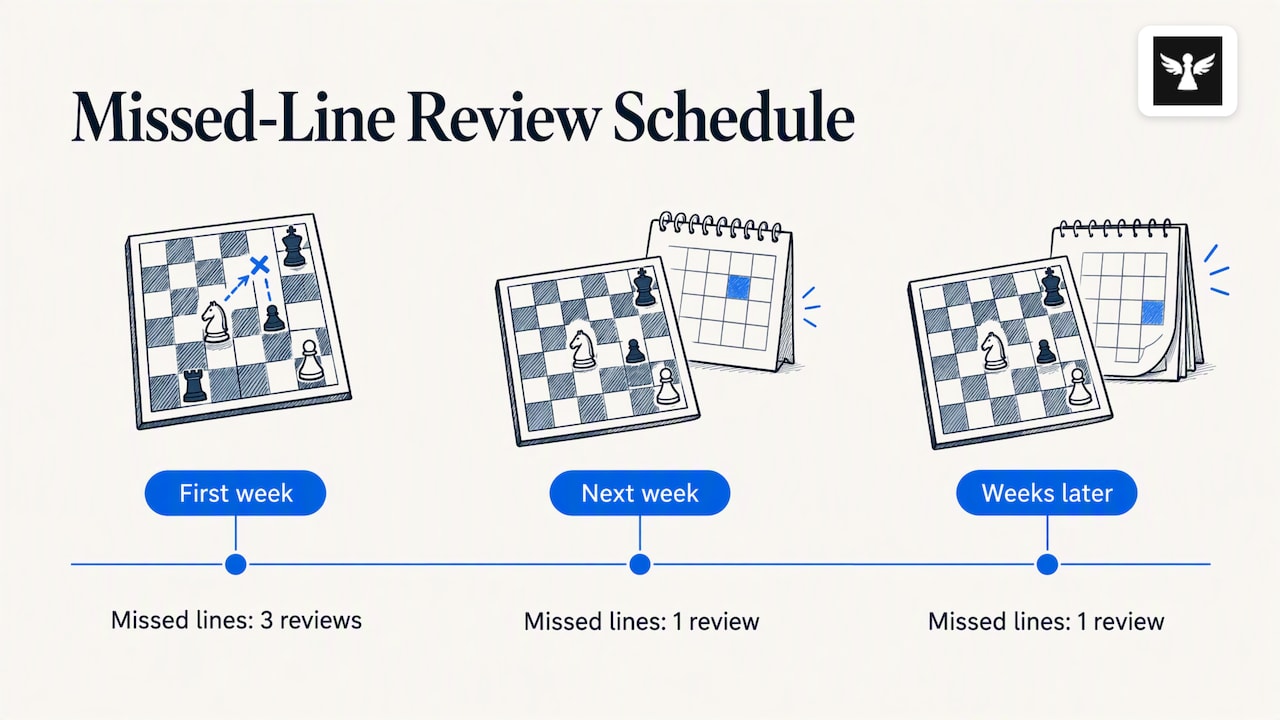
- Revisit missed lines sooner and correct ones later (spaced repetition), and apply each topic in a game right after studying it.
- Judge the plan by your own results over several weeks: fewer repeated mistakes, fewer opening problems, steadier time use.
Table of Contents
- Why most study plans fail
- Start with your level and your time
- A weekly template you can copy
- Divide your time among tactics, openings, endgames and review
- Review your games like a coach would
- Study openings without just memorizing them
- Analyze your opening performance
- Turn your Lichess or Chess.com games into your plan
- Our perspective
- Try it on your own games
- How to tell whether your plan is working
- Common questions about building a study plan
- Sources
Why most study plans fail
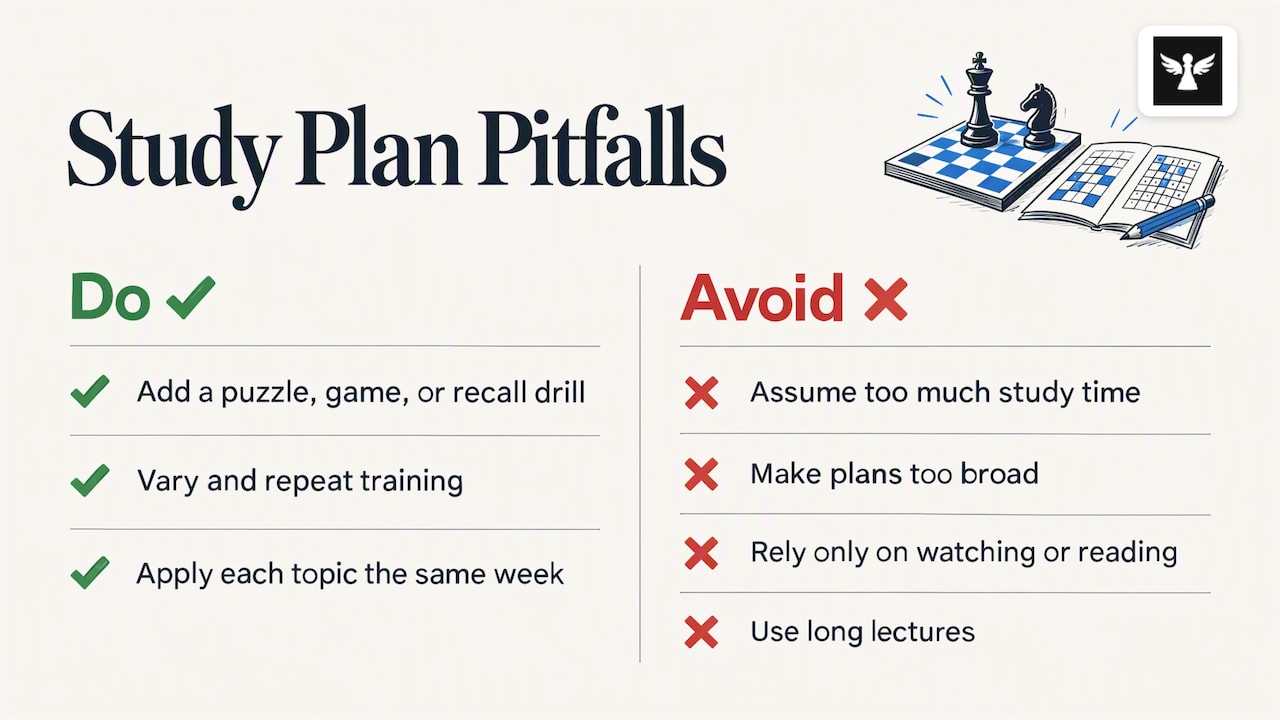
Most plans fail for boring reasons. They assume too much time, they are too broad, or they are made of passive activity: watching a video, reading a chapter, nodding along. Then life gets busy, the plan collapses, and you start again from zero.
The French Chess Federation’s pedagogical guide, École d’échecs à la française, warns that cognitive overload, such as long lectures, works against learning. It describes attention, memorization and deep understanding as built through training that is interactive, varied and repetitive. That is a useful filter for your own plan: if a session is only listening or reading, add something you have to do, such as a puzzle set, a position to play out, or a move you must recall.
The same logic appears in a training thesis by Pascal Aubry, a coach affiliated with the French federation. He stresses alternating structured explanation, active exercises, practice and questions. In practice: every topic you read about should be applied the same week, in a puzzle, a training game or a recall drill.
Start with your level and your time
Before choosing exercises, answer two questions honestly: where are you, and how many hours do you really have?
Know your level
Your rating, on Lichess, Chess.com or in a club, is a rough guide to what to prioritize. In France, the federation’s diploma system, from the “pion de bronze” up to the “roi d’or”, links levels of play to estimated Elo ranges and to training goals such as tactical complexity and endgame technique. The exact details are worth reading if you train with a club, but the idea is simple: the goals change as you improve.
As a working rule for planning (our own suggestion, not a federation standard):
- Beginner: most of your time on tactics and basic endgames, plus playing games and checking why you lost.
- Intermediate: keep tactics, but give more room to game review, structured opening work and strategy (pawn structures, piece activity).
Know your time
Pick a number you can keep when you are tired. Three 30-minute sessions and one longer weekend session beats a plan of two hours a day that lasts nine days. If you only have 20 minutes on a weekday, do a single thing: a puzzle set or a recall drill.
A weekly template you can copy
This template is a starting point, built from the principles above: active practice, slow games, review, and one focus topic at a time. Scale the minutes up or down.
| Day | Block | Suggested time | What you do |
|---|---|---|---|
| Monday | Tactics | 20 to 30 min | A set of puzzles, slowly, calculating before you move |
| Tuesday | Focus topic | 30 min | One opening, one endgame or one pawn structure |
| Wednesday | Tactics | 20 to 30 min | Puzzles, ideally themes you miss often |
| Thursday | Slow game | 45 to 60 min | One game at a slow time control |
| Friday | Game review | 30 to 45 min | Analyze Thursday’s game, then note takeaways |
| Saturday | Focus topic + recall | 30 to 45 min | Apply Tuesday’s topic, repeat missed opening lines |
| Sunday | Rest or light play | Optional | Casual games, no pressure |
A few notes on how to use it.
Tactics. Short and frequent works best. Choose puzzles by theme (forks, pins, back-rank ideas) or by opening, so what you practice also appears in your games. Our tactics training and puzzles guide explains how to organize that.
Slow games. Blitz is fun, but if it is the only thing you play, you rarely practice thinking carefully. Include games with time to think, such as 15+10 or slower, and treat them as the raw material for your review.
Focus topic. Choose one area for several weeks, then change. Spreading yourself across six topics means none of them sticks.
Divide your time among tactics, openings, endgames and review
There is no official formula for the ideal split, and anyone who gives you an exact percentage is guessing. What you can do is choose a starting split and adjust it using your own games.
- Beginners: tactics and playing slow games take the biggest share. Add short endgame sessions (king and pawn endings, basic mates) and a few minutes of opening principles.
- Intermediate players: keep tactics steady, then move time toward review and a rotating focus topic. If you keep reaching bad positions by move 12, openings deserve the focus slot.
The French federation’s teaching material lists areas to keep in mind when looking at positions: material, piece activity, king safety, pawn structure and combinations. That list works well as a checklist during review. When you look at a critical position from your game, run through it in order and see which item you missed.
Review your games like a coach would
Review is the part of a plan most players skip, and it is where most of the learning is. Game review turns a result into information.
At a federation masterclass in 2019, the French Chess Federation advised analyzing all your slow games to find the causes of errors, assess your opening choices and look for tactical or strategic improvements, preferably without computer help first. Here is a simple routine based on that advice:
- Replay the game on a board or screen, without an engine. Mark the moments where you were unsure, surprised or lost the thread.
- Look at your clock. The same masterclass recommends noting your remaining thinking time during the game to see phases where you spend too much or too little. If you burned ten minutes on move 8 in a position you should know by heart, that is an opening gap. If you rushed a critical middlegame decision, that is a time management gap.
- Write down the cause of each mistake, not only the better move. Was it a calculation slip, a missed tactic, a plan you did not know, or a line you forgot?
- Only then run the engine to check your conclusions and find what you missed.
- Pick one or two lessons, and feed them into next week’s focus topic or puzzle themes.
For a deeper walkthrough, see our guide on how to analyze your games for free, and our broader article a practical plan to improve at chess.
Study openings without just memorizing them
Openings are where plans most often go wrong. Beginners try to memorize twenty moves of theory and forget everything by the first surprise. Intermediate players collect lines without understanding them.
Understand first, memorize second
A French federation thesis on choosing and building an opening repertoire recommends that a beginner focus on general principles, tactical and positional themes, pawn structures, plans and model games rather than mechanical memorization. It also suggests testing the opening in practice and checking the unfamiliar situations that come up.
So for each opening in your repertoire, begin with:
- the typical pawn structure and where the pieces belong,
- the two or three plans both sides usually follow,
- one or two model games,
- only then, the main lines and the most common traps.
If you play 1.d4 and like a solid setup, our London System guide shows the moves, plans and traps in that logic. If you face 1.e4 and want a sturdy reply, the French Defense guide does the same for Black.
A study, practice, check cycle
US Chess, summarizing a method by Grandmaster David Smerdon, describes reading the introductions and illustrative games, playing the opening in training games, checking the variations that gave you trouble, playing serious games, and then deepening the theory step by step. The key idea is that mistakes and memory lapses in real games give you a context that makes lines easier to remember.
That gives you a clean opening loop for your weekly plan:
- Study a small piece of an opening (one variation, not the whole tree).
- Play it in a game.
- After the game, check where you deviated or got confused.
- Fix exactly those positions, and repeat.
Use spaced repetition for the lines you forget
Spaced repetition means showing you the positions you missed more often and the ones you got right less often. A chess writer describing the method notes that it can be applied to tactics or opening cards, but works best combined with thinking, visualization and game analysis, and that you should follow it for several weeks before changing. Treat it as a tool for retention, not a replacement for understanding.
A simple version without any software: keep a list of the lines you missed, drill those three times in the first week, then once the next week, then once a few weeks later.
Analyze your opening performance
To know which opening moves deserve study time, you need to look at what happens in your own games. The federation masterclass describes the process: check your moves against theoretical alternatives, consult Grandmaster games, and judge whether the middlegame that resulted was good for either side.
Over a batch of games, ask these questions:
- Which openings do I reach most often, and what is my score in each?
- At which move do I leave my preparation, and who benefits?
- Which positions cost me the most time on the clock?
- Do I lose because of the opening itself or because I misplay the middlegame it leads to?
If you want an engine second opinion on a specific line, our Stockfish opening analysis guide explains how to use it without just copying its top move.
Turn your Lichess or Chess.com games into your plan
Generic plans written for a rating band cannot know that you always lose a tempo in the same Caro-Kann line, or that you keep stumbling on one gambit. Your game archive can. Your last games hold the most relevant study material available: your real opening choices, your real deviations and your real errors.
A do-it-yourself routine:
- Export or open your last 20 to 50 games from your platform.
- Sort them by opening and count how often each appears.
- Mark the first move where you left your preparation or lost the evaluation.
- Build a short list of five to ten positions to repeat in your recall sessions.
This works, but it takes effort. That is the gap we built ChessFlux to close.
Our perspective
We built ChessFlux around one belief: the best opening study plan is the one that starts from the games you actually play. Most players do not need another generic course. They need to know which of their own lines break down, and to practice those positions until they hold.
That is why the app builds a personalized repertoire from your last 100 games on Lichess or Chess.com, lets you train it move by move, and compares what you really played with what you intended to play. Instead of guessing which opening to study this week, you see the moves to improve and work on them.
A plan should also be measurable. When your practice sessions come from your own games, you can see whether the same mistakes keep returning or fade, and you adjust accordingly. That is the kind of progress we want every beginner and intermediate player to be able to see.
Rolf
Try it on your own games
If you want the opening block of your plan to run itself, ChessFlux has a free tier with the core features and a Premium subscription for more advanced training and customization. You connect your Lichess or Chess.com account, and the app builds your repertoire from your recent games, sets up targeted repetition and points out the moves that need work.
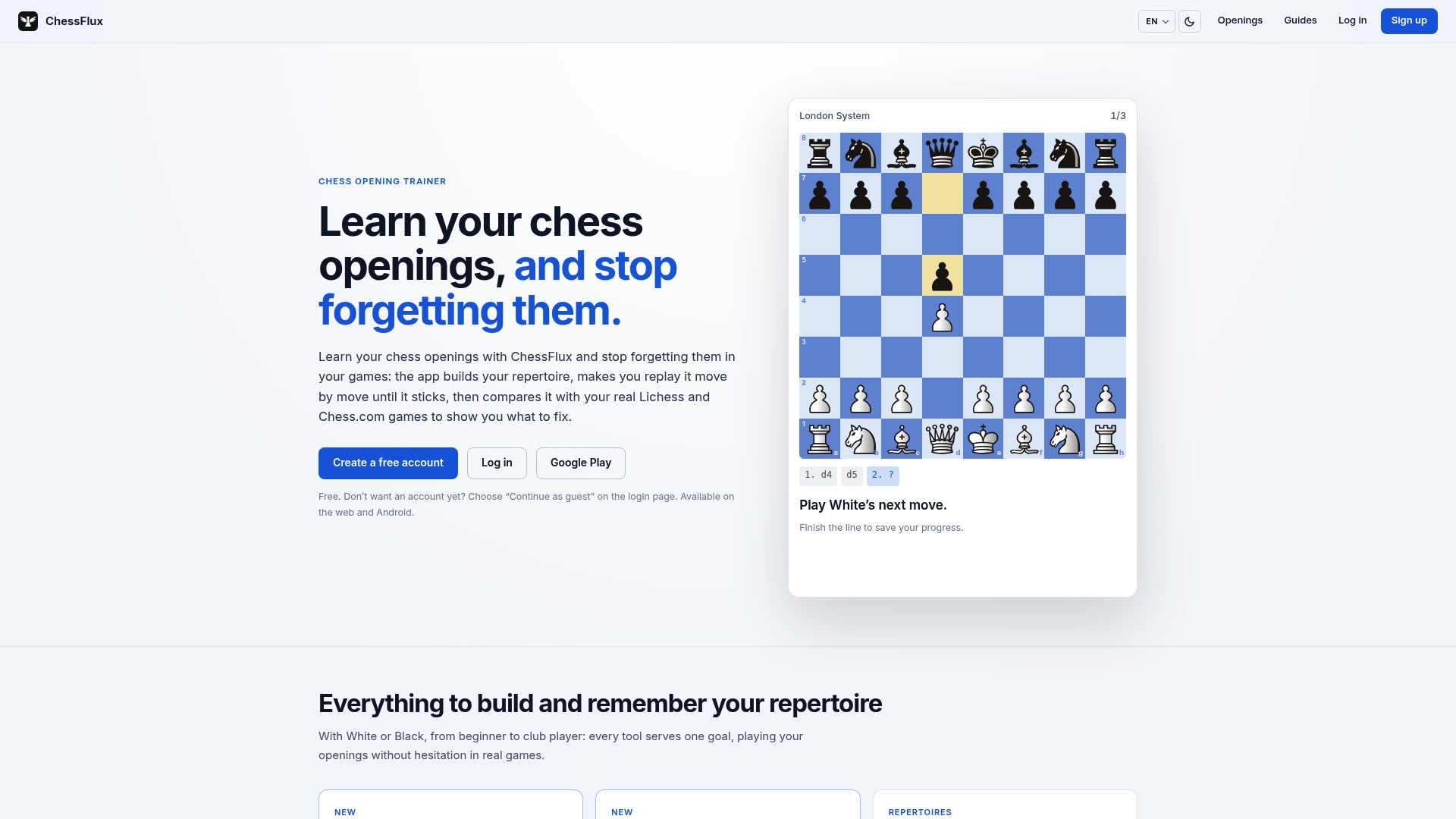
Start on the ChessFlux home page, or read how to build a repertoire from your Lichess or Chess.com games and how the game debrief compares your openings with your repertoires. For the memorization side, see our guide to memorizing chess openings with active training.
How to tell whether your plan is working
Do not judge your plan by your rating alone. Ratings move in streaks, and a few weeks of data can mislead. Track process indicators instead:
- Repeated mistakes. Are you making the same errors, or new ones? New mistakes are a sign of progress.
- Opening outcomes. Do you leave your preparation later, and reach playable positions more often?
- Time use. Following the federation’s advice to note your remaining time, check whether you still burn minutes early and arrive short of time late.
- Puzzle accuracy by theme. If forks are now easy and pins are not, shift your puzzle themes.
- Consistency. How many planned sessions did you actually complete? A plan you complete 80 percent of the time is a good plan.
Give any change at least several weeks. Then keep what works, cut what you skip, and change one thing at a time. Our guide to tracking chess opening progress shows how to follow your results over time.
Common questions about building a study plan
How many hours a week should I study chess?
There is no official figure, and it depends on your goals. A realistic start for most adults is three to five short sessions a week, around 30 minutes each, plus one slow game. Choose an amount you can keep for months, then raise it only when the habit is stable.
Should I study openings or tactics first?
For most beginners, tactics come first because they decide so many games at lower levels. Opening work still deserves a small, steady slot: learn principles and one simple repertoire, then deepen it with your own games. Intermediate players can give openings a rotating focus slot when their reviews show repeated opening trouble.
Do I need an engine to review my games?
Yes, but use it second. The French federation advises analyzing your slow games yourself first, to understand your own thinking, and checking with a computer afterward. That order shows you why you made the mistake, not only what the better move was.
How do I remember opening lines for longer?
Play them in real games soon after studying them, revisit the lines you missed more often than the ones you got right, and learn the plans behind the moves. Memory sticks better when a line is attached to a position you actually reached and a mistake you actually made.
Sources
- École d’échecs à la française, FFE pedagogical guide
- Méthodes d’entraînement, Pascal Aubry
- FFE diplomas and training goals by level
- FFE masterclass of 8 February 2019
- Choix et construction du répertoire d’ouvertures
- How to Really Learn an Opening, US Chess
- L’entraînement par répétitions espacées