
The best defense against 1.d4 is the one you can understand, remember and play comfortably game after game. For most club players that means choosing between a solid classical setup with 1…d5 and a flexible Indian setup with 1…Nf6, then learning one pawn break and one repertoire tree well. This guide compares the main choices, explains what each one asks of you, and shows how to lock your choice into memory.
TL;DR
- 1.d4 fights for the center and slows Black’s development, so every good reply either controls e4 or challenges the d4 pawn.
- 1…d5 is the classical, easiest-to-grasp answer. 1…Nf6 is more flexible but needs more attention to move orders.
- Learn each defense through its characteristic pawn break (…c5, …e5) rather than through endless variations.
- Pick a setup that is simple to learn, still playable if you forget theory, and awkward for your opponent.
- Train from your own games: the lines you actually meet matter more than the ones in a book.
Table of Contents
- What 1.d4 is trying to do
- Black’s main replies at a glance
- 1…d5: the classical answer
- 1…Nf6: the Indian family
- Other replies: Dutch, Old Benoni, Horwitz
- Which defense should you choose?
- Learn the pawn break, not just the moves
- Common mistakes against 1.d4
- How to memorize your defense
- Build and train your repertoire with ChessFlux
- FAQ
- Sources
What 1.d4 is trying to do
With 1.d4, White grabs space in the center. The pawn controls c5 and e5, the queen looks down the d-file, and the bishop on c1 gets an open diagonal (Chess Strategy 101). It is the second most common first move after 1.e4, and Queen’s Pawn games tend to be less forcing, more closed and more positional (King’s Repository).
The useful way to see it: 1.d4 aims more at slowing down Black’s development than at speeding up White’s. If Black ignores the center, White plays 2.e4 and enjoys a big two-pawn center with room to develop. So Black’s job in the first moves is simple to state: stop that. Every main reply (1…d5, 1…Nf6, 1…e6, 1…c5, 1…f5) attacks or controls the e4 square or the d4 pawn, as King’s Repository explains.
Keep that idea in mind and the rest becomes easier. Choosing a defense is choosing how you want to deal with the center: occupy it, or pressure it from a distance.
Black’s main replies at a glance
| Reply | Name | Character | Best suited to |
|---|---|---|---|
| 1…d5 | Closed Game, Queen’s Gambit Declined, Slav | Classical, solid, direct control of the center | Beginners and players who like clear structures |
| 1…Nf6 | Indian Defenses | Flexible, hypermodern, many transpositions | Players ready to learn plans and move orders |
| 1…e6 | Horwitz, often heading to the French | Transpositional, invites 2.e4 | Players who already enjoy the French |
| 1…c5 | Old Benoni | Hits d4 straight away | Players who like imbalance |
| 1…f5 | Dutch Defense | Controls e4 with a flank pawn, sharp | Attacking players |
The description of each reply comes from the overview in King’s Repository. It describes 1…d5 as the most common reply at club level and the second most common in tournament games, and 1…Nf6 as the mainline today.
1…d5: the classical answer
Playing 1…d5 mirrors White’s move, plants a pawn in the center and controls c4 and e4. It is the most natural first reply, and the structures are easy to read, which is why many coaches suggest it for newer players.
The usual test comes with 2.c4, the Queen’s Gambit. You then have two families of answers.
Queen’s Gambit Declined: 2…e6
After 1.d4 d5 2.c4 e6 you support the d5 pawn and keep a very sturdy position. The price is that your bishop on c8 is hemmed in behind the pawn chain, so you need to solve that problem sooner or later. The standard solution is the pawn break …c5, which opens the position and frees your pieces. If you want to see how White sets the trap behind the gambit, our page on the Queen’s Gambit walks through the moves, variations, plans and traps from White’s side, which helps you know what you are facing.
Slav: 2…c6
The Slav (1.d4 d5 2.c4 c6) also supports d5, but it does so with a pawn that leaves the c8 bishop free to come out. Its typical break is also …c5 or, in some structures, …e5. Many players find it a little more active than the Declined, and the Semi-Slav grows out of the same ideas when you add …e6.
Queen’s Gambit Accepted
Taking the pawn with 2…dxc4 is a third option. It gives Black easy development and a clear plan, usually striking back with …c5 or …e5, at the cost of having to be careful about White’s central control.
A practical note: a 1…d5 repertoire has a few side branches that appear at club level, such as the London System, the Colle System and the Trompowsky, all of which count among the openings that begin with 1.d4 (Chess Strategy 101). You do not need a long file on them, but you do need one reliable setup against each.
1…Nf6: the Indian family
The move 1…Nf6 does not occupy the center. It watches it, controlling e4 and keeping options open. After 2.c4, Black can head in several directions, and this is where the big names appear: the King’s Indian (1.d4 Nf6 2.c4 g6 3.Nc3 Bg7), the Grünfeld (1.d4 Nf6 2.c4 g6 3.Nc3 d5), the Nimzo-Indian (1.d4 Nf6 2.c4 e6 3.Nc3 Bb4) and the Queen’s Indian (Chess Strategy 101).
The flexibility is both the attraction and the challenge. After 1…Nf6, Black may be heading for …g6, …e6 or …d5, and early choices can transpose into different openings, as New In Chess points out in its 1.d4 repertoire guide. You need to know your move order.
King’s Indian
Black lets White build a big center, then attacks it with …e5. The play is rich and often double-edged, with kingside attacking chances. It rewards players who like initiative and do not mind a bit of tension.
Grünfeld
Here Black strikes at the center at once with …d5, then uses …c5 and the pressure of the bishop on g7 to undermine White’s pawns. It is dynamic and concrete, so it asks for more theory than most.
Nimzo-Indian and Queen’s Indian
The Nimzo-Indian pins the knight on c3 with …Bb4 and fights for e4. The catch is that White can avoid it with 3.Nf3, so a player learning the Nimzo must prepare for that move. A common companion is the Queen’s Indian with …b6 (Davies, Opening Repertoire Nimzo-Indian and Queen’s Indian Defences). The author argues these systems combine soundness with the chance to unbalance the game, and recommends learning their strategic feel and plans rather than memorizing endless variations. For a deeper walk-through, see our article on the Nimzo-Indian Defense, which covers plans, variations and a method to retain them.
Benko Gambit
If you want a fighting weapon, the Benko (1.d4 Nf6 2.c4 c5 3.d5 b5) sacrifices a pawn for long-term pressure on the queenside. It is a favorite for players who prefer activity over comfort.
Other replies: Dutch, Old Benoni, Horwitz
The Dutch (1…f5) controls e4 with a flank pawn. It is ambitious and leads to unbalanced games, but it weakens your king’s position a little, so you need to know the typical plans. The Old Benoni (1…c5) attacks d4 directly. And 1…e6 is the Horwitz, a transpositional move: it invites 2.e4, and after 2…d5 the game becomes a French Defense (King’s Repository).
That last point is worth a thought if you already play 1.e4 e6 as Black. A move order based on 1…e6 lets you reuse knowledge. Our page on the French Defense shows the structures you would be heading for.
Which defense should you choose?
There is no single best defense, only the best one for you. A useful filter comes from the practical-repertoire principles in New In Chess: pick lines that are simple to learn, still playable after you forget the theory, and uncomfortable for your opponent. The same guide stresses that move orders and transpositions matter greatly against 1.d4.
Turn that into questions:
- Do you like closed, clear positions? Start with 1…d5 and the Queen’s Gambit Declined or Slav.
- Do you prefer counterattack and imbalance? Look at the King’s Indian, Grünfeld or Benko.
- Do you want a positional, strategic game? The Nimzo-Indian and Queen’s Indian fit.
- Do you already play the French against 1.e4? Consider 1…e6.
- How much time can you spend on theory? Fewer branches mean more reliable play. The 1…d5 structures forgive memory lapses better than the sharpest Indian lines.
For a beginner, we would start with 1…d5 and a single answer to 2.c4. For an intermediate player looking for fresh winning chances, an Indian setup is a natural next step once the basics of the center are familiar.
Learn the pawn break, not just the moves
The single most useful habit is to attach each defense to its characteristic pawn break. The Queen’s Gambit Declined and the Slav aim for …c5, the King’s Indian for …e5, and the Grünfeld relies on …c5 and the pressure of the g7 bishop. When you forget a move, the break tells you where you are heading.
This fits Davies’s advice above: understand plans, and treat the book as something other than a telephone directory of variations (source). A line you understand is a line you can reconstruct under pressure, even when your memory fails.
Common mistakes against 1.d4
- Ignoring the center. If you let White get 2.e4 for free, you start from a worse position. Always ask which of your moves controls e4 or d4.
- Learning only one move order. White can reach similar positions by different routes. Decide in advance how you answer 2.Nf3, 2.Bf4 (the London) or 2.Bg5 (the Trompowsky).
- Memorizing without reasons. If you cannot say why both sides play each move, the line will fall apart the first time the opponent deviates.
- Switching defenses after one loss. A defense needs a few dozen games before its patterns feel natural.
Our view: build the repertoire from your own games
We built ChessFlux on one conviction: a repertoire is only useful if it reflects the games you actually play. Most opening courses hand every player the same tree of variations. But a club player facing 1.d4 meets a narrow set of replies again and again: the London, a quick 2.Nf3, a gambit now and then.
That is why our app builds your repertoire automatically from your last 100 games on Lichess or Chess.com, then compares what you really played with what you intend to play. The gaps become your training list. You spend your time on the positions that cost you points, not on lines you will never see.
Our advice to anyone choosing a defense against 1.d4 is simple: choose the setup whose ideas you can explain, then let your real games tell you what to fix first.
Rolf
How to memorize your defense
Choosing is half the work. The other half is making the lines stay in your head. Research and coaching advice point the same way.
Alternate study and play
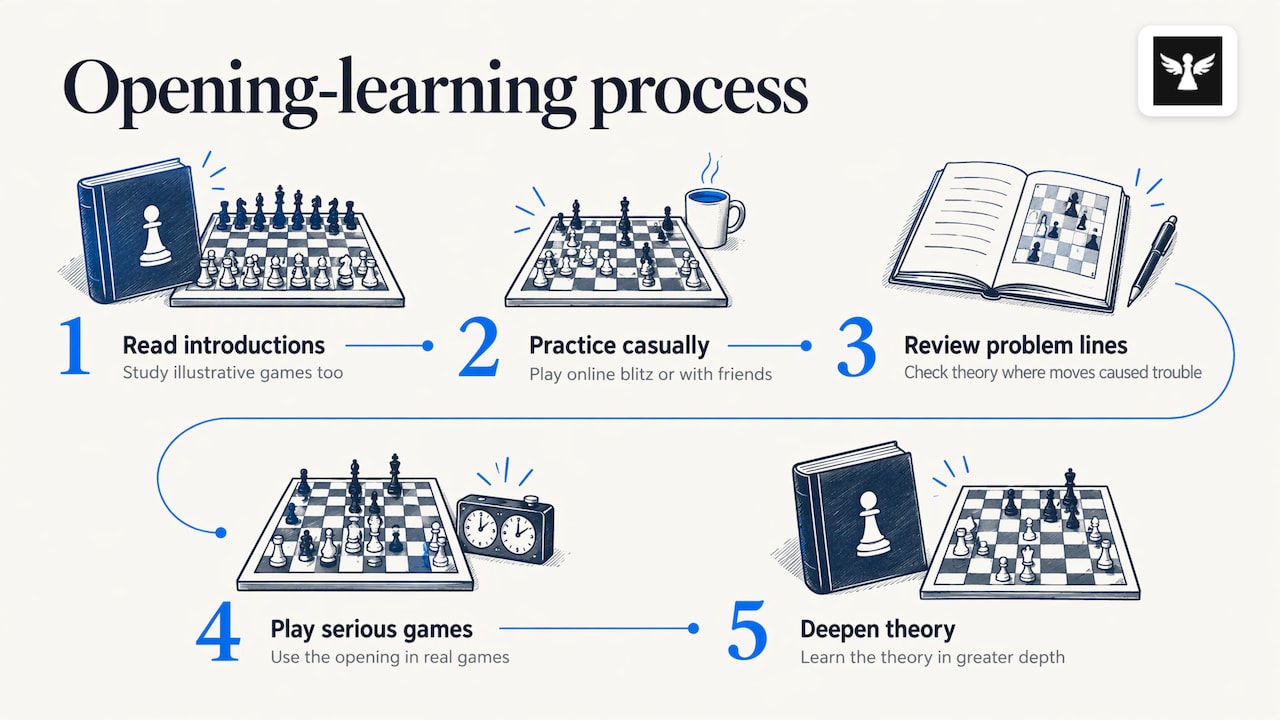
GM David Smerdon’s process for mastering an opening runs in five steps: read the introductions and illustrative games, play the opening in less serious games such as online blitz or with friends, go back and check the theory for the lines that caused problems, play it in “real” games, then learn the theory in greater depth. The key, according to US Chess, is alternating between study and practice. Forgetting or misplaying a variation and looking it up afterward is what makes it stick. IM Cyrus Lakdawala adds that the goal for club players is to get the key ideas and positions into your head so you get a feel for the lines.
Use active recall
Nate Solon suggests setting a short timer, opening an empty study, and reconstructing the line without hints, while understanding the reason for each move (Zwischenzug). Recognizing a move on a screen is not the same as producing it at the board, so test yourself by producing the move.
Review your games with a method
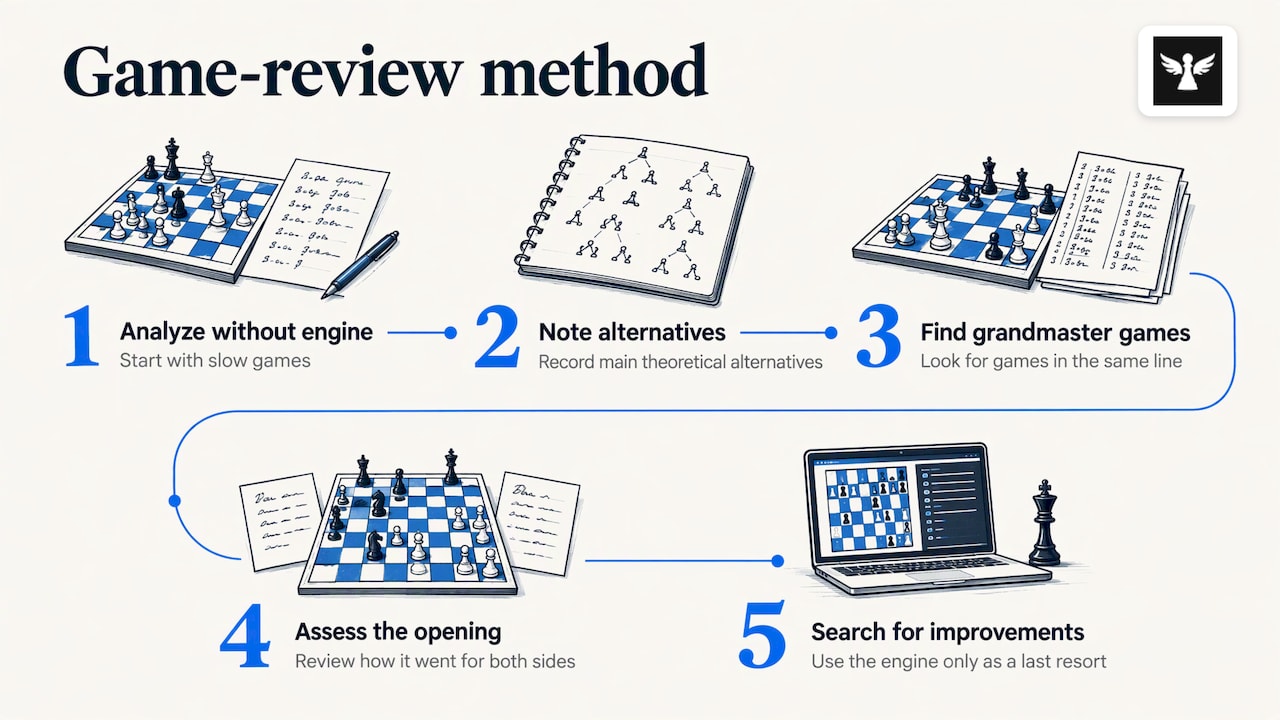
The French Chess Federation recommends, for opening analysis, that you note the main theoretical alternatives, look for grandmaster games in the same line, make a short assessment of how the opening went for both sides, and search for improvements. It also advises analyzing slow games without the engine first and using it only as a last resort (FFE masterclass, 8 February 2019).
If you want a fuller routine, our guides on how to learn chess openings and how to practice openings so they stick cover it step by step. Once your lines are in place, analyzing them with Stockfish helps you check the ideas after you have thought for yourself.
A simple weekly plan
- Pick one defense and one answer to each of White’s three most common second moves.
- Write or build the tree, with a one-line plan for each branch.
- Play ten to twenty games with it, online, at a relaxed time control.
- Review every game where you left your preparation and note the first move that surprised you.
- Train those positions until you can reproduce the moves and say why they work.
Structured repetition of your own trouble spots is worth more than rereading a whole book chapter.
Build and train your repertoire with ChessFlux
ChessFlux turns this method into a routine. You connect your Lichess or Chess.com account, and the app builds a repertoire from your recent games, then runs a game debrief that compares your real openings with the repertoire you chose. You can also create your own variation trees, import PGNs and studies, and drill the moves one by one with active opening training. The free version covers the core features, and ChessFlux Premium adds options such as unlimited puzzles, advanced training and more customization.
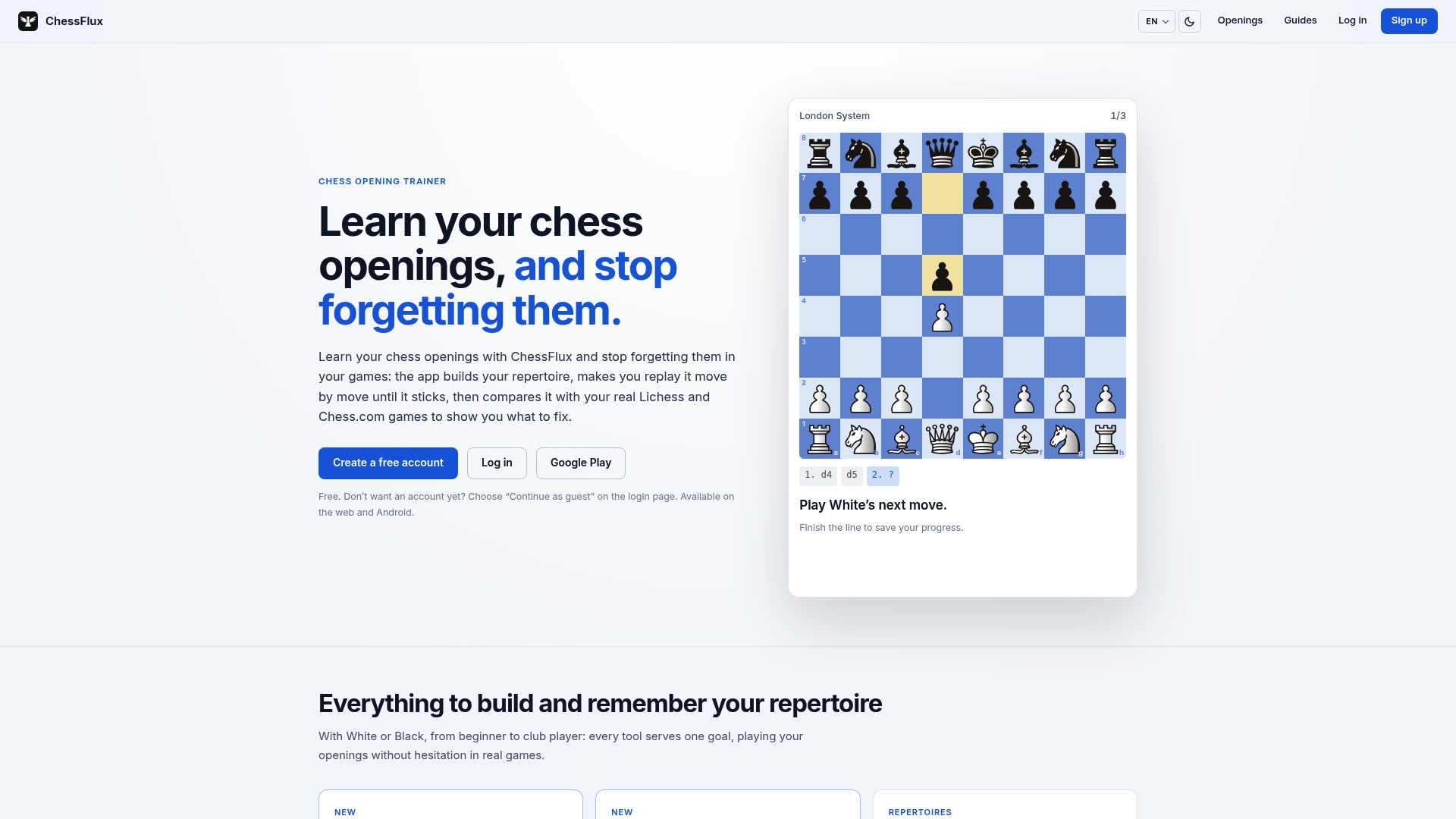
Ready to try it against 1.d4? Start with ChessFlux and see which of your openings need work first. You can also read our guide to building a chess opening repertoire before you begin.
FAQ
What is the best defense against 1.d4 for a beginner?
A classical setup with 1…d5 is the easiest place to start. It claims the center directly and gives you structures that are easy to read. Pair it with one clear plan, such as the …c5 break, and you will have a dependable base.
Is 1…Nf6 better than 1…d5?
Neither is simply better. 1…Nf6 is flexible and is considered the mainline today, but it needs more attention to move orders and transpositions. 1…d5 is more direct and more forgiving when you forget theory, so it suits players who want fewer branches to remember.
How do I stop White from playing the London System?
You do not need to refute it, only to have a set answer. Choose a standard setup in advance, such as …d5, …e6 and …c5 followed by natural development, and drill it until it is automatic. Build that branch in your repertoire so you meet it without surprise.
How many 1.d4 variations should I memorize?
Fewer than you think. Learn the main line of your chosen defense, one answer to each common sidestep, and the plan behind every branch. Understanding why the moves are played will carry you further than a long list of variations.
Can I build a 1.d4 repertoire from my own games?
Yes. With ChessFlux you can import your last 100 games from Lichess or Chess.com, and the app builds a repertoire from the lines you actually play, then shows where your games depart from it.
Sources
- Queen’s Pawn Opening, King’s Repository
- Queen’s Pawn Opening, Chess Strategy 101
- Opening Repertoire: Nimzo-Indian and Queen’s Indian Defences, Nigel Davies
- Keep It Simple: 1.d4, New In Chess
- How to Really Learn an Opening, US Chess
- How to Remember Your Openings, Nate Solon
- Masterclass FFE, 8 February 2019