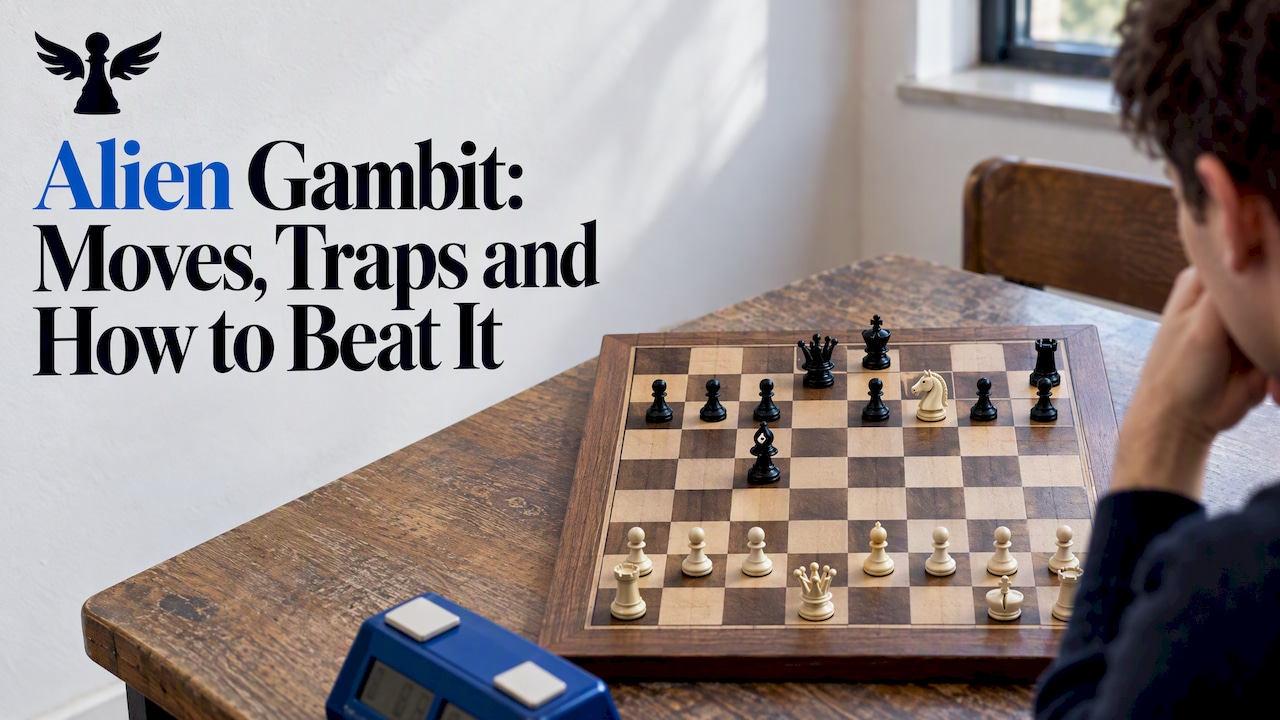
The Alien Gambit is a speculative knight sacrifice that White plays against the Caro-Kann Defense: 1.e4 c6 2.d4 d5 3.Nc3 dxe4 4.Nxe4 Nf6 5.Ng5 h6 6.Nxf7!?. White gives up a piece for two pawns’ worth of chaos and an exposed black king. It is sound enough to cause real damage in fast online games, and unsound enough that Black, who knows the right answers, usually ends up with the better position. This guide gives you the moves, White’s ideas, the traps on both sides, and a practical way to remember all of it.
TL;DR
- The Alien Gambit starts with 6.Nxf7 after 1.e4 c6 2.d4 d5 3.Nc3 dxe4 4.Nxe4 Nf6 5.Ng5 h6. Its ECO code is B15.
- As Black, take the knight with 6…Kxf7, then develop calmly with …e6, …c5 and …Nc6 and walk the king toward safety.
- As White, speed is everything: checks, pins and fast development. Once Black coordinates, the extra piece decides the game.
- The gambit scores well at club level and much worse against strong players, so it is a practical weapon, not a refutation of the Caro-Kann.
- Whichever side you play, the gambit rewards memorized lines. Drilling them from your own games is the fastest way to get comfortable.
Table of Contents
- What the Alien Gambit is
- Why 6.Nxf7 is a real threat
- The correct answer: 6…Kxf7
- White’s plans and ideas
- Traps and tactical ideas
- Playing against the Alien Gambit in a real game
- Win rate: what the data says
- The Bonjour Variation and related ideas
- Who is Witty Alien?
- Should you play the Alien Gambit?
- A perspective from the ChessFlux team
- Train the Alien Gambit until it is automatic
- A simple study plan
- FAQ
- Sources
What the Alien Gambit is
The gambit lives inside the Caro-Kann Defense, one of the most solid replies to 1.e4. If you want the full picture of that defense first, our Caro-Kann Defense guide covers the main lines, plans and traps.
The standard move order is:
- e4 c6
- d4 d5
- Nc3 dxe4
- Nxe4 Nf6
- Ng5 h6
- Nxf7!?
Lichess’s opening database describes it as an aggressive, speculative knight sacrifice against the Caro-Kann, and the Lichess openings entry records this exact move order. The same entry notes that the opening was popularized by Volen Dyulgerov, who plays online as Witty Alien, which is where the name comes from. The opening carries the ECO code B15, according to the opening statistics on ChessCodex.
The point of 5.Ng5 is to attack the f7 pawn at once. Many Caro-Kann players answer 5…h6 on instinct, to kick the knight away. That is exactly the move White hopes for, because now the sacrifice works tactically: the knight lands on f7 and attacks both the black queen on d8 and the rook on h8.
Why 6.Nxf7 is a real threat
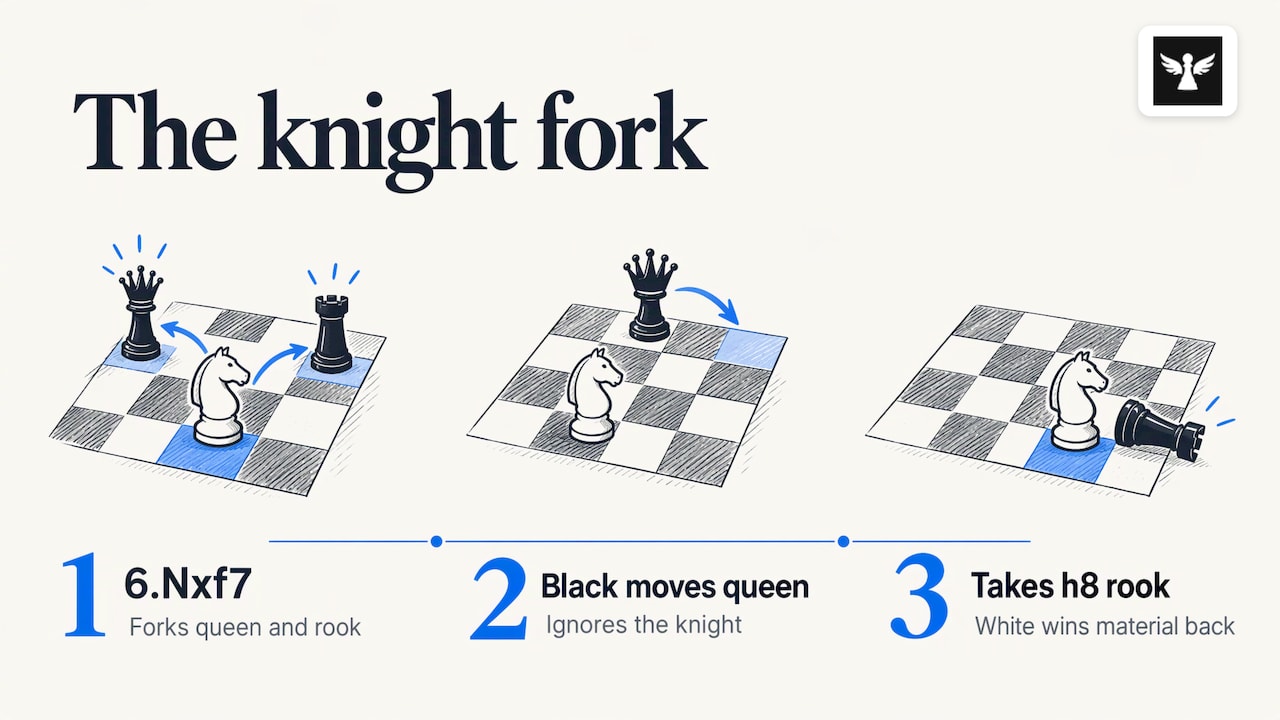
The sacrifice has a concrete logic. After 6.Nxf7, the knight forks queen and rook. If Black ignores the knight and moves the queen, White takes the rook on h8 and has won material back with interest. So Black has to deal with the knight right now.
That forcing character is why the gambit is so popular in bullet and blitz. The Lichess entry states that the opening has been used successfully in bullet and blitz, with more than 78,000 games already played when it was added to the database. In those time controls, a black player who has never seen the position often spends a minute finding the right idea while the clock runs.
The correct answer: 6…Kxf7
The practical answer is to take the knight. After 6…Kxf7, the black king is exposed and White is a piece down, but White has easy development and a series of forcing moves. Black’s king is not in real danger if Black plays accurately, and the extra piece is worth a lot once the position calms down.
A typical continuation is 7.Bc4+, putting the king in check from the bishop and gaining a tempo. Black’s main defensive tasks from here are:
- Block or step aside safely. The king often walks toward g8, where it tucks in behind the pawns and the h-pawn push to h6 even gives it some air.
- Strike the center. The pawn break …c5 attacks White’s pawn on d4 and opens lines for Black’s pieces.
- Develop with purpose. Moves like …e6 and …Nc6 close diagonals against the king and bring defenders into play.
- Trade pieces. Every exchange takes away an attacker. With less material on the board, White’s extra pawns do not compensate for the missing piece.
The ChessOpeningsLab write-up on this line summarizes White’s side the same way: its only hope is speed, and once Black is coordinated, the extra piece decides.
White’s plans and ideas
If you are the one playing the gambit, you should know what you are paying for. You give up a knight, so you need to get something concrete in return. The attack rests on a few ideas.
Rapid development with checks
The bishop check on c4 is the most natural way to gain tempo. After the black king is dragged out, White follows with Nf3 and Ne5+, which adds another check and keeps the king under pressure. Each check forces Black to respond instead of developing.
Pins and pressure on the white squares
The sacrifice weakens the squares around the black king, in particular the light squares and the diagonal toward g8 and h7. Wikibooks describes the gambit as an attack against these weakened squares, while also noting that it loses against precise play. That is an honest summary: the compensation is real, but it is temporary.
Keeping the initiative
White does not have time for slow moves. A quiet developing move that lets Black play …e6 and …c5 usually hands over the game. If you play this opening, prepare the forcing sequences until you can play them without thinking.
Traps and tactical ideas
The gambit is full of small traps, which is part of its charm. Here are the best-known ones, with the ideas behind them.
A trap against greedy development: 7…Bg4 and 8.Ne5+
The developing move …Bg4 looks natural, since it pins a piece and develops a bishop. But it can run into 8.Ne5+, which gives check and exposes Black to further tactics. According to the Chess-Teacher analysis, this is one of the common traps in the line. The lesson for Black: when the king is exposed, development moves that do not address the king’s safety are risky.
A mating trap: 10…Bh7?? and 11.Bxe6#
In some lines Black is tempted by a move such as …Bh7, which looks like a retreat but leaves the e6 square without enough protection. The result can be a quick mate with the bishop landing on e6. White’s setup with g4 on move ten adds to the danger. This pattern shows why Black should keep the king’s escape squares and the light-squared defense in mind.
The queen and rook fork
The opening trick itself is also a trap. A player who does not know the gambit might respond to 6.Nxf7 by moving the queen, only to see the knight take the rook on h8. Taking the knight is not just good, it is the only sensible move.
How Black avoids all of them
The refutations share a theme: focus on defensive development, such as …e6, …c5 and …Nc6, and avoid greedy pawn grabs while the king is exposed. A black player who resists the urge to counter-attack early will avoid most of the traps above.
Playing against the Alien Gambit in a real game
Here is a simple checklist for the first moves after 6.Nxf7.
- Capture the knight. Play 6…Kxf7. Do not try to be clever with the queen.
- Answer checks calmly. If 7.Bc4+, look at …e6 and the king walk toward g8 before anything else.
- Play …c5 as soon as it is safe. Hitting the center takes the sting out of White’s play.
- Bring the knight to c6 and the bishop to a safe square. Make sure every developing move also covers a weak square near the king.
- Offer trades. When the pieces come off, you are simply a piece up.
- Check every capture. If a pawn grab loses a tempo, skip it. Do not take pawns while the king is still in the open.
The common mistake is to counter-attack too early. With the king exposed, a slow and solid approach is usually the best way to win, because it takes away White’s fastest source of play: your own mistakes.
Win rate: what the data says
The numbers show why the gambit is popular and why it is not a refutation.
| Rating group | White’s score | Source |
|---|---|---|
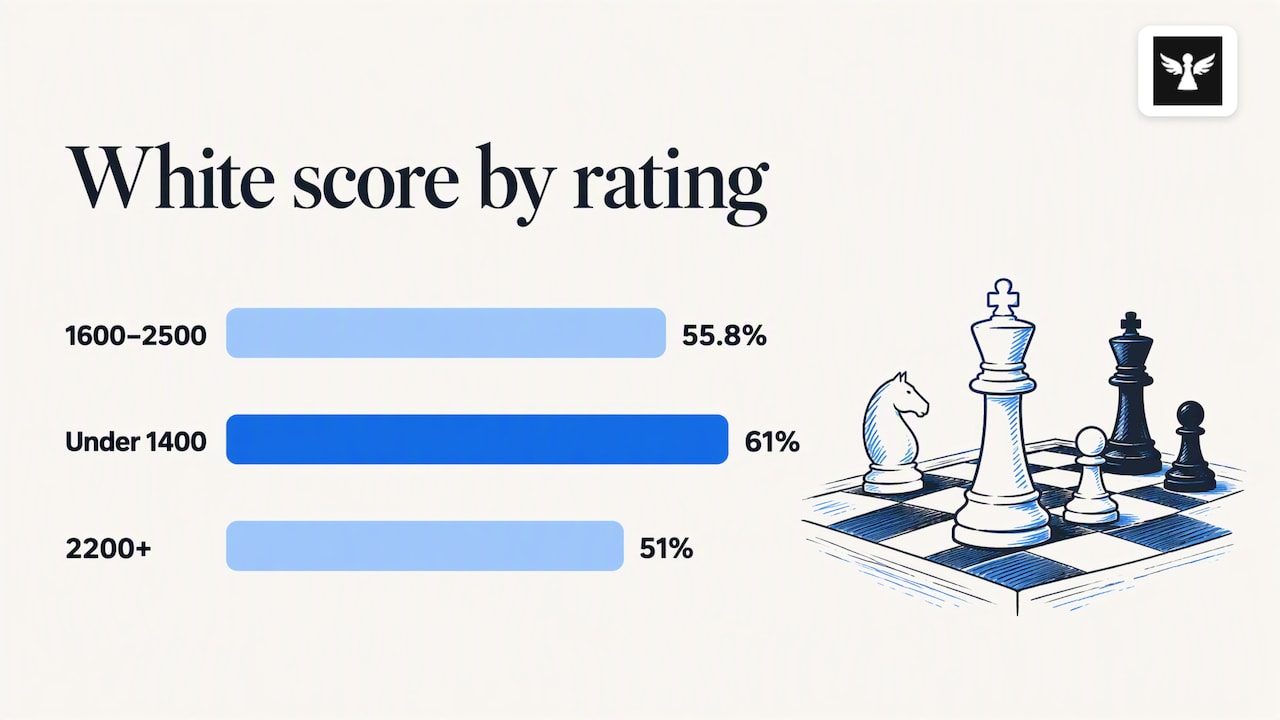
| 1600 to 2500 (175,465 rated Lichess games) | 55.8% | ChessCodex |
| Under 1400 | 61% | ChessCodex, rating data as of 27 September 2026 |
| 2200 and above | 51% | ChessCodex, rating data as of 27 September 2026 |
Two things stand out. First, White scores better than 50% in a large sample of ordinary rated games. That means that, in practice, many players simply do not know the right answers. Second, the score falls as the rating rises: from 61% below 1400 to 51% at 2200 and above. Stronger players find the defensive moves, trade pieces and convert the extra material.
Some content sites quote higher figures for specific samples, around 58% to 59% for White. Treat those as snapshots of particular databases rather than as a universal number. The pattern is what matters: the gambit works best against opponents who have not prepared for it.
The Bonjour Variation and related ideas
The same style of sacrifice appears against other defenses. The Bonjour Variation is the name used for the Alien Gambit idea in the French Defense. If you play 1…e6 as Black, it is worth knowing about, and our French Defense guide covers the structures you will meet. The common thread is that White tries to hit f7 early, and Black has to know the safe answer.
Who is Witty Alien?
According to the Lichess entry, Witty Alien is the online name of Volen Dyulgerov, a Bulgarian content creator and candidate master who popularized the opening in bullet and blitz. The opening is named in his honor. The sacrifice itself is an old tactical motif, but his games and videos are what brought it to a wide audience.
Should you play the Alien Gambit?
It depends on your goal.
- For fun and fast time controls: it is an excellent surprise weapon. You give up a piece, but you get a quick attack and a lot of chances for your opponent to go wrong.
- For long-term improvement: it teaches useful attacking skills, such as using checks and tempo. But it is not a sound foundation for a serious repertoire against well-prepared opponents.
- If you play the Caro-Kann: you need a ready answer. A black player who knows 6…Kxf7 and the follow-up plan will often be happy to see the gambit.
Either way, the knowledge pays off. Even if you never play 6.Nxf7, knowing how to meet it protects you in every blitz game.
A perspective from the ChessFlux team
Gambits like this one show why opening knowledge is a memory problem as much as a chess problem. Most players do not lose to the Alien Gambit because they lack talent. They lose because they met the position once, forgot the answer, and had to find it again with a clock running.
That is why we built ChessFlux around your real games. The app builds a personal repertoire from your last 100 games on Lichess or Chess.com, then compares what you actually played with what you intended to play. If you keep stumbling in the Caro-Kann, or keep missing the right reply to a trap, it shows up in your own results, and you can drill exactly those lines move by move.
We think this beats generic opening courses, because you spend your time on the positions that cost you points, not on lines you will never reach. Memorize the answer once, repeat it at the right moment, and the trap turns from a danger into a free point.
Rolf
Train the Alien Gambit until it is automatic
Knowing the moves is the easy part. Keeping them in your head across hundreds of blitz games is harder. ChessFlux is a freemium app: the core features are free, and the Premium subscription unlocks options such as unlimited puzzles, advanced training and additional customization. You can import your games from Lichess or Chess.com, build a repertoire with variation trees, import PGNs and studies, and practice each line until it sticks.
If you want to start, create your repertoire on ChessFlux and add the Caro-Kann lines you face. Our guide on building a chess opening repertoire explains how to organize the variations, and the page on memorizing openings with active training shows how the repetition works. To check whether a sacrifice really holds, you can also analyze the position with Stockfish.
A simple study plan
Here is a plan you can follow in about a week, whichever side you play.
- Day 1: play through the main line to 6.Nxf7 and 6…Kxf7 on a board, saying aloud why each move is played.
- Day 2: study the checks and the king walk. Find the squares where the king is safe.
- Day 3: learn the two traps, 7…Bg4 8.Ne5+ and the 11.Bxe6# mate pattern.
- Day 4: play five blitz games from the position, as both colors.
- Day 5: review your games and see where you deviated.
- Day 6: drill the tactics around f7 and e6 with puzzles. The tactics training guide shows how to filter puzzles by theme or opening.
- Day 7: add the lines to your repertoire and test yourself.
This is simple, but repetition on a schedule is what moves a line from “I saw this once” to “I know this.”
FAQ
Is the Alien Gambit sound?
No. With accurate play, Black should come out ahead, and the Wikibooks opening theory page describes it as losing for White against precise defense. In practice, though, it scores well in rapid, blitz and bullet games because many opponents do not know the correct plan.
What is the best response to the Alien Gambit?
Take the knight with 6…Kxf7. Then develop with …e6, …c5 and …Nc6, walk the king toward g8 if needed, and trade pieces. Avoid early counter-attacks and pawn grabs while your king is exposed.
Who invented the Alien Gambit?
The opening is named after Witty Alien, the online name of Volen Dyulgerov, who popularized it. The Lichess opening entry credits him with that popularization, not with inventing the underlying sacrifice, so it is more accurate to say he made it famous.
What is the Alien Gambit’s ECO code?
It is B15, which sits in the Caro-Kann Defense family. The sacrifice comes at move six after 1.e4 c6 2.d4 d5 3.Nc3 dxe4 4.Nxe4 Nf6 5.Ng5 h6.
Is there a version against the French Defense?
Yes, it is called the Bonjour Variation. It applies the same idea of attacking f7 early, in a French Defense structure. If you play the French, it is worth learning the safe reply.
Sources
- Alien Gambit, Lichess chess-openings database entry
- Caro-Kann Defense: Alien Gambit (B15): Moves and Win Rates, ChessCodex
- Alien Gambit | Learn the Ideas, Traps, and Refutation, Chess-Teacher
- Chess Opening Theory: 6. Nxf7, Wikibooks