
The Scotch Game is a 1.e4 opening where White strikes at the center on move three: 1.e4 e5 2.Nf3 Nc6 3.d4. Instead of maneuvering slowly, as in the Ruy Lopez or the Italian Game, White opens the position at once and plays for quick piece activity. It is a clear, logical choice for beginners and a real weapon for club players. This guide covers the moves, the variations you will face, the plans on both sides and how to make it stick in your memory.
TL;DR
- The Scotch starts with 1.e4 e5 2.Nf3 Nc6 3.d4. White challenges e5 immediately and opens the center.
- Black usually answers 3…exd4 4.Nxd4, then chooses between 4…Bc5 (Classical) and 4…Nf6 (Schmidt Variation).
- The Scotch Gambit (4.Bc4) and the Göring Gambit (4.c3) are different lines, where White gives up a pawn for development.
- It suits players who like open positions and clear plans, and it has far less theory to absorb than a Ruy Lopez.
- Memorize it from your own games: the lines Black actually plays against you matter more than the ones in a textbook.
Table of Contents
- What the Scotch Game is and how it arises
- The first moves, step by step
- Is the Scotch a good opening for beginners?
- Main variations after 4.Nxd4
- Gambits: Scotch Gambit and Göring Gambit
- The Four Knights Scotch: another route to the same ideas
- Black’s other third moves and a classic mistake
- Plans for White and Black
- Our perspective on learning the Scotch
- Train the Scotch with ChessFlux
- How the Scotch fits in a repertoire
- FAQ
- Sources
What the Scotch Game is and how it arises
The Scotch Game, also called the Scotch Opening, begins with 1.e4 e5 2.Nf3 Nc6 3.d4. These are the most natural opening moves in chess: White takes space with the e-pawn, develops the knight to attack e5, and Black defends with the other knight. Move three is where the Scotch departs from the quieter systems. White offers to exchange the d-pawn for Black’s e-pawn, and in doing so tries to gain control of the center.
The name has a historical origin. According to the reference page on the opening, it comes from a correspondence match played in 1824 between Edinburgh and London.
It later had a second life. Garry Kasparov helped make the Scotch topical after years of neglect, and it remained an integral part of his repertoire. His reasoning, as summarized on the reference page, was that it posed Black lasting strategic problems while avoiding the heavily analyzed Ruy Lopez.
The first moves, step by step
Here is the starting sequence, with the idea behind each move:
- 1.e4 e5: both sides claim the center with a pawn.
- 2.Nf3 Nc6: White attacks e5, Black defends it.
- 3.d4: White attacks e5 a second time and asks Black to decide what to do about the tension.
Black now has several options, but the practical choice is narrow. As the reference page notes, Black usually plays 3…exd4, because holding on to the e5 pawn without letting White open the center is difficult. After 3…exd4 White normally recaptures with 4.Nxd4, and the knight lands on a strong central square.
What does White get? A knight on d4 that eyes c6, b5 and f5. An open e-file and open diagonals for the bishops. A lead in development if Black is careless. What does White give up? The Scotch does not keep the tension: the center becomes more open and symmetrical, so White does not have the long-term bind that a Ruy Lopez can offer. That is the price of simplicity.
Is the Scotch a good opening for beginners?
Yes, with a nuance. It is a good choice for players who are learning to think about the center, development and piece activity, for three reasons.
- The ideas are concrete. You open the center, develop quickly, castle and use your pieces. There is no need to understand complex pawn structures before you can play it.
- Less theory in the early stages. Compared with the Ruy Lopez, you can reach a playable middlegame with fewer memorized moves. You still need to know what to do against …Bc5, …Nf6 and …Qh4, but the list is short.
- It gets Black out of comfort. Many players you meet online have prepared against 3.Bb5 or 3.Bc4, and fewer know the Scotch lines well.
The weaknesses are real, too. Black can equalize with accurate play, notably in the Schmidt Variation, and the positions can become drawish and symmetrical if you do not know your plans. The Scotch is not a trap-based system. If your opponent knows the main lines, you need a plan, not just a hope that they blunder. That is a good lesson for a beginner anyway.
Main variations after 4.Nxd4
After 3…exd4 4.Nxd4, Black has two principal replies. The reference page describes the main line as continuing 3…exd4 4.Nxd4, with Black then playing …Bc5 (the Classical Variation) or …Nf6 (the Schmidt Variation).
| Line | Moves | Black’s idea | White’s usual plan |
|---|---|---|---|
| Classical | 4…Bc5 | Pressure on d4 and a possible fork on c6 and f2 | Trade or retreat the knight, then develop and castle |
| Schmidt | 4…Nf6 | Attack e4 and keep a flexible structure | 5.Nxc6 bxc6 6.e5 gaining time against the queen and knight |
| Steinitz | 4…Qh4 | Early queen activity against e4 | Develop with 5.Nc3 and make the queen lose time |
Classical Variation: 4…Bc5
Black develops the bishop with a direct attack on the d4 knight. If White takes on c6, the bishop on c5 supports a recapture that breaks the pawn structure, so White has to choose a plan. The most common response is to challenge the bishop or to trade on c6 and then bring the queen to d2 to prepare long-term pressure. Either way, you should develop quickly and not drift into pawn grabbing on move six.
The practical lesson: do not play automatically. After 4…Bc5 you have to compare retreating the knight with exchanging it, and your answer decides the character of the game.
Schmidt Variation: 4…Nf6
This is the most testing reply for many players. Black attacks e4 and, after 5.Nxc6 bxc6 6.e5 Qe7, gets active piece play and a solid enough position. You will face this line often, since it is a natural developing move that attacks a pawn. White’s plan is to gain a lead in space, use the e-pawn to harass the knight and aim for kingside initiative. Black’s plan is to challenge the center with …d5 or pressure the e5 pawn.
Steinitz Variation: 4…Qh4
The early queen move attacks e4 immediately. It looks aggressive, and it is a line that beginners meet in casual games. White’s answer is simple: develop with tempo (5.Nc3 is the natural move) and treat the queen as a target, not a threat.
Gambits: Scotch Gambit and Göring Gambit
A common confusion on forums is the difference between the Scotch Game and the Scotch Gambit. They are not the same. As noted on the reference page, the Scotch Game proper continues 4.Nxd4. The Scotch Gambit (4.Bc4) and the Göring Gambit (4.c3) are distinct lines in which White sacrifices a pawn to accelerate development and create immediate attacking pressure.
- Scotch Gambit, 4.Bc4. White develops the bishop first and delays the recapture on d4. It often transposes to Italian-style positions and offers more attacking chances, with more risk.
- Göring Gambit, 4.c3. White offers a pawn with 4…dxc3 5.Nxc3, aiming for open lines, quick development and pressure against f7. Black can decline with 4…d5 and keep the extra material under control.
If you are a 1000-rated player asking whether the “sacrifice” works, the answer is yes, as long as you know the follow-up. Gambits reward knowledge, and they punish players who sacrifice a pawn with no plan. Start with the main line and add a gambit later.
The Four Knights Scotch: another route to the same ideas
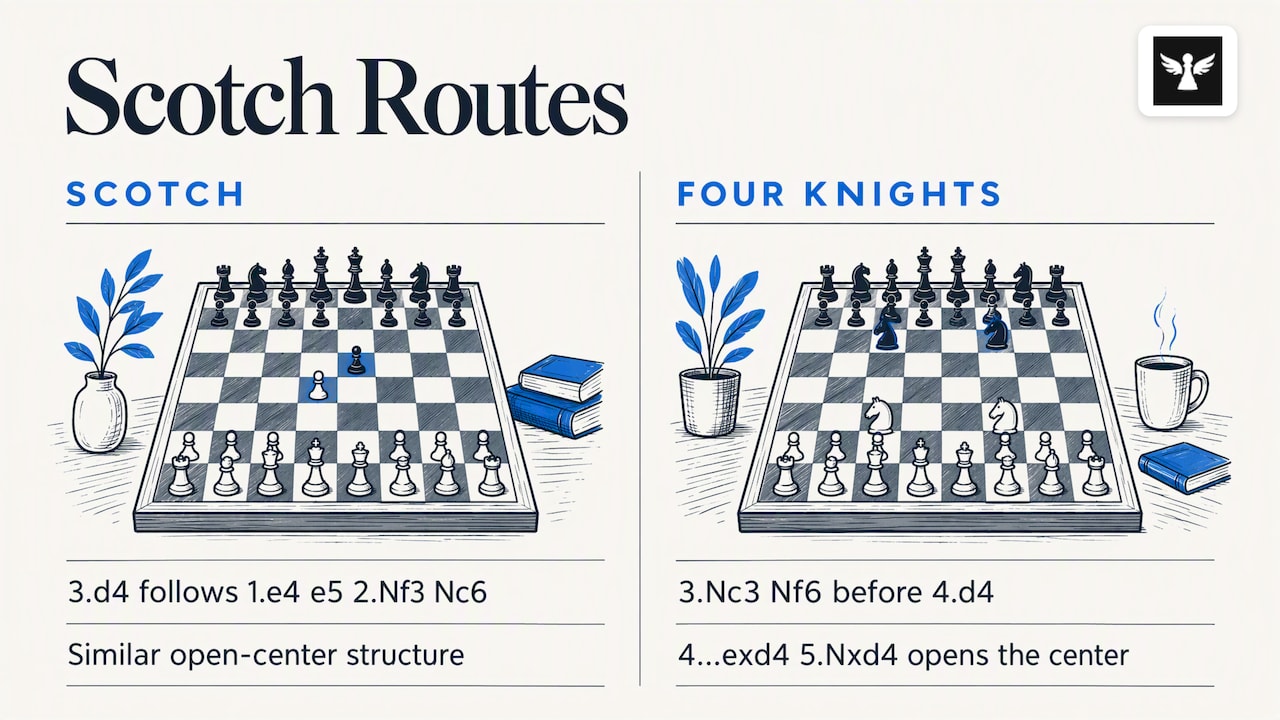
You will also see the Four Knights Scotch, reached by 1.e4 e5 2.Nf3 Nc6 3.Nc3 Nf6 4.d4. White develops the second knight first and then plays d4. The structure feels similar, since the center opens after 4…exd4 5.Nxd4, but there is an important difference: Black has already developed the knight to f6, so you will find it in a slightly different move order and with some of the Schmidt-style ideas arriving earlier. If you like the Scotch, it is worth learning as a second branch of the same family.
Black’s other third moves and a classic mistake
Not every opponent plays 3…exd4. The most common alternative is 3…d6, which defends e5 directly. It looks solid but is often considered a mistake, because 4.d5 drives the knight away and gives White an imposing center. After 3…d6 you should punish the passive setup by taking space, not by hoping for tricks.
Other frequent errors, from both sides:
- White grabs material too soon. Moving the queen out early and capturing pawns on the wing gives Black time to develop.
- White forgets to castle. The open e-file is dangerous for an uncastled king.
- Black plays passively after 4.Nxd4. Without a plan, Black allows a strong center and a comfortable game for White.
- Both sides trade pieces automatically. In the Scotch, trading on c6 changes the structure, so each trade should have a reason.
Plans for White and Black
If you play White
- Reach the position with 3.d4 and recapture on d4 with the knight.
- Develop all minor pieces, aim for quick castling and keep the center under control.
- Decide whether to keep your knight on d4 or exchange it on c6, based on Black’s fourth move.
- Use the open files for rooks and the queen, and look for e4-e5 when it gains time.
If you play Black
- Do not rush to hold the e5 pawn at all costs; exchange on d4.
- Choose a setup you can remember: Classical …Bc5 if you like active bishops, Schmidt …Nf6 if you prefer solid development.
- Challenge the center with …d5 when you can do it safely.
- Watch for tactics on c6, f7 and the e-file, since the open position makes them common.
Our perspective on learning the Scotch
We see the same pattern again and again with players who study openings: they read a guide, memorize twelve moves of a main line, and then their opponent plays move six differently. The theory was not wrong. The mistake was studying lines the opponent never plays.
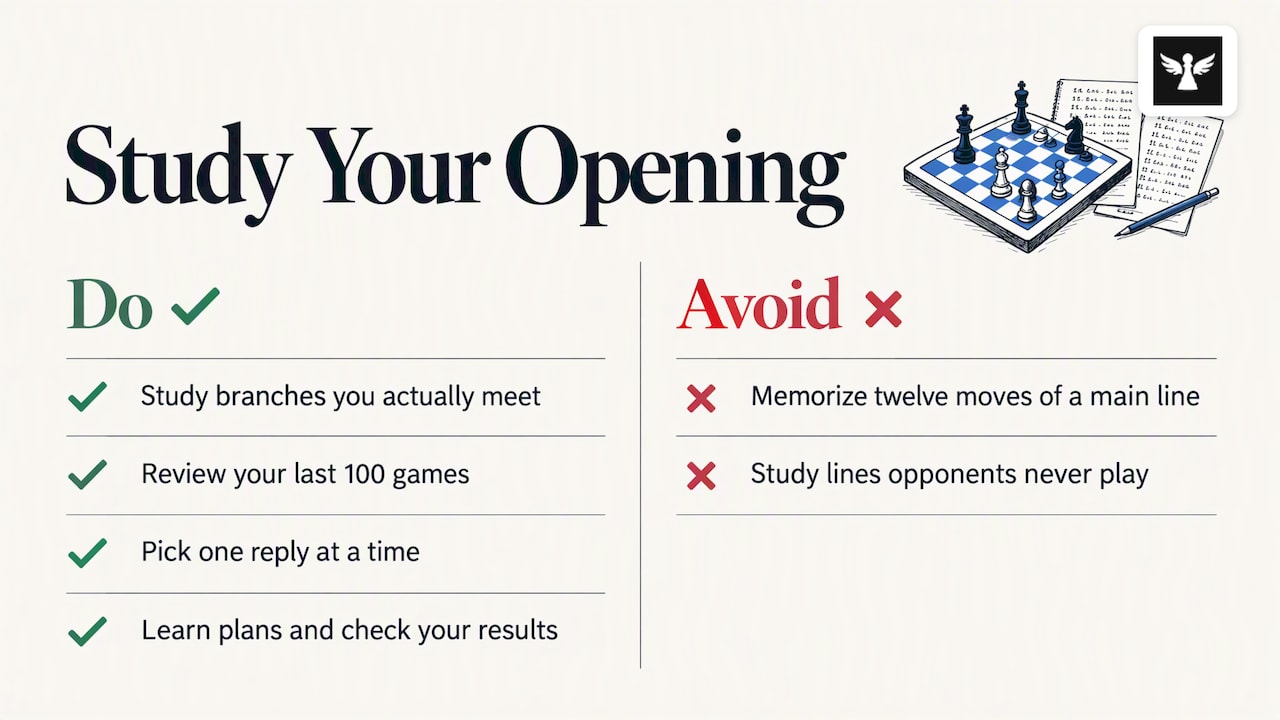
The Scotch is a good example. Its tree is short enough to learn, but it branches quickly into the Classical, the Schmidt, the Steinitz and the gambits. The efficient approach is to study the branches you actually meet. That is why we built ChessFlux around your real games: your last 100 games on Lichess or Chess.com show which replies you face, where you leave your preparation and which moves cost you points. Reviewing those, not a generic course, is how an opening becomes automatic.
Our advice: pick one reply to 3…exd4 4.Nxd4 at a time, learn the plans behind the moves, and check your results against your own games before adding more.
— Rolf
Train the Scotch with ChessFlux
ChessFlux is a freemium opening trainer. It builds a personalized repertoire from your last 100 Lichess or Chess.com games, helps you memorize it move by move and compares your real results with your repertoire so you know what to fix. You can also build variation trees, import PGNs and studies, and check your lines with Stockfish. Start on the free plan at ChessFlux, and move to Premium if you want unlimited puzzles and more advanced training.
If you want to go step by step, read how to build a chess opening repertoire, how to import your Lichess or Chess.com games and how to analyze openings with Stockfish. To sharpen the tactics that the Scotch produces, try chess tactics puzzles.
How the Scotch fits in a repertoire
The Scotch is a 1.e4 e5 weapon, so it sits next to the other open games. If you want a slower, more strategic alternative at move three, look at the Ruy Lopez. If you prefer a classical development with the bishop on c4, see the Italian Game. Players who face 1.e4 without wanting to play 1…e5 can compare it with the French Defense or the Scandinavian Defense. For a broader view, browse our chess openings library or the opening guides.
A practical way to organize your study:
- Week one: learn the first three moves and the idea of 4.Nxd4.
- Week two: learn one reply to the Classical and one to the Schmidt.
- Week three: add the answers to 3…d6 and 4…Qh4.
- After that: play games, then review where your preparation ended.
FAQ
Is the Scotch a good chess opening?
Yes. It is a sound, direct opening that fights for the center immediately and has been used by top players, including Kasparov. Black can equalize with accurate play, but the Scotch gives you active pieces and clear plans, which makes it a strong practical choice.
How do you play the Scotch Opening in chess?
Play 1.e4, then 2.Nf3 and 3.d4 after 1…e5 2…Nc6. If Black captures on d4, recapture with the knight, develop your pieces and castle. From there, choose your plan according to whether Black plays …Bc5, …Nf6 or …Qh4.
What is the difference between the Scotch Game and the Scotch Gambit?
In the Scotch Game, White recaptures on d4 with 4.Nxd4. In the Scotch Gambit White plays 4.Bc4 and delays the recapture, aiming for quick development. The Göring Gambit (4.c3) is a separate pawn sacrifice from the same position.
What should Black play against the Scotch?
The usual move is 3…exd4, followed by either 4…Bc5 or 4…Nf6. The move 3…d6 is considered weaker, since 4.d5 gives White a big center.
Sources
- Scotch Game, reference page (English)
- Scotch Game, reference page (mobile)
- Opening surveys in CBM 133, ChessBase