The best chess puzzle strategy is a fixed routine, not a flash of inspiration. Find out whose turn it is, count the material, list the forcing moves (checks, captures, threats), calculate each one to the end, then try to refute your own answer before you play it. Puzzles stick best when they come from your own games and openings, because then you train the positions you actually reach. That is the idea behind our puzzle training at ChessFlux, which builds on your recent Lichess or Chess.com games.
This guide gives you the routine step by step, shows where beginners and intermediate players go wrong at each step, and explains how to turn a pile of puzzles into real progress over the board.
TL;DR
- Before you calculate, read the position: who is to move, what material each side has, which pieces are attacked, defended, pinned or stuck.
- List forcing moves first: checks, then captures, then threats. Follow each line while forcing moves remain, and look for the refutation of your own idea.
- Write down your full solution before moving a piece or asking an engine. Then check what you missed.
- Study results suggest that reviewing your own games and taking lessons pays more per hour than raw puzzle volume, so link puzzles to the mistakes in your games.
- Short daily sessions at the right difficulty beat marathon sessions.
Table of Contents
- Why a puzzle is easier than a game, and why that misleads you
- Step 1: Read the position before you think about moves
- Step 2: List the forcing moves
- Step 3: Calculate each line, and attack your own idea
- Step 4: Verify before you move
- Step 5: Learn from the wrong answer
- How to practice: difficulty, volume and rhythm
- How much do puzzles actually transfer to your games?
- Connect puzzles to your own openings and mistakes
- Where ChessFlux fits
- Our view on puzzle strategy
- A simple weekly plan
- FAQ
- Sources
Why a puzzle is easier than a game, and why that misleads you
A chess puzzle is a very short slice of a game. As Roberto Villuela of the Nairobi Chess Club explains in his puzzle notes, you first need to know who is to move, then what material is on the board, and then you concentrate on forcing moves: checks, captures and threats. The goal of the solution is usually one of four things: checkmate, decisive material gain, a positional advantage or a defensive resource.
That last point is the useful one. A puzzle tells you something is there. In a real game nobody tells you, so the habit you must build is not “find the trick” but “look for the trick in the same order every time”. If you solve puzzles by gut feeling, you will feel clever on the app and blind in your next rapid game.
So the strategy has two layers:
- A calculation routine that works on any position.
- A practice plan that makes the routine automatic in positions from your own games.
Step 1: Read the position before you think about moves
Jacob Aagaard’s advice, quoted in a French Chess Federation coaching thesis by Martin Lacombe, is that before thinking you must learn to see. That thesis also describes Martin Weteschnik’s “status examination”: for each piece, ask whether it is attacked, defended, en prise (capturable for free), pinned, or limited in its movement.
Here is the quick version you can do in ten seconds:
- Whose turn is it? Sounds silly, but a wrong answer here ruins everything, especially when the board is shown from Black’s side.
- Count material. Are you ahead, equal or behind? If you are behind and the puzzle is not about a mate, you are probably looking for a way to win material back.
- Spot loose pieces. Any piece with no defender is a target. Any of your own pieces with no defender is a risk.
- Check both kings. How many safe squares do they have? Is there a back-rank weakness?
- Note pins and long lines. Mentally trace the rays of bishops, rooks and the queen, ignoring the pieces in the way, and ask what would happen if those pieces moved.
Where it goes wrong: beginners jump to the first attractive capture. Intermediate players often read the position correctly but skip the opponent’s threats, so they find a great move that loses to a simple reply. Make “what does my opponent want to do?” part of the reading, every time.
Board vision is a skill in itself. If you lose track of pieces when you calculate three or four moves deep, our visualization exercises are a good place to build it.
Step 2: List the forcing moves
Forcing moves are moves your opponent must answer in a specific way. Three types matter, in this order of priority:
- Checks. The most forcing of all, since the reply is limited to a few options.
- Captures. They change the material and often open lines.
- Threats. A move that threatens mate or wins material next turn.
The French coaching thesis recommends exactly this approach, which it calls EPM (Échecs, Prises, Menaces): look at checks, captures and threats on the first move and again in every sub-variation, keep going as long as there are some, and try to refute your own line. A general puzzle strategy summarized by an online chess wiki goes in the same direction: checks first, then captures, then moves that create an immediate threat such as a mate threat.
Write the candidates down, even mentally as a short list: “Qxh7+, Rxe6, Nf6+”. A list prevents the most common beginner mistake, which is to fall in love with the first idea and never compare it to anything.
Where it goes wrong: you list the moves but skip the quiet ones. Many puzzles end with a quiet move that creates an unstoppable threat. If every forcing move fails, widen the search to moves that improve a piece, block a defender or cut off an escape square.
Step 3: Calculate each line, and attack your own idea
How deep should you calculate? The same thesis separates two situations. In a strategic position, you look about two or three moves per side and then judge the result. In a tactical position, full of forcing moves, you calculate as deep as the sequence of forcing moves demands, sometimes ten plies or more.
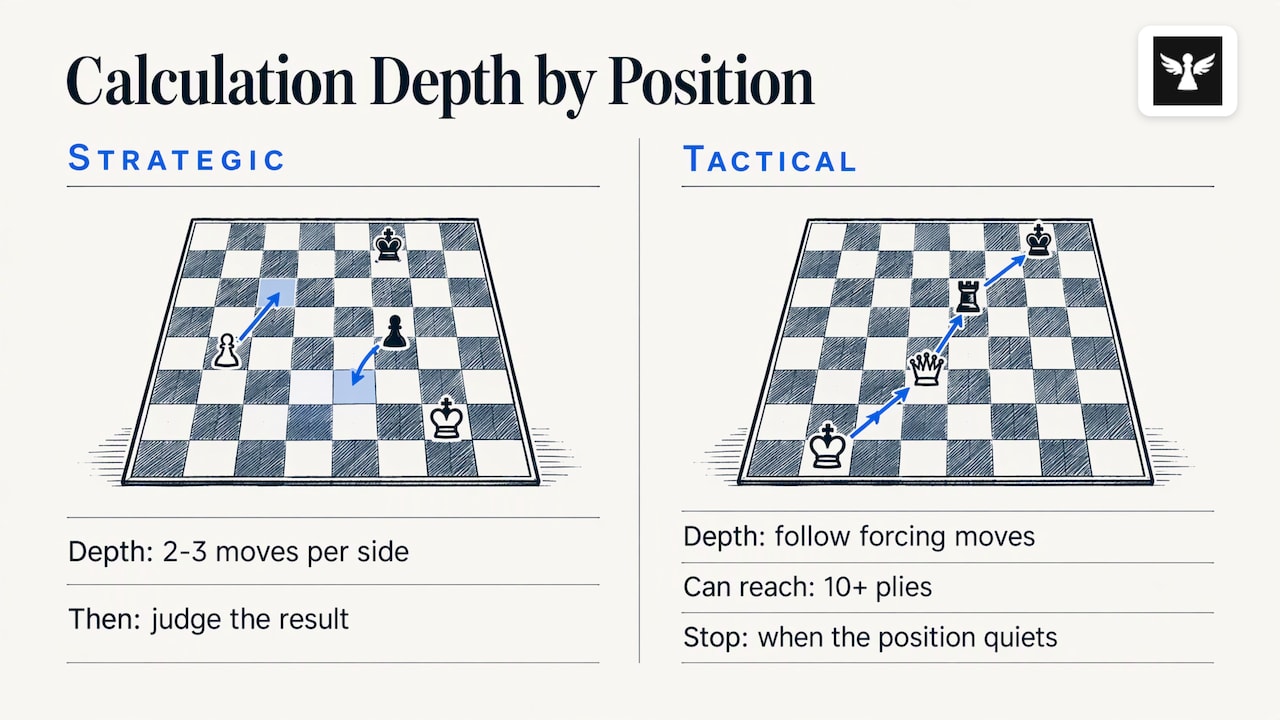
Puzzles are, by definition, tactical positions. So the rule is simple: keep following the line while the moves stay forcing, and stop when the position quiets down. Then evaluate: who has more material, whose king is safer, whose pieces are more active?
Two habits make the difference here:
Look at your opponent’s best reply, not the one you hope for
For each of your candidate moves, ask what the most annoying answer is. Often there is one: a zwischenzug (an in-between move), a counter-check, or a quiet defensive move. If your line only works against a weak reply, it is not a solution.
Visit a line more than once if you need to
A well-known piece of old advice, from the grandmaster Alexander Kotov, says that you should examine each branch of the variation tree only once. Research by Fernand Gobet and colleagues, in a scientific review of chess training, argues that this advice can lead to disaster in competition. Coming back to a line after you have learned something from another branch is not a waste. It is how you catch mistakes. The same review notes that traditional quiz books are useful for tactics, which is one more reason to keep a steady diet of well-chosen exercises.
A practical way to apply this: after you reach a conclusion, spend a few seconds going back to the first candidate you discarded and ask whether what you now know changes your judgment.
Step 4: Verify before you move
In a game, you verify to avoid a blunder. In a puzzle, you verify to train the habit. Before you play the first move of your solution:
- Is every move in your line legal and possible? Re-check that no piece you rely on has already moved or been captured earlier in the sequence.
- Does the opponent have a check, a capture or a threat at each point that you did not consider?
- Is there a stronger alternative at the start?
Write the full solution down, or say it aloud, before you check it. If you click the first move and let the app reveal the next one, you are practicing guessing, not calculation. Players who do this regularly often feel that they “solve” hundreds of puzzles and still miss tactics in games: in those sessions, the app did half of the work.
Step 5: Learn from the wrong answer
A failed puzzle is more useful than a solved one, if you do the following:
- Find the exact point of failure. Did you misread the position, miss a candidate, stop calculating too early, or overlook a defense?
- Name the pattern. A fork, a pin, a skewer, a discovered attack, a back-rank mate, a deflection. Naming it is what lets you recognize it next time. If these words are new to you, start with our guide to five tactical patterns to learn first.
- Replay the solution from the start, without looking, until you can explain why each move works.
- Return to the puzzle a few days later. If you can solve it from scratch, you learned it. If not, the pattern is not yet yours.
The point is to separate three types of errors: errors of vision (you did not see a piece or a line), errors of method (you skipped checks, captures or threats) and errors of knowledge (you did not know the pattern). Each one needs a different fix, and noting which it is takes ten seconds.
How to practice: difficulty, volume and rhythm
Puzzle sets that are far above your level feel productive but mostly teach frustration. The sweet spot is a puzzle you solve about two times out of three, with effort.
The grandmaster Romain Édouard’s calculation training books follow this logic. According to a French review of his book, it offers 276 mate exercises with gradually increasing calculation depth, and recommends reading chapter by chapter with a warm-up, an intense phase, a break and relaxation phases. The first volume of his calculation training series is aimed at players from modest to confirmed level, with the hardest examples marked by an asterisk, according to the publisher’s French teaser.
What you can take from this, whatever book or app you use:
- Start with mates and short combinations. They teach you to see forcing sequences with a clear end.
- Increase depth gradually. Move from two-move to three-move solutions only when the shorter ones feel routine.
- Work in short, focused blocks. Fifteen to twenty minutes with full attention beats an hour of clicking.
- Mix themes. Practicing only forks makes you find forks everywhere. Mixed sets train the harder skill: recognizing which pattern is present.
For a daily structure you can follow, see our daily tactics routine, and for the calculation side specifically, our practical calculation training method.
How much do puzzles actually transfer to your games?
Good question, and recent research gives a measured answer. A 2026 longitudinal study by Southwick and colleagues, covering more than 40,000 chess players, tracked rapid ratings on Chess.com against the type of practice. It associated one hour of puzzles with a gain of 0.73 rapid rating points, not significantly different from the gain associated with playing games. Reviewing games was associated with 4.41 points per hour, and lessons with 5.21 points per hour.
The lesson is not to drop puzzles. It is to use them in the right place: as the training ground for the exact weaknesses that game review exposes. These are associations observed in a large sample, not guarantees for any single player, but the direction is clear. Practice that is connected to what happens in your own games pays more per hour than practice that is not.
Connect puzzles to your own openings and mistakes
Most players practice in two separate worlds. They solve random puzzles in one tab and memorize opening lines in another, and never link them to the games they actually lose. A better routine looks like this:
- Review your last games. Mark every moment you lost material or missed a tactic.
- Classify each miss. Vision, method or pattern, as above.
- Practice puzzles on that pattern. If you keep missing back-rank tricks, train back-rank puzzles.
- Practice puzzles from your openings. Tactics cluster around the structures your openings create. If you play the Italian Game, certain sacrifices on f7 and d5 will come up again and again.
The fourth step is where most players leave progress on the table. Tactics are not random: they grow out of the opening you chose. When you know the typical tactical motifs of your own repertoire, the first ten moves stop being a memory exercise and become a source of winning chances.
Where ChessFlux fits
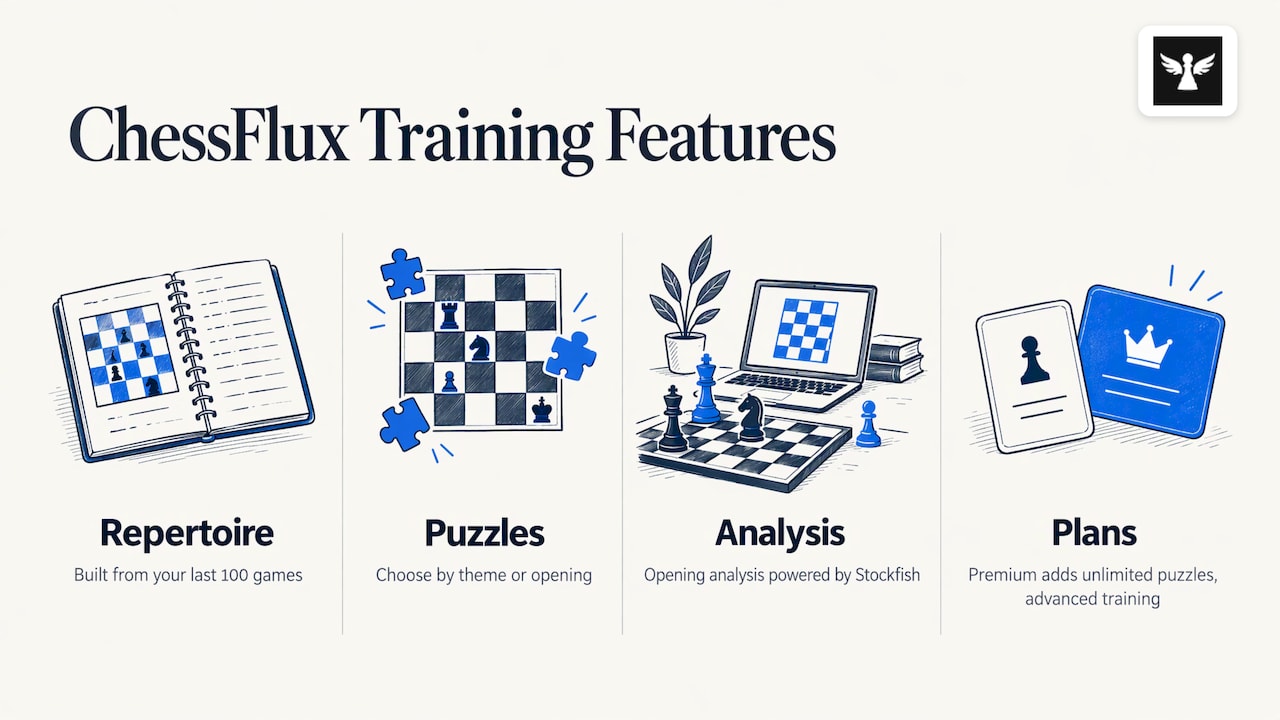
ChessFlux is an opening training app. It builds a personalized repertoire from your last 100 games on Lichess or Chess.com, compares your real performance to that repertoire, and points out the moves worth improving. It also includes chess tactics puzzles that you can pick by theme or by opening, and an opening analysis tool powered by Stockfish. That combination is what makes the connected routine above practical: the games you play shape the repertoire, and the repertoire shapes which puzzles you see.
The app has a free plan with core features, and a Premium subscription that unlocks options such as unlimited puzzles, advanced training and additional customization. You can start with the free version on chessflux.fr and read more about the tactics and puzzles training.
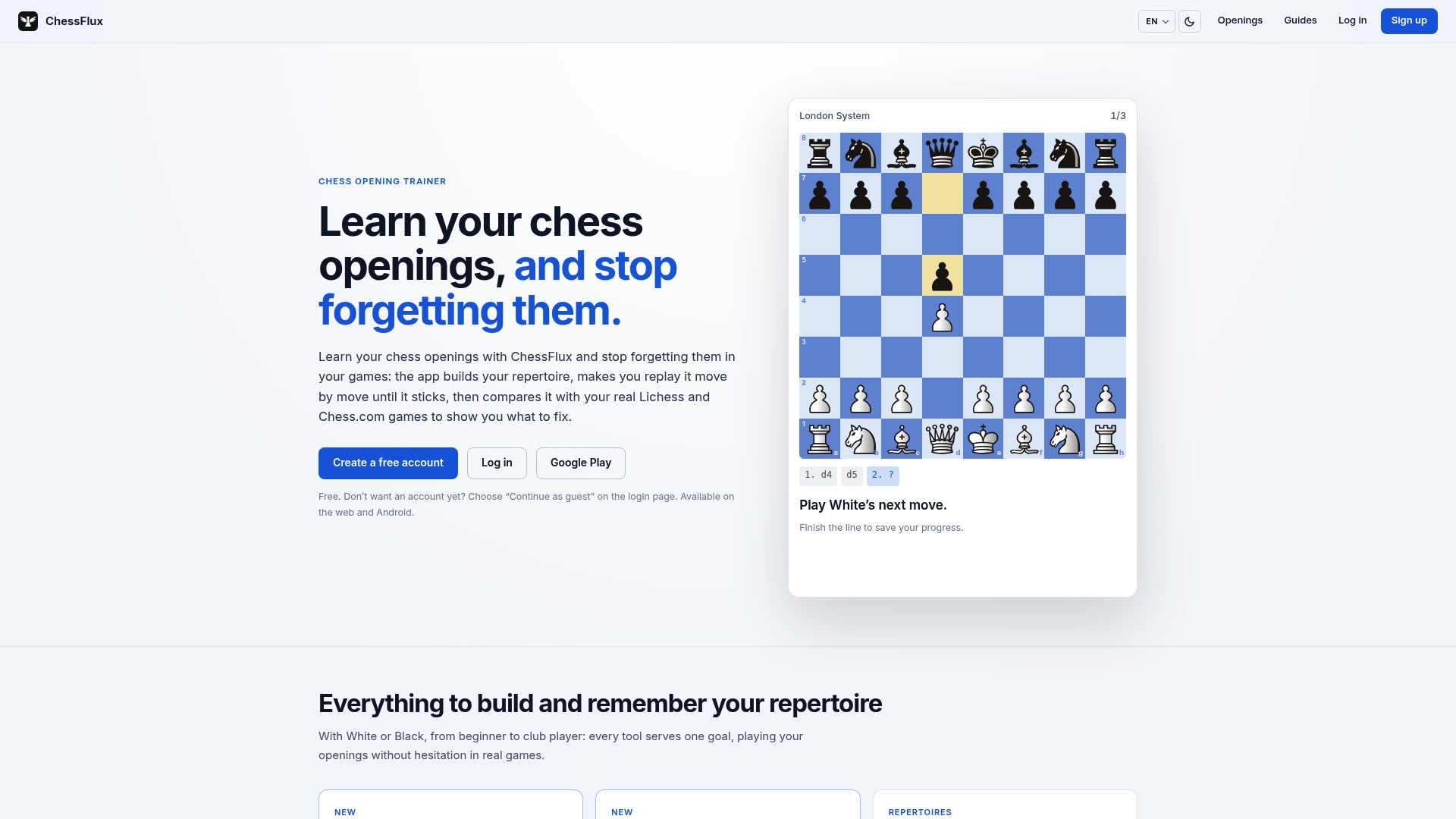
If you want to go one step further, our guide on how to build a chess opening repertoire shows how the repertoire and the puzzles feed each other.
Our view on puzzle strategy
We think most players do not have a puzzle problem. They have a connection problem.
A player rated around 1200 can solve a hundred puzzles a week and still drop a knight to a simple fork in the middlegame. The puzzles were fine. What was missing was the link between the puzzle and the game: nobody asked which pattern cost them the last three losses, or which opening produced the position where it happened.
That is why we built ChessFlux around your real games. Your last 100 games on Lichess or Chess.com tell us which openings you actually play and where you leave the repertoire. From there, the training can be targeted: the lines you need to memorize, the moves to improve, and the tactics that tend to appear in the structures you reach.
A routine beats talent here. Read the position, list checks, captures and threats, calculate to the end, and try to refute yourself. Do it on puzzles taken from your own chess and it becomes a habit you carry into the next game.
Rolf
A simple weekly plan
Here is one way to put everything together. Adjust the time to your life.
| Day | Focus | Time |
|---|---|---|
| Monday | Play two or three games at a time control that lets you think | 45 min |
| Tuesday | Review those games, mark every tactical miss, name the pattern | 20 min |
| Wednesday | Puzzles on the pattern you missed most, writing out each solution | 15 to 20 min |
| Thursday | Opening work: review the lines where you left your repertoire | 20 min |
| Friday | Puzzles from your own openings, mixed themes | 15 to 20 min |
| Weekend | Play, then repeat | flexible |
If you improve more slowly than you hoped, do not add more puzzles. Check the routine first: are you writing out solutions, are you finding the point of failure, are you returning to missed puzzles after a few days? For a broader plan beyond tactics, see our practical plan to improve at chess.
FAQ
How do I solve chess puzzles faster?
Speed comes from a stable routine, not from rushing. Read the position, list checks, captures and threats, and calculate each line to the end. After a few weeks the routine becomes automatic, and you will spot the key pattern in seconds. Add a time limit only once your accuracy is steady.
How many puzzles should I solve a day?
There is no magic number. Fifteen to twenty minutes of focused work, with a few carefully calculated puzzles, is more valuable than dozens clicked through quickly. Quality matters most: write out your solution, and review every mistake.
What should I do when I cannot find the solution?
Go back to the basics. Re-read the position, check whose move it is, and list every check and capture for both sides. If you are still stuck after a few minutes, look at the first move only, then try to find the rest yourself. Afterwards, name the pattern and return to the puzzle in a few days.
Are puzzles or real games better for improving?
Both have a place. A large 2026 study found puzzles and playing associated with similar rating gains per hour, while game review and lessons were associated with larger ones. The practical answer is to play, review your games, and use puzzles to train the weaknesses the review shows.
Can beginners use the same method as stronger players?
Yes. The routine is the same at every level: read, list forcing moves, calculate, verify. What changes is the depth. Beginners should start with one- and two-move tactics and short mates, then extend gradually.
Sources
- Améliorez votre calcul aux échecs (Martin Lacombe, French Chess Federation DEFFE thesis, 2023)
- Traps, Tricks & Mistakes: Puzzles (Nairobi Chess Club, 2026)
- Training in chess: A scientific approach (Gobet et al.)
- Not All Practice Is Created Equal: Longitudinal Evidence (Southwick et al., 2026)
- Le calcul aux échecs à la portée de tous (Echecs & Stratégie, 2023)
- Entraînement au calcul, tome 1 (Thinkers Publishing, French teaser)