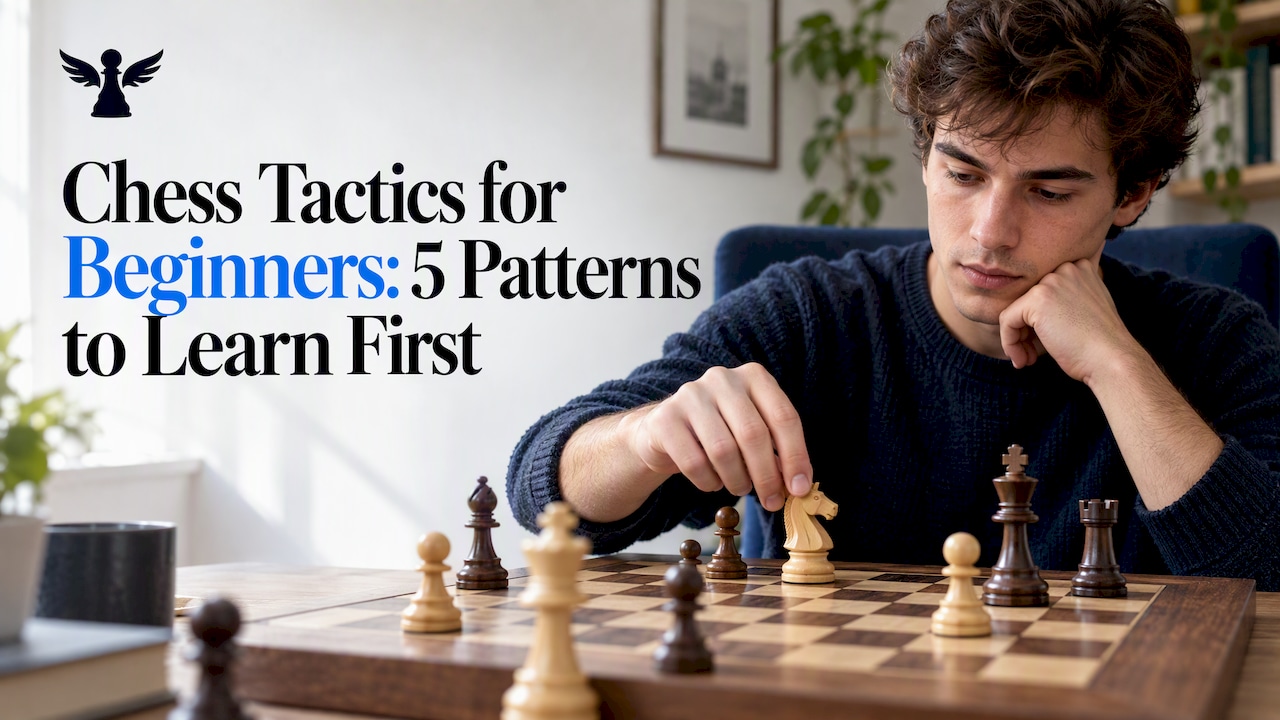
The easiest chess tactics for beginners are the fork, the pin, the skewer, the discovered attack and removing the defender. Learn to recognize these five patterns, check every move for checks, captures and threats, and practice a few minutes a day. That combination wins more games at beginner level than any opening theory.
This guide explains each pattern with a concrete picture, shows you how to spot tactical chances in your own games, and gives you a routine you can keep up. It also explains how tactics connect to your openings, because that is where most beginner tactics actually start.
TL;DR
- Five patterns cover most beginner tactics: fork, pin, skewer, discovered attack and removing the defender.
- A tactical move is almost always a check, a capture or a threat. Look at those first, every move.
- Scan before you calculate: king safety, loose pieces, and double-attack chances.
- A short daily session beats an occasional long one. Consistency is what builds pattern recognition.
- Tactics often come from your openings. Training the lines you really play gives you the positions where your tactics appear.
Table of Contents
- What counts as a tactic (and what does not)
- The five patterns to learn first
- How to spot a tactic during a game
- How strategy and development create tactical chances
- A practice routine that actually sticks
- Learn tactics from your own games
- Where openings and tactics meet
- Train tactics on the lines you play
- Common beginner mistakes with tactics
- FAQ
- Sources
What counts as a tactic (and what does not)
A tactic is a short, forcing sequence of moves that wins material or delivers checkmate, and it works because of the concrete position in front of you. You can calculate it. If you can say “I play this, he must do that, and then I win a piece,” you are looking at a tactic.
Strategy is different. Strategy is about long-term features: pawn structure, the safety of your king, which squares your pieces will want in ten moves, which pawn break to prepare. A strategic plan rarely has a forced answer. A tactical idea almost always does.
A simple test helps beginners tell the two apart:
| Question | Tactic | Strategic plan |
|---|---|---|
| Is the move forcing (check, capture or threat)? | Usually yes | Often no |
| Can you calculate it to a clear result? | Yes, in a few moves | Not fully |
| Does it win material or mate quickly? | That is the point | Rarely right away |
| Does it depend on one specific position? | Yes | It applies across many positions |
The French Chess Federation (FFE) states this plainly in a masterclass recap: a tactical move is necessarily a check, a capture or a threat. You can read the FFE masterclass summary with Kevin Terrieux (in French) for the full approach. That sentence alone gives beginners a useful filter: if a candidate move is none of those three, it is probably not the tactic you are looking for.
The five patterns to learn first
Beginner material from the French federation’s training world starts with the same family of ideas. A beginner workbook linked to the FFE programme, Tactique et premières combinaisons, covers pins, absolute and relative pins, and attraction and deflection sacrifices among its early tactical themes. The five patterns below are the foundation under all of those.
The fork (double attack)
A fork is one piece attacking two or more enemy pieces at once. Your opponent can only save one, so you win the other.
Knights are the classic forking piece because they attack in an unusual shape and cannot be blocked. A knight landing on a square where it attacks a king and a rook is the textbook example. Queens fork too, and so do pawns: a pawn move that attacks two pieces diagonally wins material very cheaply.
How to spot it: look for two enemy pieces that are one knight move away from the same empty square, or two pieces lined up so that your queen can hit both. Then check the square is safe. A fork that loses the forking piece for nothing is not a fork, it is a blunder.
The pin
A pin freezes an enemy piece in place. A bishop, rook or queen attacks along a line through one enemy piece toward a more valuable piece behind it. If the front piece moves, the piece behind is exposed.
There are two kinds. In an absolute pin, the piece behind is the king, so the pinned piece cannot legally move at all. In a relative pin, the piece behind is something valuable but not the king, so the pinned piece can move but would lose material if it did.
A pinned piece is also a weak defender. If a knight pinned to the queen is supposed to guard a square, you can attack that square and the knight cannot really help. Piling extra attackers onto a pinned piece is one of the most common ways beginners win material.
The skewer
A skewer is a pin in reverse. You attack a valuable piece, it has to move, and you capture the less valuable piece behind it. A rook checking a king along a file, with the enemy rook or queen sitting on the same file behind it, is the standard example: the king steps aside and you take the piece.
Skewers show up mostly in the endgame and in open positions with long lines. Whenever your bishop, rook or queen has a long open line, ask yourself what is lined up on it.
The discovered attack
A discovered attack happens when you move one piece and, by doing so, open a line for another piece behind it. Now two things are happening at once: the piece that moved does something, and the piece you uncovered attacks something.
The most powerful version is a discovered check, because the opponent must answer the check and cannot deal with whatever your moved piece just attacked. If your moving piece also captures or threatens a queen, the result is often decisive. Beginners tend to miss these because they look at the moving piece and forget what stands behind it.
Removing the defender
Sometimes a piece is protected by exactly one defender. If you capture, chase away or distract that defender, the protected piece falls. This is called removing the defender, and the more specific forms are deflection (forcing a defender away from its post) and attraction (luring a piece onto a bad square). Both appear in the FFE-linked beginner workbook cited above.
The habit to build is counting. For every enemy piece you might attack, count attackers and defenders. If defenders are fewer than attackers, you may win it. If one defender holds everything together, go after that defender.
How to spot a tactic during a game
Knowing the patterns is half the work. The other half is noticing, at the board, that one of them is available. The FFE advises a diagnosis first: scan the king, the pieces that are attacked or unprotected, and the possibilities for a double attack. Then look for candidate moves, beginning with checks, captures and threats, and calculate those candidates all the way through. This comes from the FFE masterclass recap mentioned above.
Here is that advice as a routine you can run on every move:
- Look at your opponent’s last move. What does it threaten? What did it leave undefended?
- Scan for loose pieces. Any piece, yours or theirs, that no other piece protects is a target.
- Check both kings. Is either one exposed, stuck in the center, or short of escape squares?
- List forcing moves. Checks first, then captures, then threats.
- Calculate each forcing move to the end. Do not stop at the first good-looking reply. Ask what your opponent’s best answer is.
- Run a blunder check before you play: what does my move leave unprotected?
This takes discipline at first and feels slow. After a few weeks it becomes a quick glance, and the glance is what catches the free knight.
How strategy and development create tactical chances
Tactics do not appear out of nowhere. They grow from positions, and positions are shaped by how well you played the first ten moves. This is why the old advice still holds: control the center, develop your pieces, castle early, and do not move the same piece twice without a reason.
Here is the connection in practice:
- Developed pieces can attack. A bishop still on its starting square cannot pin anything. A knight on the rim cannot fork.
- A castled king is a safer king. Your own king in the center gives your opponent forks, pins and discovered checks against you.
- Central control gives your pieces room. Pieces placed on active central squares reach more targets, so more double attacks become possible.
- Undeveloped opponents are tactical gifts. If your opponent has left a bishop and a rook at home while you have developed fully, open lines in the center usually produce tactics for you.
In short, good development does not replace tactics. It builds the stage on which tactics happen. A beginner who gets a comfortable position out of the opening will see far more chances than one who is already scrambling by move eight.
A practice routine that actually sticks
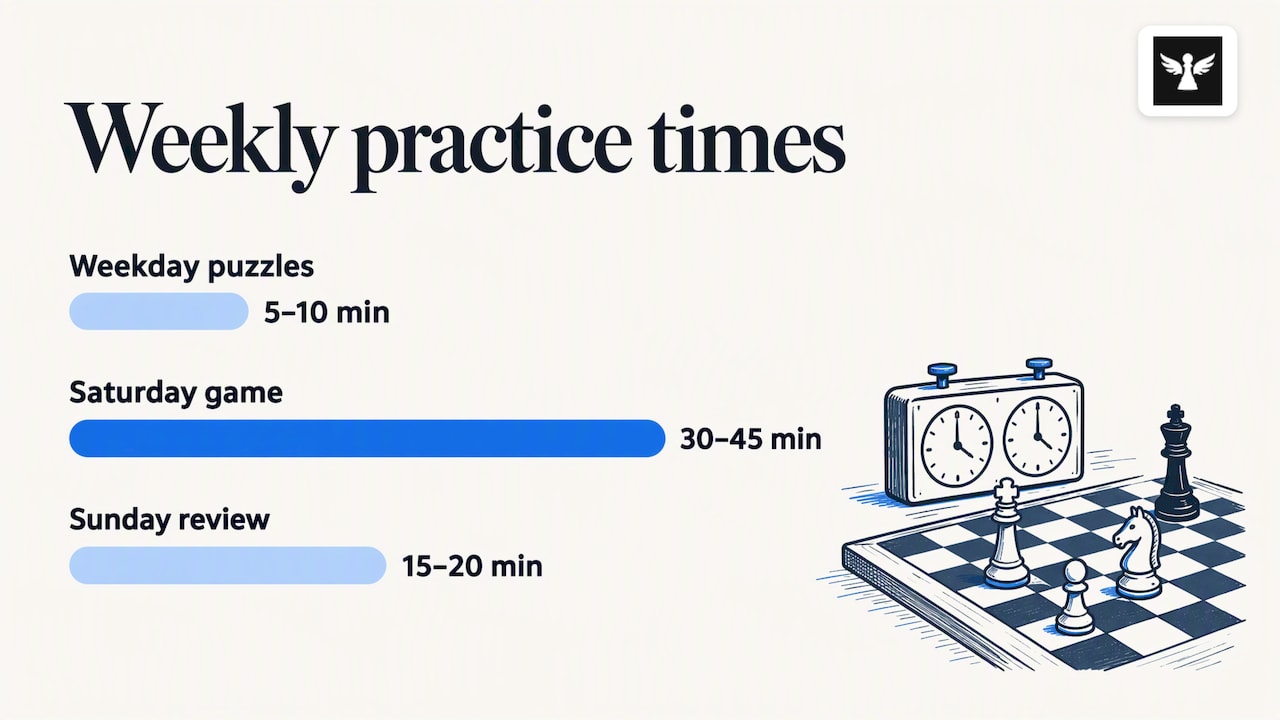
Pattern recognition is a habit, and habits are built by frequency, not by marathon sessions. The 365 Steps to Tactical Mastery guide suggests a near-daily routine of roughly 5 to 10 minutes, and says consistency and thoughtful solving matter more than the number of exercises completed. For a beginner, that is a realistic target: a coffee-break session you will not skip.
Here is a simple weekly structure:
| Day | What to do | Time |
|---|---|---|
| Monday to Friday | A few puzzles on one theme (for example, forks only) | 5 to 10 minutes |
| Saturday | Play one longer game, slowly, using the six-step routine | 30 to 45 minutes |
| Sunday | Review that game and write down every missed tactic | 15 to 20 minutes |
Some useful rules for puzzle sessions:
- Solve by theme first. Spend a week on forks, then a week on pins. Knowing the theme tells your brain what to look for, which builds the pattern.
- Do not guess. Find the whole line before you move a piece. A puzzle solved by luck teaches nothing.
- Repeat what you miss. If a puzzle beat you, come back to it in a few days and solve it again from scratch.
- Move to mixed puzzles later. In a real game nobody tells you which theme is hiding, so mixed sets prepare you for it.
For structured, school-style material, the FFE’s École d’Échecs à la Française is the federation’s official teaching programme for clubs, schools and associations. It is organized over four years with one level per year, and the instructor booklets, videos and student exercise books are free to download without an account. If you live in France, it is also worth asking your local club whether it follows the programme.
Learn tactics from your own games
Puzzles teach the patterns in isolation. Your own games show you which patterns you personally miss. After each game, go back and mark three things: a tactic you played, a tactic you missed, and a tactic your opponent had against you. Most players find that the same two or three motifs keep recurring, and that is your study list.
The free, step-by-step method for this is covered in our guide to analyzing your chess games. If you want a wider plan that brings tactics, openings and endgames together, see How to Improve at Chess: A Practical Plan That Works.
Where openings and tactics meet
Many beginner tactics are not random middlegame accidents. They sit inside known opening traps and typical positions. A few examples of how that works:
- In many openings, a pinned knight on f3 or c3 is a recurring theme, and knowing the line tells you when the pin becomes a threat.
- Some openings lead regularly to the same fork squares. Players who have studied the line see the fork coming before it happens.
- When you do not know your opening, you spend your thinking time just surviving the first ten moves. When you do, you arrive in the middlegame with time and energy to calculate.
That is why opening knowledge and tactical skill feed each other. If you play the French Defense, for example, our French Defense guide with moves, plans and traps shows the typical tactical motifs of that structure. You can also browse the full set of chess opening guides.
Our perspective
We built ChessFlux on one observation: most beginners practice tactics in a vacuum and openings in a vacuum, and then wonder why neither shows up in their real games. A puzzle set picked at random does not know which positions you actually reach.
That is why we start from your real games. ChessFlux builds a repertoire from your last 100 games on Lichess or Chess.com, compares what you played with what you meant to play, and points to the moves that need work. Our puzzles can be filtered by theme or by opening, so the forks and pins you practice come from lines you really play.
We believe progress should be measurable. When your training follows your own games, you can see which positions you handle well and which ones keep costing you material. In our experience of designing the app, that feedback loop is what turns scattered practice into steady improvement.
Rolf
Train tactics on the lines you play
If you want puzzles that match your own games, ChessFlux offers a free core app and a Premium subscription that unlocks options such as unlimited puzzles, advanced training and extra customization. You can import your last 100 games from Lichess or Chess.com, get a personal repertoire, and practice tactics by theme or by opening.
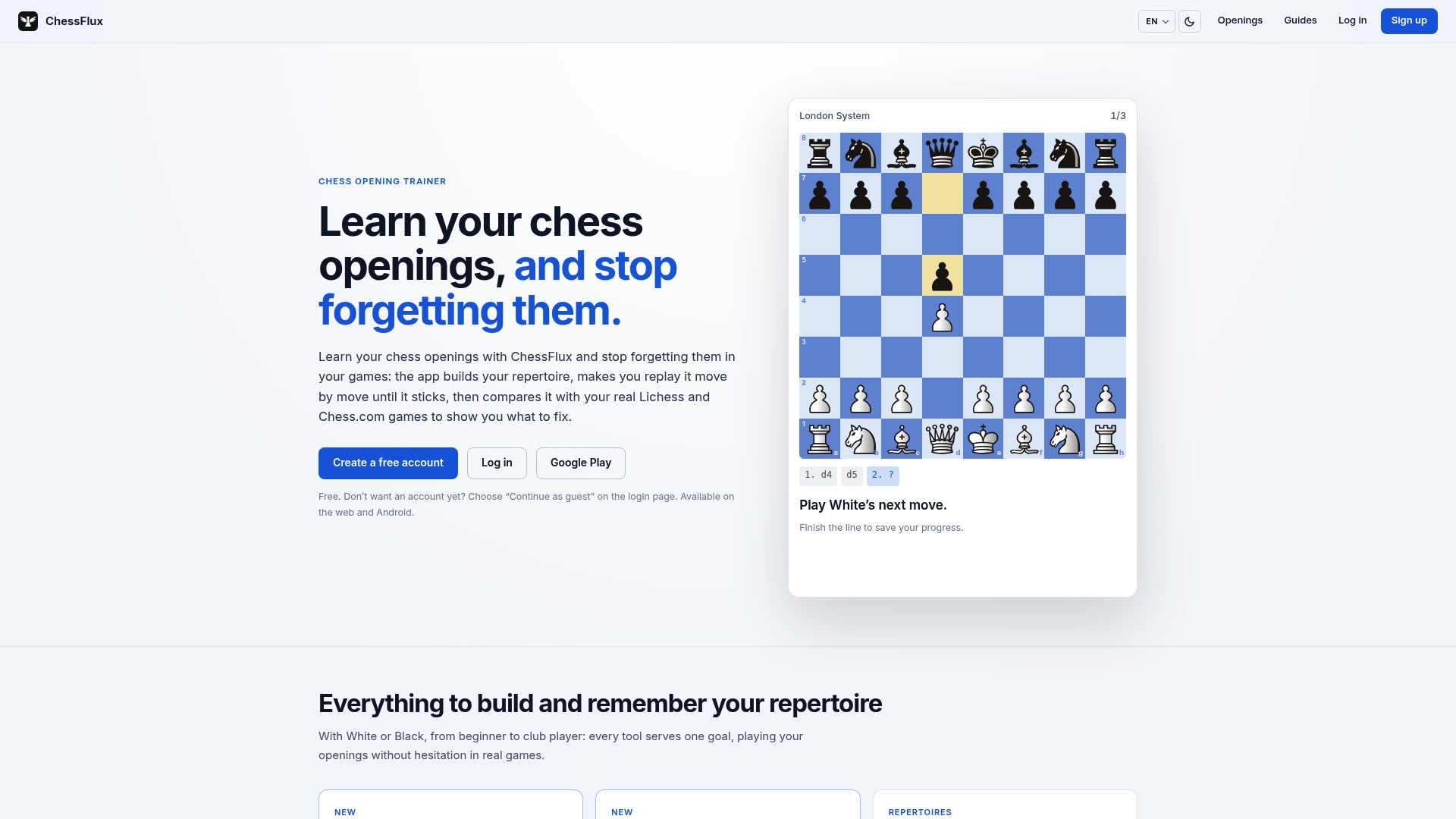
Start on the ChessFlux home page, read how the tactics training and puzzles work, or see how to build a repertoire from your Lichess or Chess.com games.
Common beginner mistakes with tactics
A few habits slow most beginners down. Fixing them is quicker than learning new patterns.
- Playing the first capture you see. A capture is a candidate, not an answer. Check what it leaves unprotected.
- Ignoring your opponent’s threats. Before looking for your own tactic, ask what your opponent wants to do. Half of tactical improvement is not falling for theirs.
- Trying to calculate everything. You do not need to see ten moves ahead. Most beginner tactics are two or three moves deep. Calculate forcing lines fully and ignore quiet ones.
- Skipping the review. Playing many games without review repeats the same mistakes. One reviewed game teaches more than five forgotten ones.
- Learning too many themes at once. Pick one pattern, solve it until it feels obvious, then move on.
FAQ
What are the easiest chess tactics for beginners?
The fork, the pin and the skewer are the easiest to learn because each one rests on a single, easy-to-picture idea. The discovered attack and removing the defender come next. Together these five patterns cover most of the material you will win in beginner-level games.
How do I know if a move is a tactic or just a plan?
Ask whether the move is forcing and can be calculated. A tactic is a check, a capture or a threat that leads to a clear result in a few moves. A plan, like improving a piece or preparing a pawn break, is slower and has no forced outcome.
How long should I practice tactics each day?
A short, regular session is enough to start. One guide to tactical training recommends about 5 to 10 minutes almost every day, prioritizing careful solving over volume. Add longer sessions once the habit is solid and you enjoy it.
Should I learn openings or tactics first?
Start with both at a basic level. Learn core opening principles (develop, control the center, castle) and the five tactical patterns together. Once you know the lines you actually play, tactics from those positions come up more often and are easier to recognize.
Can I practice tactics from my own online games?
Yes. Review your games from Lichess or Chess.com, mark the tactics you missed, and practice those themes specifically. Tools that build training from your own game history can speed this up by pointing at the positions you actually reach.
Sources
- Masterclass FFE du 6 avril 2020 avec Kevin Terrieux
- Tactique et premières combinaisons (cahier débutant)
- École d’Échecs à la Française, Fédération Française des Échecs
- 365 Steps to Tactical Mastery