A perpetual check is a sequence where one player keeps giving check and the other king cannot escape the checks for good, so the same position keeps coming back. Strictly speaking, the checks do not end the game. A draw happens through the repetition rules, and the player who is worse uses the checks to reach one. It is the most common way to save a lost position, and also the most common way to throw away a won one. If you play on Lichess or Chess.com, you will meet it often, on both sides of the board.
TL;DR
- A perpetual check is a never-ending series of checks that the checked king cannot stop. The game is drawn by repetition, not by the checks themselves.
- Under FIDE rules, a player may claim a draw when the same position appears a third time, and the game is drawn automatically at the fifth (FIDE Articles 9.2 and 9.6 summarized here). Online servers usually apply threefold repetition for you.
- If you are worse, look for checks before every defensive move. If you are better, look for where your king can hide before you attack.
- Perpetual check lives on open kings, loose pawn shields and a queen that can reach the back rank or the long diagonal.
- Your own games show how often it costs you half points. Review them with your openings in mind, because the opening decides how safe your king is.
Table of Contents
- What perpetual check means
- How the draw is declared
- A typical perpetual check, step by step
- The patterns behind most perpetuals
- If you are worse: how to find the perpetual
- If you are better: how to avoid giving one
- Is a perpetual check a good result?
- Perpetual check and your openings
- Practice: how to get better at seeing perpetuals
- Promo: see where your openings leave your king exposed
- Our perspective
- FAQ
- Sources
What perpetual check means
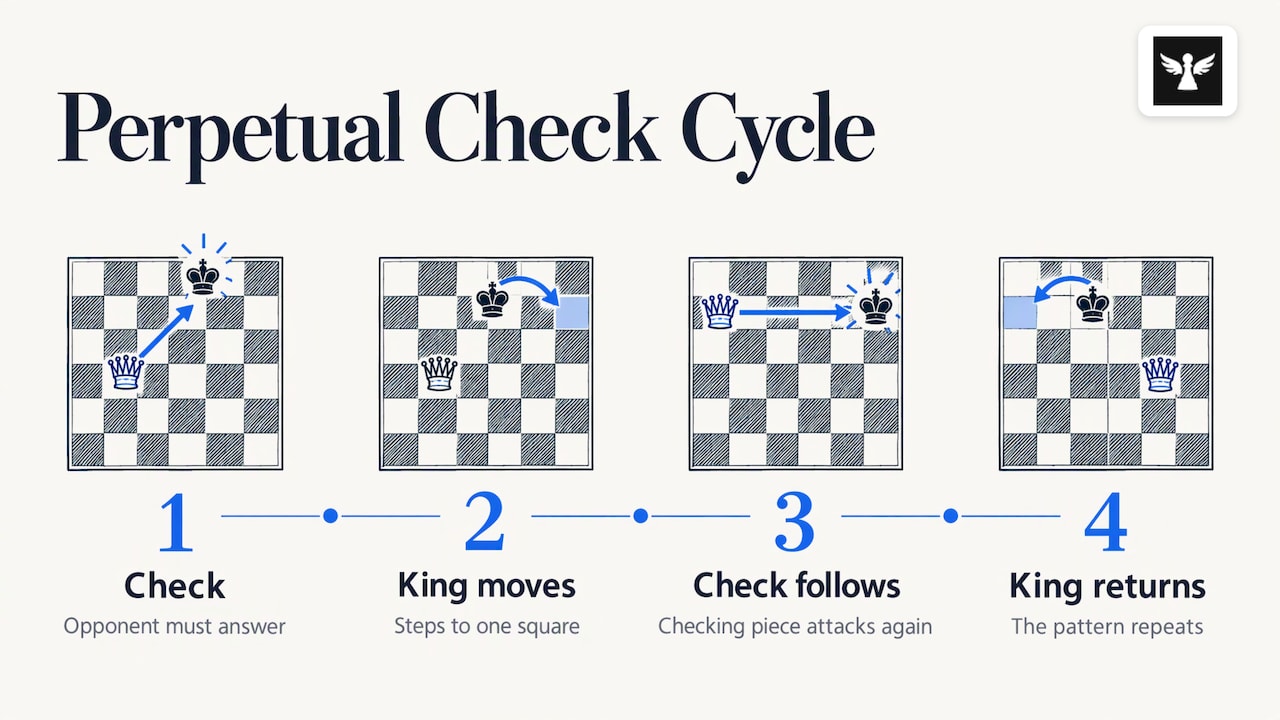
One player checks the king. The opponent has to answer the check by moving the king, blocking or capturing the checking piece. In a perpetual, none of those answers breaks the pattern: the king steps to one square, the checking piece follows with another check, and the king has to go back. Round and round.
The name is a little misleading. As players on the Lichess forum point out, no separate rule says “perpetual check is a draw”. What exists is a position where the checking side can force a repetition of positions, or run into the 50-move rule. The draw then comes from those rules.
That distinction matters in practice. You do not need to find an “official” perpetual check. You need to show that the position can be repeated and that your opponent has no way out.
How the draw is declared
Here is the rule in plain terms, as the FIDE Laws of Chess set it out. FIDE is the international chess federation, and its Laws apply in official tournaments, including those held in France.
| Occurrence of the same position | What happens |
|---|---|
| 1st and 2nd | Nothing. The game goes on. |
| 3rd | The player to move may claim a draw. |
| 5th | The game is drawn automatically. |
The figures come from this summary of FIDE Articles 9.2 and 9.6. The same page notes that the moves do not need to come in the same order: what counts is the same position, with the same player to move and the same possibilities available.
On Lichess and Chess.com, the server tracks repeated positions for you, and a draw by repetition can be claimed or is applied by the platform. In a game over the board, you must claim the draw yourself, usually by writing your move on your scoresheet and calling the arbiter, so learn how your event handles it.
A typical perpetual check, step by step
Think of a position where you are down a rook, but your queen sits close to the enemy king. The enemy king has castled, the pawn in front of it has moved, and no piece of his can step in between.
- You give check with the queen on one square.
- The king has only one legal reply, because every other square is covered or blocked by his own pieces.
- You check again from another square, and the king has to return.
- The position appears a second time, then a third, and you claim or receive the draw.
Three conditions have to be true together:
- The king has no safe squares beyond the shuttle. Usually its own pawns or pieces trap it.
- No piece can block the check. A rook or bishop that can interpose ends the sequence.
- The checking piece cannot be captured. A queen that can be taken for free is not a perpetual.
When all three hold, you have the draw in hand. When one fails, the “perpetual” is just a few spite checks before you lose.
The patterns behind most perpetuals
You do not have to calculate everything from scratch. A few recurring shapes explain most perpetual checks in club games.
The exposed king after a pawn storm
When your opponent pushes the pawns in front of his own king to attack you, he opens lines against himself. A queen and one more piece, often a knight or a rook, can then deliver checks that cannot be blocked. This is the most frequent way a winning attack collapses into a draw.
The queen alone on the open board
A queen can check from far away along files, ranks and diagonals. If your opponent has no piece near the king, one queen can keep checking from both sides of the board. Taking your queen off the board, or putting a piece where it can block, is the cure.
The back rank and the corner
A king stuck in the corner with pawns on the second rank has few squares to run to. Checks along the first or eighth rank can repeat when no piece guards the line.
The check that comes with a threat
Some checks also attack something else, such as a rook or a queen. These are not perpetual checks in the strict sense, because the sequence ends in a win of material, but they begin the same way. Our article on discovered check covers a related idea: the check that comes from a piece moving out of the way.
If you are worse: how to find the perpetual
When you are losing material, this checklist is the quickest way to find a draw.
- List every check you have. Not just the obvious ones: captures that check, pawn checks and discovered checks too.
- Look at the enemy king’s escape squares. Count how many are free after each check.
- Ask whether a piece can block. If the answer is yes, check whether you can pin that blocker or capture it.
- Look for two checking squares. You need to be able to go back and forth, so find a second square from which the queen checks again.
- Test the repeat. Play the two checks in your head three times. If the king ends up on the same squares each time, you have found it.
This habit takes a few seconds and saves many half points. The chess tactics for beginners list helps you build the pattern recognition, and a calm daily tactics routine keeps it sharp.
If you are better: how to avoid giving one
Most players lose more points by allowing a perpetual than they gain by finding one. The fix is simple but needs discipline.
- Before you attack, find a shelter for your king. A pawn step such as h3 or a2-a3 creates an escape square so that the last check can be answered by moving the king forward.
- Trade queens when you are ahead. No queen, no long series of checks. An ordinary extra rook then wins on its own.
- Keep a piece close to your king. A knight or bishop that can block removes whole families of perpetuals.
- Run the same check list for your opponent. Before every attacking move, ask: if I lose my initiative, what checks does he have?
- Do not grab pawns with your queen far from home. That is how the checking squares get opened.
This ties directly to the hanging pieces habit: check what is loose, yours and your opponent’s, before you move.
Is a perpetual check a good result?
It depends on the game, and on the person across the board.
Against a stronger player, a draw rescued by a perpetual is a good result. Against an equal opponent, taking a draw from a worse position is a good result. Taking a draw from a better position is a missed chance, which is why the previous section matters.
In a tournament where you need a win, the position may force you to avoid the repetition. Repeating a position twice is allowed, so you can try a different move on the third time. Only you know whether the alternative is a real try or a blunder.
Perpetual check and your openings
Many perpetual checks start in the opening. Where your king goes, what pawns you move and what pieces you develop all decide whether an opponent can later harass you with checks.
Some examples of what that means in practice:
- Castling early and leaving the pawn shield alone keeps the king safe from queen checks. Moving the f-pawn or g-pawn without a reason creates the very squares a queen needs.
- In structures with the king in the center, such as in some French Defense lines, a queen on the open diagonal can check repeatedly. Know where your king will live.
- In solid setups such as the London System or the Caro-Kann, the king is usually safe and checks are rare, which is one reason players choose them.
- When you face 1.d4, the choice of defense changes where your king can be harassed later.
You can see the pattern across all the chess openings: the plan for the king is part of the opening, not something you improvise in the middlegame.
Practice: how to get better at seeing perpetuals
Three exercises work well for club players.
- Puzzles on a theme. Solve a set of positions where the only way to save the game is a perpetual. You are training the check list from the earlier section.
- Blindfold the checks. Take a position and play out the check sequence in your head, then verify on the board. The visualization exercises are made for this.
- Review your drawn and lost games. Look for the moment you could have given or avoided a series of checks. If the same king structure keeps showing up, it points to an opening problem.
The third one is the most useful and the one most players skip.
Promo: see where your openings leave your king exposed
Our app builds a personal repertoire from your last 100 games on Lichess or Chess.com. It compares what you actually played with that repertoire, so you can see which opening lines you keep reaching and where you leave the book. That is a quick way to find the openings in which your games drift into messy positions, including ones with checks against your king.

You can start with the free version at ChessFlux, and read how to build a repertoire from your own games or memorize openings with active training. The app also offers tactics puzzles by theme or opening, and opening analysis with Stockfish, an engine that evaluates positions.
Our perspective
Most players meet perpetual check as a surprise: a won game becomes a draw, and the cause seems to be one bad move at the end. We see it differently. The bad move is usually the opening choice made twenty moves earlier, which left the king without shelter or the queen without a way to be traded.
That is why we built ChessFlux around your own games rather than around generic courses. A repertoire drawn from your last 100 games on Lichess or Chess.com shows the structures you actually reach, and the training sessions repeat the lines where you leave your preparation. Once you know your lines, you stop spending your thinking time on the opening and can use it to check the king’s safety, yours and your opponent’s.
Perpetual check is a tactical idea, but the way to avoid it, or to find it when you need it, is preparation: know your structures, and the checks stop being a surprise.
Rolf
FAQ
What is perpetual check in chess?
It is a series of checks that the checked player cannot escape, so the same positions repeat. The game then ends in a draw through the repetition rules. The checks themselves are what make the repetition possible.
Is perpetual check the same as threefold repetition?
Not exactly. Threefold repetition is the rule: when the same position appears three times, the player to move may claim a draw. Perpetual check is one way to get there, by forcing the opponent to repeat. Repetition can also happen without any checks.
Can you avoid a perpetual check when you are winning?
Often yes. Give your king an escape square, trade queens, or bring a piece close enough to block. Before each attacking move, list the checks your opponent would have if the attack stalls.
Does the game end on the third repetition?
Not automatically in over-the-board play under FIDE rules: a player must claim the draw on the third occurrence, and the game is drawn automatically on the fifth, according to this summary of the FIDE Laws. Online platforms generally handle repetition for you, but their settings differ, so check how yours works.
Sources
- How Many Times Can You Repeat a Position in Chess? (FIDE Articles 9.2 and 9.6)
- What does perpetual checks mean? (Lichess forum)