
The Stafford Gambit is a trappy pawn sacrifice for Black that arises from the Petrov’s Defense: 1.e4 e5 2.Nf3 Nf6 3.Nxe5 Nc6. Black gives up a pawn for fast development and quick attacking chances against White’s kingside. Engines say White is better, but at club and online level it scores far better than its evaluation suggests. This guide covers the moves, the main lines, the traps, how White can decline or defend, and how to learn it.
TL;DR
- The gambit starts with 3…Nc6 after White takes the e5 pawn. The main line continues 4.Nxc6 dxc6, and Black gets an open d-file and an active bishop for the pawn.
- The famous trap is 5.d3 Bc5 6.Bg5?? Nxe4!, when Black wins the queen or mates.
- White’s safest plan is to take the pawn, trade the knight, play d3, Be2, and delay castling until Black’s ideas are under control.
- It suits fast online games best. In classical chess against prepared opponents it is a risk.
- Memorize the lines by drilling them move by move, then check them against your own games.
Table of Contents
- What is the Stafford Gambit?
- The move order, step by step
- The main line: 4.Nxc6 dxc6
- How White can decline or defend
- Is the Stafford Gambit actually good?
- When to play it, and when not to
- Black’s plan when White avoids the traps
- Perspective
- Learn the lines with ChessFlux
- How to practise it: a simple plan
- FAQ
- Sources
What is the Stafford Gambit?
The Stafford Gambit is a sharp, irregular opening that arises from Petrov’s Defense after 1.e4 e5 2.Nf3 Nf6 3.Nxe5 Nc6. Its ECO code is C42. Black offers a pawn in return for rapid development, open diagonals for both bishops and immediate tactical pressure on White’s kingside.
The name comes from the game Lowens–Stafford, played in 1950. In it White answered with 5.e5 Ne4 and blundered with 6.d3??, then resigned after 6…Bc5!, because 7.dxe4 runs into 7…Bxf2+ and the queen falls. The opening stayed obscure for decades. It exploded in online blitz in the early 2020s, largely through American International Master Eric Rosen, according to the same reference page. A 2021 academic paper, Gambits: Theory and Evidence, notes that it spread among beginner and novice players because streamers played it live for thousands of viewers.
The move order, step by step
Here is the start of the opening:
- e4 e5
- Nf3 Nf6
- Nxe5 Nc6
Instead of the Petrov’s usual 3…d6 and a pawn recapture, Black develops a piece and leaves the pawn to White. Two ideas matter right away:
- Black wants to play …Bc5, aiming at f2, together with …Ng4, …h5 and …Qh4.
- White’s e5 knight is exposed. After 4.Nxc6 dxc6 the knight is gone and Black has an open d-file for the queen.
If you want a refresher on why early piece activity beats early pawn grabbing, our guide to opening traps in chess explains how traps work and how to avoid walking into them.
The main line: 4.Nxc6 dxc6
The main line goes 4.Nxc6 dxc6. According to the opening’s reference page, Black accepts doubled c-pawns and a one-pawn deficit in return for an open d-file and an active diagonal for the c8 bishop. Engine work using Stockfish’s multi-line feature, published by ChessMonitor in 2025, finds that taking the knight is by far White’s best move, with the second-best option already down to around +0.7.
After 4…dxc6, White’s main choices are:
| White’s move | Character | What Black does |
|---|---|---|
| 5.d3 | Solid, the most popular choice | 5…Bc5 with development and threats against f2 |
| 5.e5 | Sharp, can lead to complications | 5…Ne4, the line of the original 1950 game |
| 5.Nc3 | Flexible, but with pitfalls | Watch for …Ng4 ideas |
The reference page adds that White can use c3 and d4 to neutralize the bishop on c5. That is the practical antidote in many lines.
5.d3 Bc5: the key position
Most games go through this position. Black has a lead in development, a bishop pointing at f2, and a queen ready to use the d-file. White has an extra pawn and a healthy structure. The academic paper mentioned above reports a strongly negative evaluation for White’s side in its engine-learning model here, and suggests that f3 followed by c3 is a simple answer. In human games, what matters is that every natural-looking move is not safe.
The queen trap: 6.Bg5??
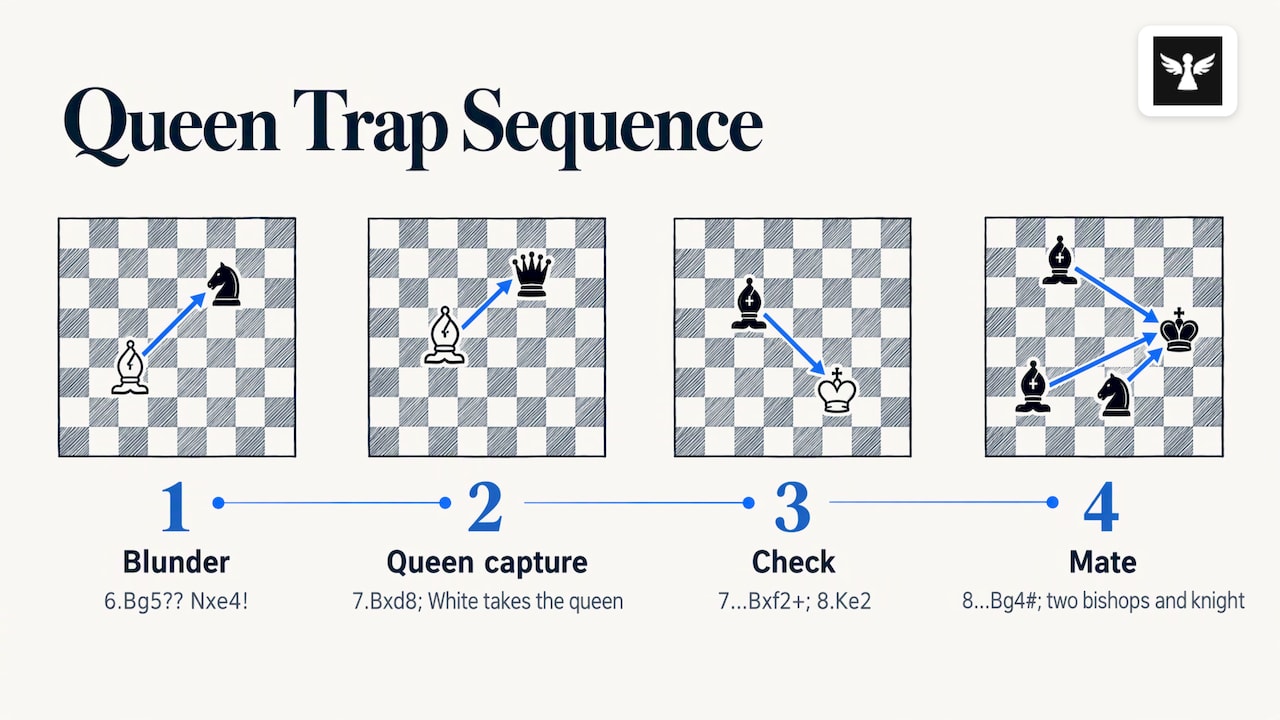
The best-known trap is built on a natural pin. After 5.d3 Bc5, the move 6.Bg5?? loses to 6…Nxe4! The trap write-up describes the typical finish: White takes the queen with Bxd8, Black plays …Bxf2+, and …Bg4# follows.
The full sequence is 7.Bxd8 Bxf2+ 8.Ke2 Bg4#. White’s king is mated by two bishops and a knight, while White has just won a queen. Check every check and capture before you grab material in this opening.
Trap number two: the 6.h3 line
A second trap appears against an opponent who plays 6.h3. House of Staunton describes the setup: Black develops the bishop to e6, the queen to d6 and castles long, then sacrifices on h3 with 9…Bxh3 and a forced mating sequence. The lesson for Black is that the attack works through harmonious development, not only one-move tricks.
How White can decline or defend
People who search for the gambit “declined” usually mean one of two things.
Declining before it starts. White can avoid 3.Nxe5 altogether. On move 3, solid choices such as 3.Nc3 or 3.d4 steer the game toward Petrov-style or Open Game structures where the Stafford does not exist. You give up the extra pawn, but you also give up Black’s trap-laden positions. Against a Stafford specialist, this is the lowest-risk way to avoid all theory. Another route is to avoid the Petrov by choosing a different second move, such as 2.Bc4 or 2.Nc3, if you play 1.e4.
Accepting but refusing the tricks. Most players take the pawn and defend actively. The practical recipe from Chesscompass is 5.d3 Bc5 6.Be2, then develop and castle. If Black plays 6…h5, it recommends 7.c3 or 7.h3 before castling. The reason is that after 7.O-O Ng4 8.Bxg4 hxg4, Black gets the half-open h-file, and the site reports that Black wins about six games in ten on Lichess after 7.O-O.
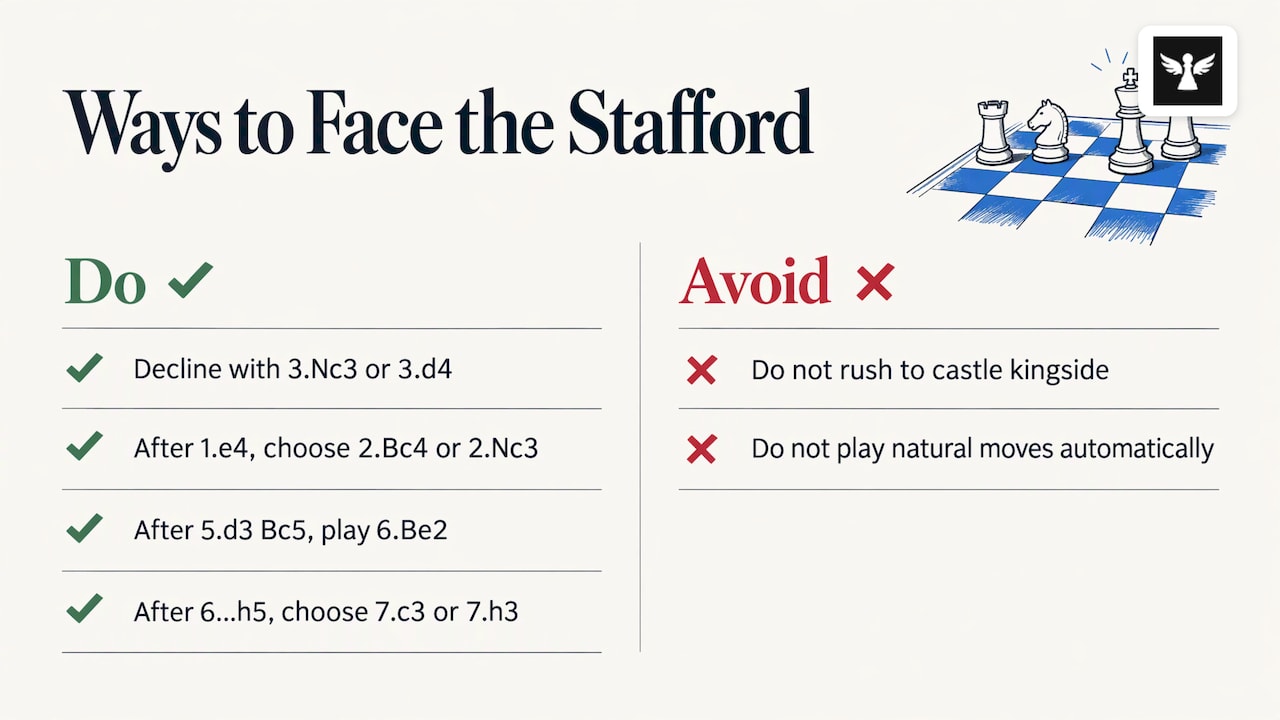
That same page also gives the key warning: White cannot just play natural moves, and in particular should not rush to castle kingside, because that often falls into Black’s attack before Black is even fully developed.
A simple defensive checklist for White
- Take the pawn on e5, then take on c6. Do not wander with the knight.
- Play d3 and Be2 instead of pinning the knight with Bg5.
- Count Black’s attackers on f2 before every move.
- Delay castling until you have played c3 or h3, or have a clear reason.
- When Black sacrifices a piece, calculate checks first, captures second.
Is the Stafford Gambit actually good?
The honest picture is that it is theoretically doubtful but practically dangerous. House of Staunton cites an engine score of +1.4 for White and calls the opening a killer choice for blitz, noting that few titled players would choose it in classical games.
Practical results back this up. According to Chesscompass, on Lichess Black wins more than White after 4…dxc6 in blitz and bullet at every rating, and in rapid and classical below 2000. Only in rapid and classical above 2000 does White come out ahead.
The ChessMonitor engine study also found that only two of the five most-played White moves in the Stafford appear among the engine’s top candidates. That gap between human habit and engine accuracy is exactly what Black exploits.
When to play it, and when not to
The Stafford fits you if:
- you play mostly blitz or bullet online;
- you enjoy attacking chess and tactical calculation;
- you want an opening with few lines to learn at the start.
It fits less well if you face well-prepared opponents in slow games, where White’s simple plan of d3, Be2 and c3 keeps the extra pawn. If you want a solid alternative, try a classical first-move choice like the Italian Game, or look at another surprise weapon such as the Alien Gambit.
Black’s plan when White avoids the traps
Against calm play, Black does not have a forced win, so the plan is to keep developing and create threats:
- Bring the bishop to c5, then …Ng4 and …h5 to prepare …Qh4.
- Use the open d-file: the queen often goes to d6 or e7, and the c8 bishop heads to e6 or g4.
- Consider long castling when the d-file is open, as in the h3 trap above.
- Do not sacrifice for the sake of it. If White has defended accurately, stay flexible and play for activity.
Perspective
Most players meet the Stafford after losing to it, then try to memorize a few traps. That works for about a week. Then an opponent plays 6.Be2 and the memorized trap never appears.
We think the better way to learn any gambit is to work from your own games. Look at which moves your opponents actually play against you, drill those branches until the replies are automatic, and review where you left your preparation. That is how ChessFlux is designed: it builds a repertoire from your last 100 games on Lichess or Chess.com, compares what you played with what you prepared, and targets the lines that matter for you.
For an opening as trap-heavy as the Stafford, this matters twice. As Black, you need the main line, the 6.Be2 h5 branch and the 6.h3 attack ready. As White, you need to recognize 6.Bg5?? at a glance and know why castling too soon is risky. Repetition turns those patterns into instinct.
Rolf
Learn the lines with ChessFlux
ChessFlux is an interactive opening trainer. You can build a personalized repertoire from your last 100 Lichess or Chess.com games, memorize it move by move, and see where your real games depart from it. You can also build variation trees, import PGNs and studies, practice tactics puzzles by theme or opening, and check lines with Stockfish. There is a free version, and Premium unlocks extra options such as unlimited puzzles and advanced training.

If you want to start with the Stafford, build a repertoire from your own games, then train the moves actively. You can start on the ChessFlux home page.
How to practise it: a simple plan
- Learn the spine. Memorize 1.e4 e5 2.Nf3 Nf6 3.Nxe5 Nc6 4.Nxc6 dxc6 5.d3 Bc5, with both sides’ ideas.
- Add the traps. Drill 6.Bg5?? Nxe4! and the 6.h3 attack until you can play them without thinking.
- Add the quiet replies. Spend equal time on 6.Be2 and the 6…h5 branch, since strong opponents will choose them.
- Train tactics. The motifs here are pins, back-rank and f2 attacks, and queen sacrifices. Our guide to chess tactics for beginners covers the first patterns to learn, and tactics puzzles by theme let you drill them.
- Check with an engine. Use Stockfish analysis to see where your improvisations go wrong, then fix the line in your repertoire.
- Review your games. Each week, compare what happened with what you prepared.
FAQ
Is the Stafford Gambit a good opening?
It is a good practical weapon for blitz and bullet, and a risky choice against well-prepared opponents in slow games. Engines give White an edge, around +1.4 in one published evaluation. But many opponents fall for the traps, and Black wins more often than White at most rating levels in fast online games.
What is the Stafford Gambit?
It is a pawn sacrifice for Black in Petrov’s Defense: 1.e4 e5 2.Nf3 Nf6 3.Nxe5 Nc6. Black gives up the e5 pawn for quick development and attacking chances against White’s king. It became widely known in online chess in the early 2020s.
How do you beat the Stafford Gambit as White?
Take the pawn, trade on c6, play d3 and Be2, and do not castle too early. Avoid the pin 6.Bg5??, which loses to 6…Nxe4. If Black plays …h5, prepare with c3 or h3 before castling.
Can White decline the Stafford Gambit?
Yes. White can avoid 3.Nxe5 and play a quieter third move, or choose a different second move so the Petrov never arises. You then give up the extra pawn, but you also avoid the traps and the theory entirely.
Sources
- Stafford Gambit, reference page
- Gambits: Theory and Evidence (arXiv 2110.02755)
- Stafford Gambit: Traps, Main Lines and How to Beat It
- Trap Them All With The Stafford Gambit
- Engine-Powered Opening Explorer
- Stafford Gambit (Petrov trap): moves and the queen trap