
An opening tree is a map of every move order that can follow a starting position. Each position is a node, each move is a branch, and the useful question is not “how big is the tree?” but “which branches will I actually meet?” The best tree for you is built from your own games. That is how ChessFlux works: it builds a personal repertoire from your last 100 Lichess or Chess.com games and trains you on the branches you really play.
TL;DR
- An opening tree shows positions as nodes and moves as branches. Trees get wide fast, so nobody memorizes one in full.
- Explorer trees show how often a move is played and how it scores. They tell you what is popular, not what suits you.
- The branches worth learning are the ones that appear in your own games, not the ones in the biggest database.
- Learn the tree in layers: your first moves, then the replies you meet most, then the sidelines that cost you points.
- ChessFlux builds that personal tree from your last 100 Lichess or Chess.com games and drills you on it.
Table of Contents
- What a chess opening tree is
- How openings are filed: ECO codes and theory tables
- What opening explorers add: popularity, results and engine scores
- The problem with the biggest tree
- Build your own tree from your own games
- How to memorize the tree so it holds
- A worked example: the Scandinavian branch
- What about the OpeningTree app?
- Promo: your tree, built from your games
- Our perspective
- FAQ
- Sources
What a chess opening tree is
Start with the initial position. White has 20 legal first moves, so the tree has 20 branches at the root. Black has 20 replies to each, and so on. Every position you reach is a node, and every move leads to a child node. Different move orders can reach the same position, which is why chess databases speak of “transpositions”: the tree is really a web where branches sometimes merge.
In practice nobody draws the whole thing. An opening tree is the part of it that people actually play, usually the first 8 to 15 moves. Past that point the branches thin out into positions that almost never repeat.
You already know the trunk. 1.e4 e5 is one branch, 1.e4 c5 is another, and 1.e4 d5 is a third. Each of those branches has its own sub-branches. The names you hear (Sicilian, French, Scandinavian) are labels stuck on large limbs of the tree.
How openings are filed: ECO codes and theory tables
Two older ways of writing the tree down are still everywhere in books and on websites.
The first is the ECO classification. The Encyclopaedia of Chess Openings sorts openings into five groups, A to E, each split into codes 00 to 99. For example, B01 covers 1.e4 d5, the Scandinavian Defense. Broadly, A holds flank openings, B the Sicilian, C the French and open games, D the queen’s gambit family and E several Indian defenses. An ECO code is a quick address for a branch, nothing more.
The second is the theory table. It lays out the possible variations from a given position as rows you read from left to right, with White’s moves above Black’s. Each new line shows a continuation or a sub-variation. It is a tree flattened onto a page.
Both are good for orientation. Neither tells you which line to play, and neither adapts to you.
What opening explorers add: popularity, results and engine scores
Online, the tree comes alive. An opening explorer shows, for the current position, every move that has been played, how many games it appeared in, and how those games ended (White wins, draws, Black wins). Some also show an engine evaluation.
On Lichess, the explorer has three tabs: a Player tab, a Lichess database tab and a Masters tab. The Player tab shows the games of one account. The database tab shows statistics from games played on the site. The Masters tab covers over-the-board master games. The same position can look very different in each one.
That difference matters for how you read the numbers:
| What you see | What it tells you | What it does not tell you |
|---|---|---|
| Number of games | How popular a move is | Whether it is good |
| White / draw / Black percentages | How the move scored for the players in that database | How it would score for you |
| Engine evaluation | The best play in the position | Whether you can find that play at move 14 |
| Master games | What strong players choose | What your opponents will choose |
A classic beginner mistake is to copy the most popular move at every step of a master tree and call it a repertoire. The result is a pile of lines that nobody explained to you, and you forget them the first time an opponent leaves the book.
The problem with the biggest tree
A tree built from millions of games is accurate about the world and almost useless about you. At your level, three things are different:
- Your opponents leave theory early. Players at club and online level often deviate by move 5 or 6. Master trees run out of relevant lines exactly where you need help.
- You do not meet every branch equally. If you play 1.e4 and your opponents answer with the Caro-Kann in one game in ten, that is a small branch, whatever its size in a master database.
- Your mistakes repeat. You tend to go wrong in the same two or three positions. A generic tree does not know that.
That is why a tree built from your games is the more practical one. It starts with the positions you reached, shows where you scored badly, and leaves out the 90% of theory you will never face.
Build your own tree from your own games
Here is the routine, step by step.
Step 1: Collect your real games
Pull together your recent games from Lichess or Chess.com. Fifty to a hundred is enough to see patterns. Fewer than that and one unusual opponent distorts the picture. With ChessFlux you skip the collecting: the app builds a repertoire from your last 100 games on either site, with no manual setup.
Step 2: Sort by first moves
Split the games by color. With White, group them by your first move and your opponent’s reply. With Black, group them by what White opened with. You will usually find that three or four branches account for most of your games. Those are your trunk.
Step 3: Mark where you left the book or lost points
For each branch, find the first move where you played something you did not intend, or where the evaluation swung against you. That position is the one to study. The failure point is often earlier than you think: a loose opening move at move 6 can cost you the game at move 20, even though you only noticed the blunder at move 20. ChessFlux compares your real games with your repertoire and flags the moves to improve in a game debrief.
Step 4: Choose one answer per position
A repertoire is a tree where, at the positions you control, you have chosen a single move. Where your opponent chooses, you keep their several options. This is the pruning that turns a huge tree into a learnable one. If you want the principles for making those choices, our guide on how to build a chess opening repertoire goes through them, and the article on chess opening strategy covers the ideas behind the moves.
Step 5: Add variations where your games show you need them
Start with a thin trunk and add a branch only when an opponent actually plays it against you. A tree that grows from experience stays small enough to remember. ChessFlux supports repertoire building with variation trees, so you can keep each branch and its sub-branches in one place, and import from PGN files or studies if you already have material.
Step 6: Check key positions with an engine
An engine score is useful for confirming that a branch is sound. Use it to verify a line you already understand, not to replace the understanding. Opening analysis with Stockfish is built into ChessFlux, so you can test a position without leaving your repertoire. See how to analyze chess openings with Stockfish.
How to memorize the tree so it holds
Reading a tree is easy. Recalling it under a clock is the hard part. A few habits make the difference.
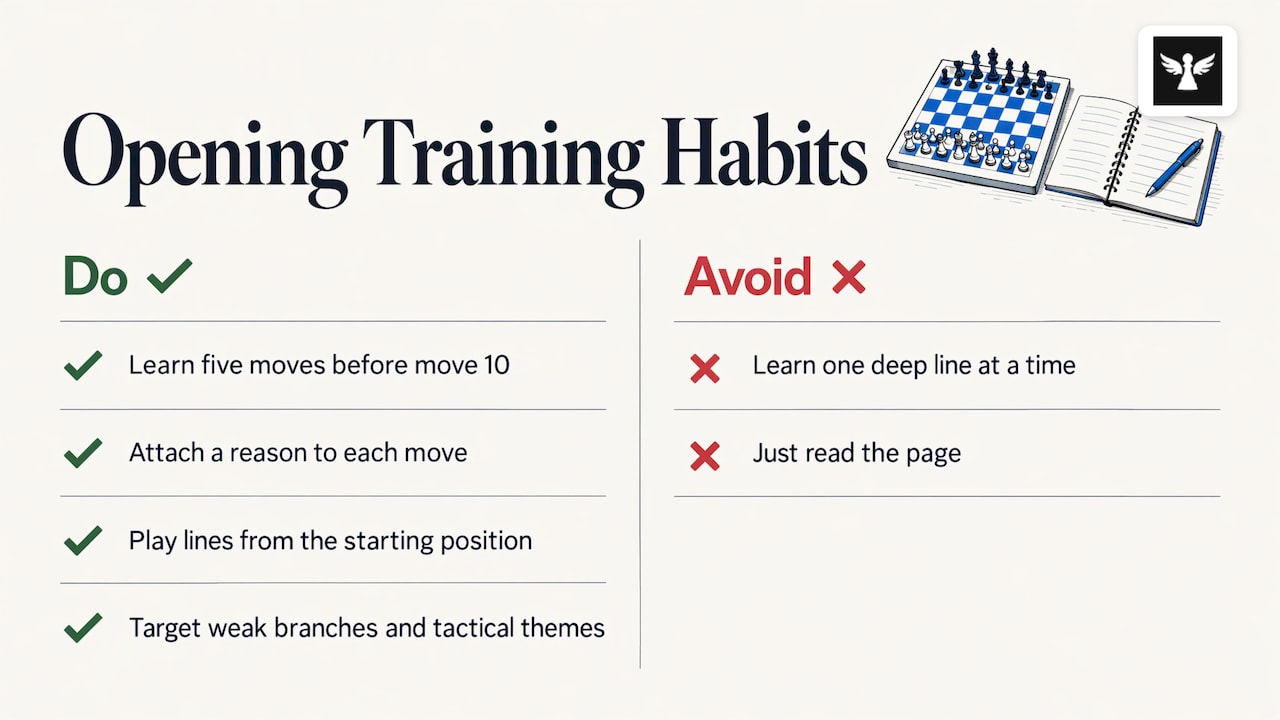
Learn in layers. First memorize your first five moves in each branch. Only then go to move 10. A tree learned breadth-first collapses less often than one learned one deep line at a time.
Attach a reason to each move. “Knight to f3 because it controls the center and prepares castling” sticks better than “Nf3 because the book says so.” When an opponent deviates, the reason tells you what to do next.
Repeat the moves, not the page. Playing the line move by move from the starting position, and being asked for the next move, is closer to a real game than reading it. Our guide on how to practice chess openings so they stick and the longer piece on how to learn chess openings go deeper on spacing and recall.
Train the branches that cost you games. Not all positions are equal. Spend most of your time on the ones your own games show you handle badly. This is the core of personalized training, and it is what ChessFlux is built around: your repertoire is compared with your real results so that the sessions target your weak spots.
Link the tree to tactics. Many opening lines hinge on a tactical idea, a pin, a fork or a trap. Puzzles sorted by theme or by opening help you see those ideas on the board. ChessFlux includes chess tactics puzzles by theme or opening.
A worked example: the Scandinavian branch
Say you play Black and, in your last 100 games, 14 of them began 1.e4 d5. That is the Scandinavian Defense, filed under ECO code B01. It is a small branch of the whole tree, but it is a big one for you.
In those 14 games, you notice that after 1.e4 d5 2.exd5 Qxd5 3.Nc3 you retreat the queen to a5 in most games, then lose points in two of them after 4.d4 and a quick attack. Your tree for this branch might look like this:
- Trunk: 1.e4 d5 2.exd5 Qxd5 3.Nc3 Qa5
- Branch to add: the sideline where White plays 4.d4 followed by a quick Bd2 or Nf3 and a long-castling attack
- Failure point: the move where you let the attack start
Now you know exactly which 10 positions to drill. You can read more on the moves and plans in our page on the Scandinavian Defense. The same method applies if your big branch is the Sicilian Defense: find the sub-branches that show up in your games, and set the rest aside. All our openings are collected on the chess openings overview, and the opening guides explain the tools.
What about the OpeningTree app?
The query “OpeningTree chess” usually points to a mobile and desktop app of that name, which presents a book of openings drawn from high-rated over-the-board games and lets you explore the tree with engine analysis. It is an explorer in the sense described above: it shows you the world’s branches. If what you want is a map of what strong players play, an explorer does that job. If you want a tree that follows your own games and drills you on it, you need a trainer that starts from your results, which is a different tool.
Promo: your tree, built from your games
ChessFlux is an interactive opening trainer. It builds a personalized repertoire from your last 100 Lichess or Chess.com games, lets you memorize it move by move, and compares your real performance with that repertoire so you can see which moves to improve. You can also build your own variation trees, import PGNs and studies, work through tactics puzzles and analyze openings with Stockfish. The core features are free, and a Premium subscription unlocks options such as unlimited puzzles, advanced training and additional customization.

Start on chessflux.fr with your Lichess or Chess.com username and see the tree of the games you actually play.
Our perspective
Most players do not have an opening problem, they have a recall problem. They have seen the right moves in a video or a book, and by move 7 in a real game they are back to guessing.
We built ChessFlux around a simple idea: the tree that matters is the one your opponents actually walk you through. Your last 100 games already contain it. They show which first moves you play, which replies you face, and where you leave your preparation. Starting there means you do not set anything up by hand, and you do not study lines you will never meet.
A generic course gives every player the same tree. We would rather give each player a small tree that fits, then repeat it until it is automatic, and measure the results against real games. That is how progress becomes something you can see, rather than a feeling.
Rolf
FAQ
What is the difference between an opening tree and an opening repertoire?
An opening tree contains all the moves that can follow a position, or all the ones that have been played. A repertoire is the part of the tree you have chosen to play: one move for you at each position, and the replies you expect from your opponent. A tree is a map, a repertoire is your route.
How deep should I learn an opening tree?
Start with your first five moves in each of your main branches, then extend to about move 10 where your games show that opponents follow the line. Go deeper only in lines that keep appearing. Depth that you never reach in a game is wasted effort at beginner and intermediate level.
Can I see a tree of my own Lichess or Chess.com games?
Yes. Lichess has a Player tab in its explorer that shows the games of a given account. ChessFlux goes further: it builds a repertoire from your last 100 games on Lichess or Chess.com, then trains you on it and compares your results to it.
Do ECO codes tell me which opening to play?
No. ECO codes only classify openings. B01, for example, is the label for 1.e4 d5, the Scandinavian Defense. They help you find a branch in a book or database, but the choice of what to play depends on your style and the positions you meet in your games.
Sources
- Encyclopédie des ouvertures d’échecs (ECO groups and codes)
- Table de théorie
- How To Use The Opening Explorer