A good chess training plan is short, regular and built on your own games. Aim for 20 to 30 minutes a day, split between tactics, a single opening topic and a review of what actually happened in your recent Lichess or Chess.com games. The plan below shows how to divide that time at beginner and intermediate level, and how to let your results decide what you study next. Our app, ChessFlux, builds your opening repertoire from your last 100 online games, so the opening part of the plan starts from the lines you really play.
TL;DR
- Regularity beats volume: 20 to 30 minutes a day brings more than one long session a week.
- Beginners should put tactics, opening principles, basic mates and simple endgames ahead of long memorized variations.
- Intermediate players add calculation, game analysis, pawn structures and typical plans.
- Pick one opening theme per week and take it from your own games, not from a generic course.
- Review every long game, starting with your own reading before the engine.
Table of Contents
- Why a plan beats “playing and hoping”
- How much time to set aside
- What a balanced plan contains
- A sample week, day by day
- Memorizing openings so they show up in your games
- Using your own games to adjust the plan
- Mistakes that break a training plan
- Turn the plan into a routine with ChessFlux
- Our perspective
- FAQ
- Sources
Why a plan beats “playing and hoping”
Most players at club or online level improve in bursts, then stall. The usual cause is not a lack of effort but a lack of structure: an evening of puzzles, a week of nothing, then a new opening video. A plan fixes three things: how often you train, what each session contains, and how you decide what to work on next.
The second point matters most. A session that has one clear job (“this week: the Italian Game as White”) is easier to start and easier to finish than an open-ended “study chess” slot. The French Chess Federation’s teaching booklet for its school program follows the same logic: for a session of about one hour, it favors a single lesson of around 15 minutes followed by three progressive exercises, rather than several topics crammed together.
How much time to set aside
There is no magic number, but the French sources agree on the shape: short, frequent, repeated.
- The French site Le Palais des Échecs describes three weekly profiles: an occasional player at 15 minutes a day, a regular player at 30 minutes, and a club or competitive player at 45 minutes or more. It also notes that net progress shows after several months at 20 to 30 minutes a day, and that 30 minutes a day is worth more than five hours on a Sunday.
- DYNSEO describes an effective practice pattern as 30 to 45 minutes, three to four times a week, mixing longer games, tactical puzzles and post-game analysis.
For most adults with a job, that gives a simple rule: pick the profile you can keep for three months, not the one you hope to keep for a week. Fifteen minutes done six days a week is a better plan than an hour you skip.
| Profile | Daily time | Weekly content |
|---|---|---|
| Occasional | 15 min | About 10 puzzles, one theme per week, one long game analyzed |
| Regular | 30 min | 10 to 15 puzzles, two or three themes, two or three long games analyzed |
| Committed | 45 min and more | 15 puzzles or more, daily study, club games, systematic analysis |
The table follows the three profiles described by Le Palais des Échecs.
What a balanced plan contains
Five ingredients appear in almost every serious plan: tactics, openings, middlegame strategy, endgames and game review. What changes with your level is the proportion.
Beginners: tactics first, short opening work
If you are still learning the game, the highest return comes from tactics, opening principles (develop pieces, control the center, castle), basic checkmates and simple endgames. Memorizing long variations pays much less at this stage, because your opponents leave the book on move five or six anyway. This is also the advice of a French training guide for beginners, which puts tactics well ahead of rote theory.
A workable beginner week, at about 20 minutes a day:
- Four days: 10 to 15 minutes of tactics, then 5 minutes on one opening idea.
- One day: a basic mate or a king-and-pawn ending.
- One day: play one longer game (15 minutes or more per side) and save it.
- One day off, or a light replay of the saved game.
If you want ready-made material, the French Federation’s Class’Echecs resource offers thirty ready-to-use sessions per cycle, with indicative durations of 30 to 60 minutes depending on the topic, plus a bank of problems to extend practice.
Intermediate players: calculation, analysis and plans
Once you are past the basics, the same French guide shifts the weight toward tactics and calculation, analysis of your own games and strategy: pawn structures, typical plans and the endgames you actually reach. Our guides on daily tactics practice, tactical patterns for intermediate players and calculation training go deeper on each of these.
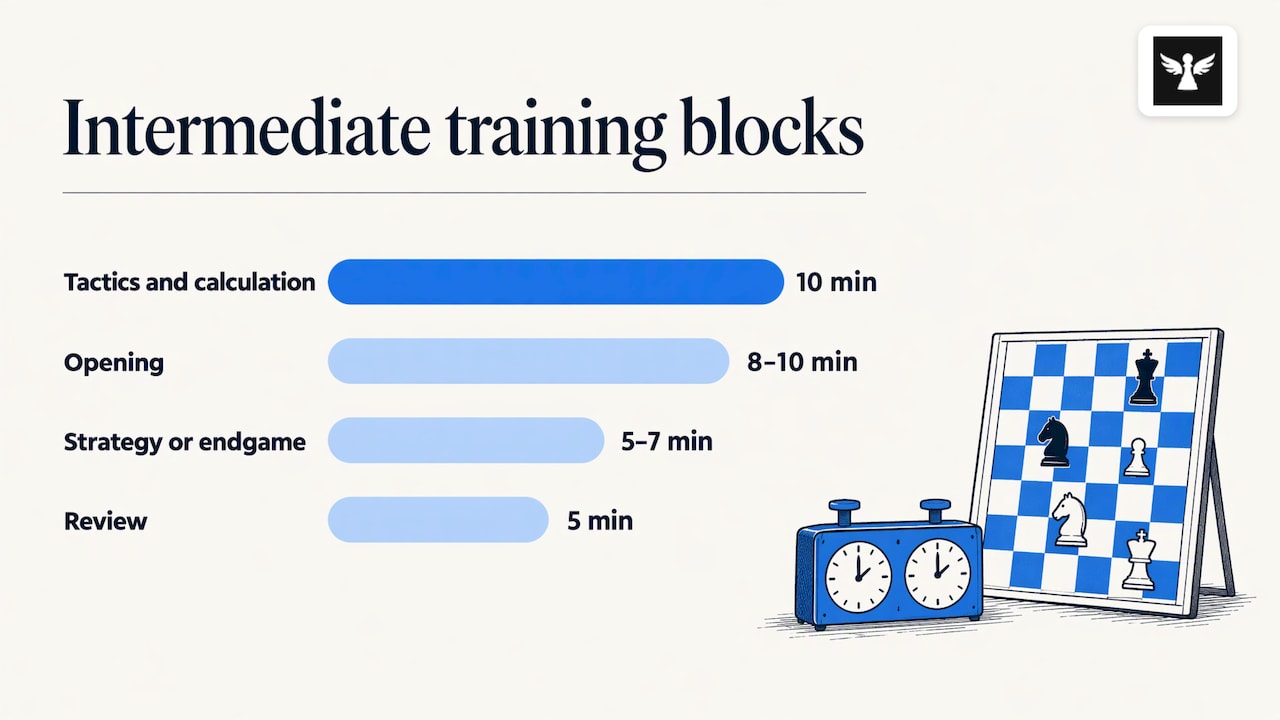
A sample 30-minute split for an intermediate player:
| Block | Minutes | Content |
|---|---|---|
| Tactics and calculation | 10 | Puzzles on one theme, solved before moving a piece |
| Opening | 8 to 10 | One line from your repertoire, played from memory, then checked |
| Strategy or endgame | 5 to 7 | One structure, plan or ending, alternating by day |
| Review | 5 | One critical moment from a recent game |
This split is a starting point, not a rule. If your games are lost in the middlegame to a missed fork, move minutes to tactics. If you are out of book and worse by move ten, move minutes to the opening.
A sample week, day by day
Here is a regular profile (30 minutes, six days) that combines the blocks above.
- Monday: tactics theme of the week (10 min), opening line for White (10 min), a pawn ending (10 min).
- Tuesday: calculation puzzles (15 min), opening line for Black (15 min).
- Wednesday: mixed puzzles (10 min), one strategic idea or typical plan (10 min), review of a loss from the week (10 min).
- Thursday: same theme as Monday, from memory (15 min), opening line repeated (15 min).
- Friday: rook or simple ending (15 min), puzzles (15 min).
- Saturday: one long game of 15 minutes or more per side, played without distractions.
- Sunday: analysis of Saturday’s game (30 min), with one lesson written down.
The Saturday game followed by an immediate analysis is the most instructive combination of the week, according to the guide published on echecsauroi.fr, a point repeated in French coaching circles. Keep the written lesson to a single sentence; you will actually reread it.
Memorizing openings so they show up in your games
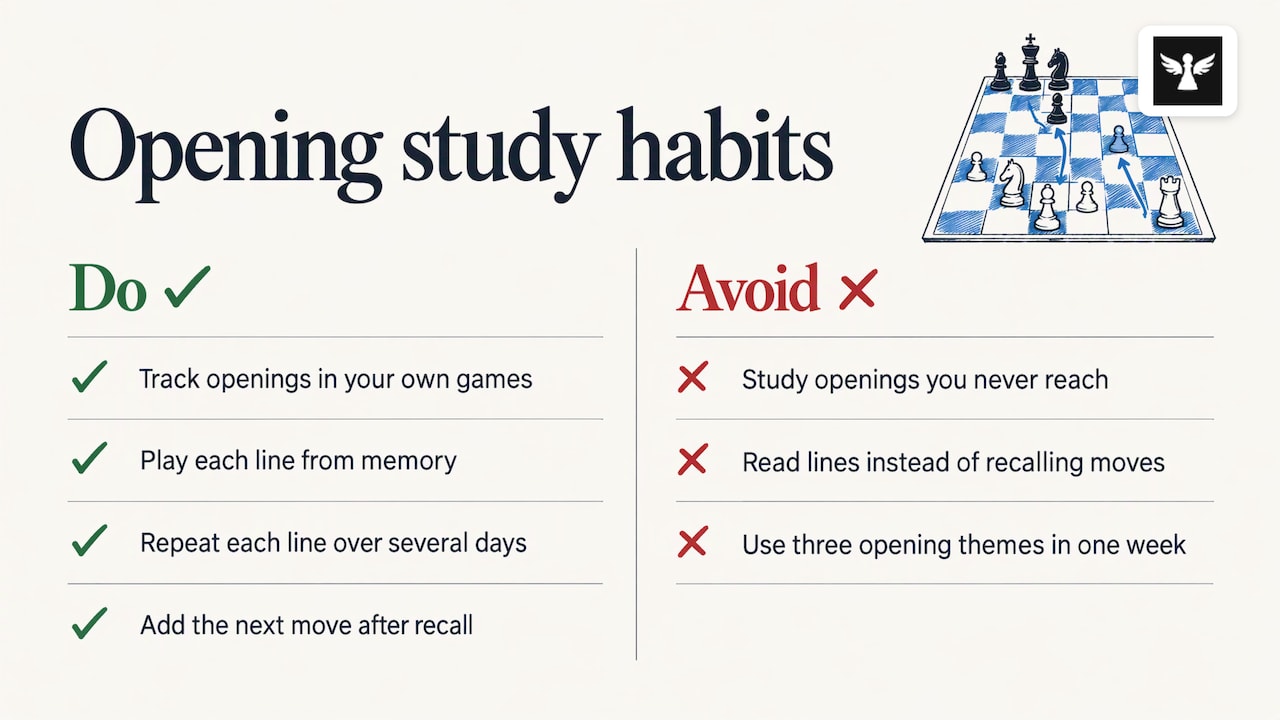
The classic mistake is to study openings you never reach. You learn twenty moves of a sharp Sicilian, then your opponents play the London System. Two habits fix this.
Study what you really play. List the first six to eight moves of your last 50 to 100 games. Which openings come up often? Where do you leave your preparation? Those are your priorities. Doing this by hand in a spreadsheet takes an evening; we built ChessFlux to do it for you: it creates a personalized repertoire from your last 100 games on Lichess or Chess.com, so your study time goes to positions that occur in your own games.
Train by recall, not by reading. Reading a line feels like learning, but only playing the moves from memory shows what you actually know. Repeat each line move by move over several days, and add the next one only when the first comes without hesitation. This is why a week should have one opening theme, not three.
The Belgian chess federation’s teaching kit gives a sense of what a basic repertoire resource contains: repertoires and opening ideas, including a collection of opening traps, alongside a position-analysis grid. For a general look at the main openings, see our chess opening guides.
Using your own games to adjust the plan
A plan that never changes stops working after a few weeks. Your games tell you what to change.
Start with your own eyes. Pascal Aubry, in his French coaching diploma thesis, recommends a first analysis done entirely by hand, without a computer, so you can pin down your errors precisely. He compares a game to an iceberg: the score sheet is only the visible part, and the analysis must bring back what you calculated, rejected and prepared during the game. Only then should you turn on the engine.
Then sort the errors into categories for a month:
- Opening: out of book early, or forgot a move you had studied.
- Tactics: missed or allowed a shot.
- Strategy: no plan, bad structure.
- Endgame: a won or drawn position not converted.
- Time: lost on the clock, or panic in the last minutes.
The category with the most entries gets the extra minutes next week. Our guide on how to analyze your chess games lays out the method in detail. In ChessFlux, the app compares your real results with your repertoire to point out the moves to improve, and you can open a position with Stockfish analysis when you want the engine’s view after your own reading.
Mistakes that break a training plan
- Changing the plan every week. Give any plan at least four weeks before judging it.
- Too many topics. One tactical theme, one opening line, one ending at a time.
- Skipping the review. Playing ten games and analyzing none is the fastest way to repeat the same errors.
- Studying only what you enjoy. Players who love openings tend to avoid endgames, and the reverse.
- Training only when motivated. Schedule fixed slots, such as the commute or after dinner, and treat them as appointments.
A full overview of how these pieces fit into a longer program is in our articles on a weekly chess study plan and how to improve at chess.
Turn the plan into a routine with ChessFlux
The opening and tactics blocks of this plan are where an app saves the most time. ChessFlux is free to start: you connect your Lichess or Chess.com account, it builds a repertoire from your last 100 games, and you train it move by move. You can also build your own variation trees, import PGNs and studies, work through tactics puzzles by theme or by opening, and analyze positions with Stockfish. ChessFlux Premium adds options such as unlimited puzzles, advanced training and more customization.
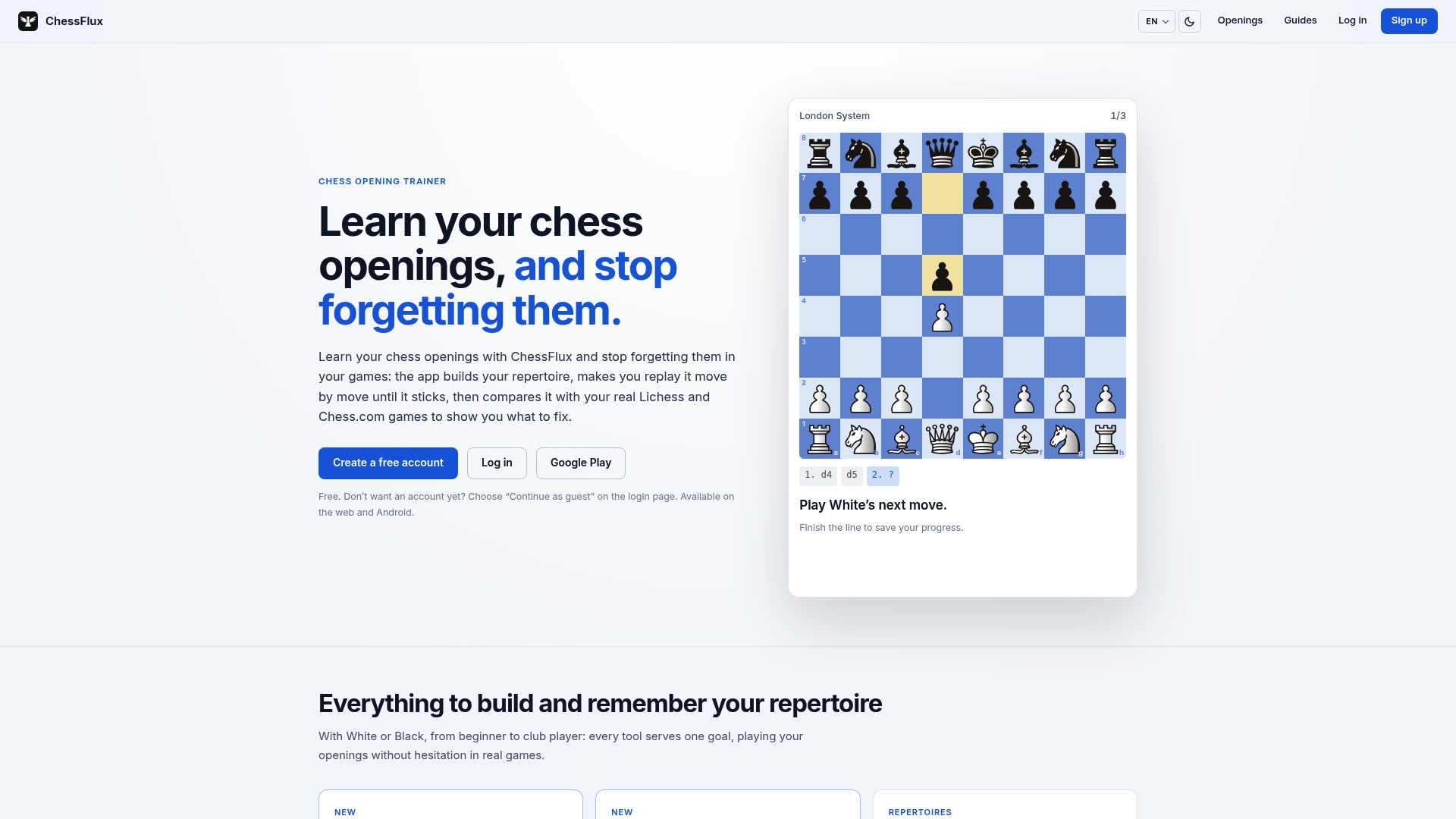
Start with the free version on ChessFlux. If you want unlimited puzzles and advanced training, the monthly Premium offer and the annual Premium offer are available.
Our perspective
Most players we talk to do not lack discipline, they lack a starting point. They open a generic opening course, memorize lines they will never reach, and then wonder why their games do not change.
Our view is that a training plan should begin with your own results. Your last 100 games already show which openings you play, where you leave your preparation and which moves cost you points. That is why ChessFlux builds the repertoire from those games and compares your real performance with it, instead of asking you to set everything up by hand.
The rest of the plan is simple: short daily sessions, one theme at a time, tactics alongside openings, and a review after every long game. Do that for a few months and progress becomes measurable rather than hoped for.
Rolf
FAQ
How long should a chess training session be?
For most players, 20 to 30 minutes a day is enough to progress if you keep it up for several months. Committed players can go to 45 minutes or more. Choose the length you can repeat, because regularity matters more than the length of any single session.
Should beginners study openings at all?
Yes, but briefly. Beginners should learn the principles (develop, control the center, castle) and one simple setup for White and Black, while spending most of their time on tactics, basic mates and simple endgames. Add deeper lines once you reach the same positions in your games again and again.
How many days a week should I train?
Three to four days is a realistic minimum, and daily short sessions are better if your schedule allows. A forum guide on France-Échecs suggests at least two hours a week, ideally five, spread between reading, tactical exercises and rapid games. Whatever the total, spread it across the week.
How do I know my plan is working?
Track three things over four to eight weeks: how often you leave your opening preparation early, how many tactical errors you make per game, and your rating at a fixed time control. If the first two fall, the rating usually follows. ChessFlux compares your real games with your repertoire, which makes the first measure easy to follow.
Sources
- École d’Échecs à la Française, Cavalier booklet
- Le Palais des Échecs, 11 tips to improve at chess
- DYNSEO, chess and intelligence
- Plan d’entraînement aux échecs, beginner guide
- FFE, Class’Echecs sessions
- FEFB, teaching kit
- Pascal Aubry, Méthodes d’entraînement