At intermediate level, tactics improve fastest when you stop practicing random puzzles and start practicing the patterns you actually miss in your own games. You already know forks and pins. What costs you points is the quieter material: a defender you could have removed, a check you did not see, a move you calculated halfway and abandoned. This guide gives you the patterns that matter, a calculation routine you can run over the board, and a weekly plan built around your real Lichess or Chess.com games. At ChessFlux, we build training around exactly that loop: your games, your weaknesses, then targeted practice.
TL;DR
- Intermediate tactics are less about knowing more motifs and more about spotting them under pressure and calculating them to the end.
- A tactical move is almost always a check, a capture or a threat. Scan for those first, for both sides.
- Solve puzzles slowly and completely, then repeat the same set in cycles so recognition becomes automatic.
- Review every lost game for the tactic that decided it, and train that theme next.
- Tactics trained on your own mistakes beat generic puzzle volume. Our tactics training and puzzles let you filter by theme or by opening.
Table of Contents
- What tactics mean at intermediate level
- The patterns worth owning
- Find the tactic: a scan before every move
- Calculate each line once, all the way
- How to practice puzzles so they transfer to games
- Turn your own games into your syllabus
- A four-week plan for intermediate players
- Practice tactics from your own Lichess or Chess.com games
- Our view on tactics at your level
- FAQ
- Sources
What tactics mean at intermediate level
A tactic is a concrete sequence of forcing moves that wins something real: material, a decisive position, or a mate. Strategy, by contrast, is the long-term plan: pawn structure, piece placement, the squares you want to control. French sources on the game describe tactics as calculation built on maneuvers, sacrifices and combinations, while strategy deals with plans and lasting positional advantages.
The former world champion Max Euwe put the difference in one line, as quoted by Echecs & Stratégie: strategy requires reflection, tactics requires observation. That is useful for you. Strategy is something you build over many moves. A tactic is already sitting on the board, and your job is to notice it before your opponent does.
That is why the beginner advice (“learn the fork”) stops working. Once you know the basic motifs, the problems become:
- Seeing: the pattern is hidden behind a quiet move, a pinned piece or a check you did not consider.
- Calculating: you find the first move but miss the defender’s best reply.
- Consistency: you solve puzzles on the screen, because you know a puzzle exists, but miss the same idea in a real game.
If you are still shaky on the basics, start with our five patterns to learn first and come back.
The patterns worth owning
Lists of tactical motifs vary from author to author, but they overlap heavily. A practical way to organize them is in two layers: the patterns you should see instantly, and the ones that need a deliberate look.
| Layer | Patterns | What to ask yourself |
|---|---|---|
| Basic, seen at a glance | Fork, pin, skewer, discovered attack, discovered check, double check, back-rank weakness | Are two of my opponent’s pieces on the same line or reachable by one piece? |
| Intermediate, needs a deliberate look | Deflection, attraction, removing the defender, overloading, interference, X-ray, intermediate move (zwischenzug), trapped piece | Which piece is doing too many jobs, and what happens if I force it to leave? |
| Advanced, rarer but decisive | Windmill, smothered mate, Greek gift sacrifice, famous mating patterns | Is the king short of escape squares, with a sacrifice available to open it? |
Do not try to learn all of them at once. Pick one pattern per week and study it from three angles:
- The geometry: what has to be true on the board for the pattern to exist.
- The trigger: the feature that should make you look for it (a loose piece, an undefended back rank, a king that cannot move).
- The defense: how the pattern is parried, because in a real game you will often need to see your opponent’s version of it.
Two patterns deserve special attention at this level because they are easy to miss.
The intermediate move
A zwischenzug is a forcing move inserted before the expected recapture or reply. It is the classic reason a “won” exchange sequence falls apart. When you calculate a line and your opponent’s move looks automatic, ask whether either side has a check or a threat to play first.
Removing the defender and overloading
Many tactics are not attacks on the target. They are attacks on whatever protects the target. If a piece guards two things, either capture it or force it to move, and one of the two falls. When a piece looks “obviously” attackable but well defended, look at the defender.
Find the tactic: a scan before every move
Most missed tactics are not calculation failures. They are scanning failures: you never looked at the right piece. The French Chess Federation’s masterclass with Kevin Terrieux, summarized in this FFE recap, describes a “tactical radar”: you scan the king (nearby holes, controlled squares, mating themes), pieces that are attacked or unprotected, awkward piece combinations, and classic ideas such as promotion, stalemate and perpetual check. The same recap notes that a tactical move is necessarily a check, a capture or a threat, and that you should think in both directions, from your side and from your opponent’s.
In practice, run this on every move where the position is sharp:
- Threats: what does my opponent want to do next? Which of my pieces are loose?
- Forcing moves: list every check, capture and threat for both sides.
- Weak points: back rank, king cover, undefended pieces, pieces defending two things.
- Candidates: pick two or three moves worth calculating.
This takes ten seconds once it is a habit, and it catches far more than raw calculation power does.
Calculate each line once, all the way
Finding the idea is half of it. The other half is calculating without getting lost. Europe Échecs describes Kotov’s candidate-move method: choose a handful of relevant moves, calculate each branch only once, start with forcing moves (captures, checks, threats, pawn breaks), end on a move by your opponent, and assume your opponent plays the best replies.
The rule “each branch once” is where intermediate players lose the most time. They calculate a line, doubt it, go back, calculate it again, then play something else in a panic. Here is a cleaner routine:
- List your candidates, including the ones that look strange. Writing down even awkward ideas makes you look beyond the automatic first thought.
- Go deep on the forcing candidate first. If it works against the best defense, you can stop.
- Finish on the opponent’s move. A line that ends after your own move is an unfinished line.
- Evaluate the final position, not just the material. A queen sacrifice that ends in a lost endgame is not a combination.
Calculation also relies on holding the board in your head, which you can train separately. Our guides on calculation training and board visualization exercises cover that in more detail.
How to practice puzzles so they transfer to games
Puzzles are the fastest route to pattern recognition, but only if you use them correctly. Solving 50 puzzles quickly and guessing half of them trains guessing. Three ideas make practice stick.
Solve fully before you move
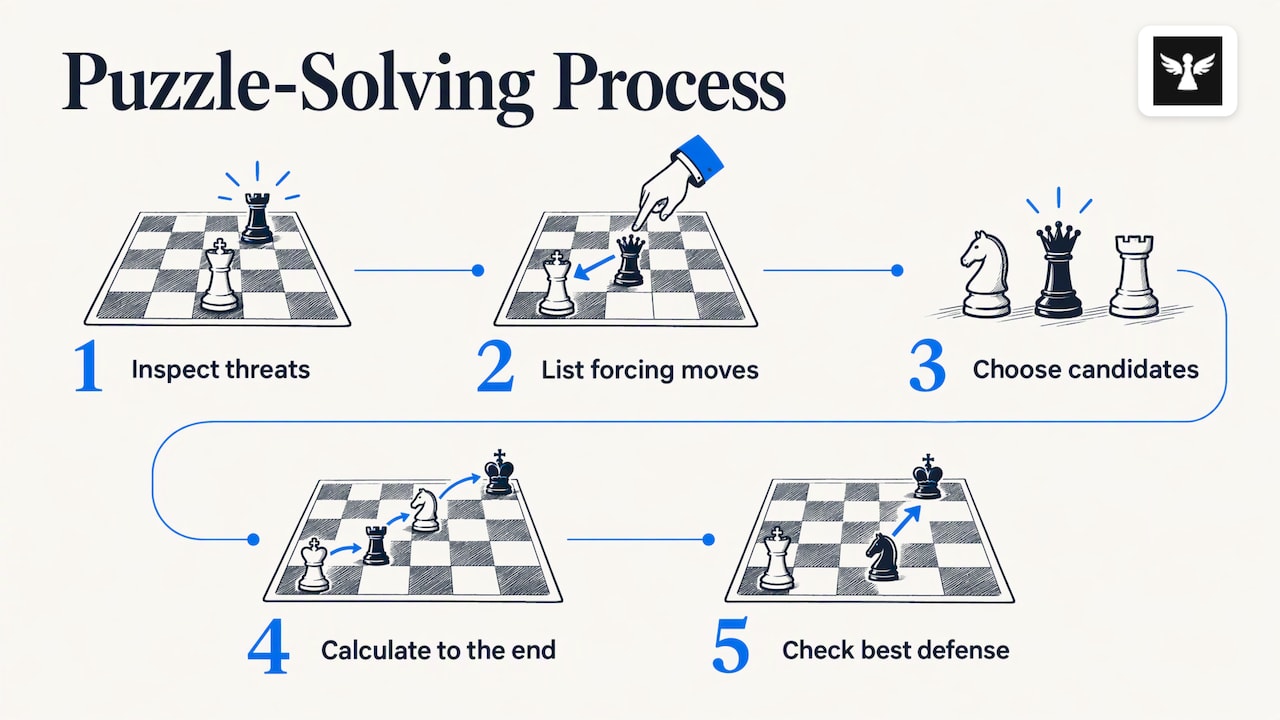
For every puzzle, look at the threats, list the forcing moves, pick your candidates, calculate to the end and check the best defense before touching a piece. If you got it right for the wrong reason, count it as a miss. This matches how you will have to think in a game, rather than in a speed contest. Our puzzle strategy guide walks through the sequence step by step.
Repeat the same set
The Woodpecker Method, a well-known cyclic training approach, is built on solving the same exercises again and again. In the authors’ excerpt, Axel Smith describes working through a set of 1,000 exercises in cycles, aiming to halve the total time on each pass until the whole set could be solved in a single day. The authors also stress adding red herrings, positions where the obvious tactic does not work, so training resembles real games.
You do not need a thousand exercises. A set of 100 to 200 positions on your weakest themes, repeated over several weeks, builds recognition more reliably than endless new puzzles. New positions test you. Repeated positions teach you.
Warm up, do not binge
French training sites commonly recommend a short daily puzzle session before playing online, for example Le Jeu de Caïssa, which suggests anywhere from 5 to 30 minutes depending on the player. The point is regularity: tactical vision fades quickly when you leave it alone for a week. For a full routine, see our guide to a daily tactics practice and the French-language entraînement tactique.
Turn your own games into your syllabus
Generic puzzle collections cover every motif evenly. You do not miss every motif evenly. Your games tell you which three or four you actually need.
After every lost game, do this:
- Replay it without an engine first. Mark the moment where the game turned: a lost piece, a missed shot, a sudden collapse.
- Name the tactic. Was it a fork you walked into? A pin you ignored? A defender you did not notice?
- Run the engine second. Stockfish shows you the best move, but your own diagnosis comes first, because that is where the learning is.
- Write one lesson. One sentence, not a page.
- Feed it into your puzzle work. If three games in a row ended with a back-rank problem, back-rank puzzles are your next week.
The blog Les Échecs sans Peine suggests the same logic: identify critical moments, diagnose missed tactics and weak phases, then adjust your training program accordingly.
There is one more place tactics hide that many intermediate players overlook: the opening. Many tactical shots come from known structures, such as a sacrifice on h7 or a trap in a specific line. If you know your opening well, you recognize the tactic when it appears. If you do not, you are calculating from scratch. This is why we pair tactics with opening work: puzzles by opening let you practice the shots that arise from the lines you really play.
A four-week plan for intermediate players
Here is a plan that fits around normal life. Adjust the times, not the structure.
| Week | Focus | Daily work (15 to 30 minutes) | Weekend |
|---|---|---|---|
| 1 | Basic patterns under time pressure: forks, pins, back rank | 8 to 10 puzzles on one theme, solved fully | Review two lost games, name the decisive tactic |
| 2 | Removing the defender and overloading | Warm-up set, then 4 to 6 harder puzzles with 2 to 5 moves of calculation | Replay your Week 1 misses |
| 3 | Deflection, attraction, interference | Same structure, with a candidate list written for each puzzle | Play slower games and apply the scan every move |
| 4 | Zwischenzug, trapped pieces, defense positions | Include puzzles where you must find the only defense | Repeat the full set from Weeks 1 to 3 and compare your time |
Two details make this plan work. First, every session has two parts: a quick warm-up on a single theme, then a smaller number of problems that force real calculation. Second, defensive puzzles count. In a real game, you will often need to find the only move that holds, and that skill is rarely trained.
For how this fits into a wider routine, our chess training plan shows how to balance tactics, openings, endgames and game review.
Practice tactics from your own Lichess or Chess.com games
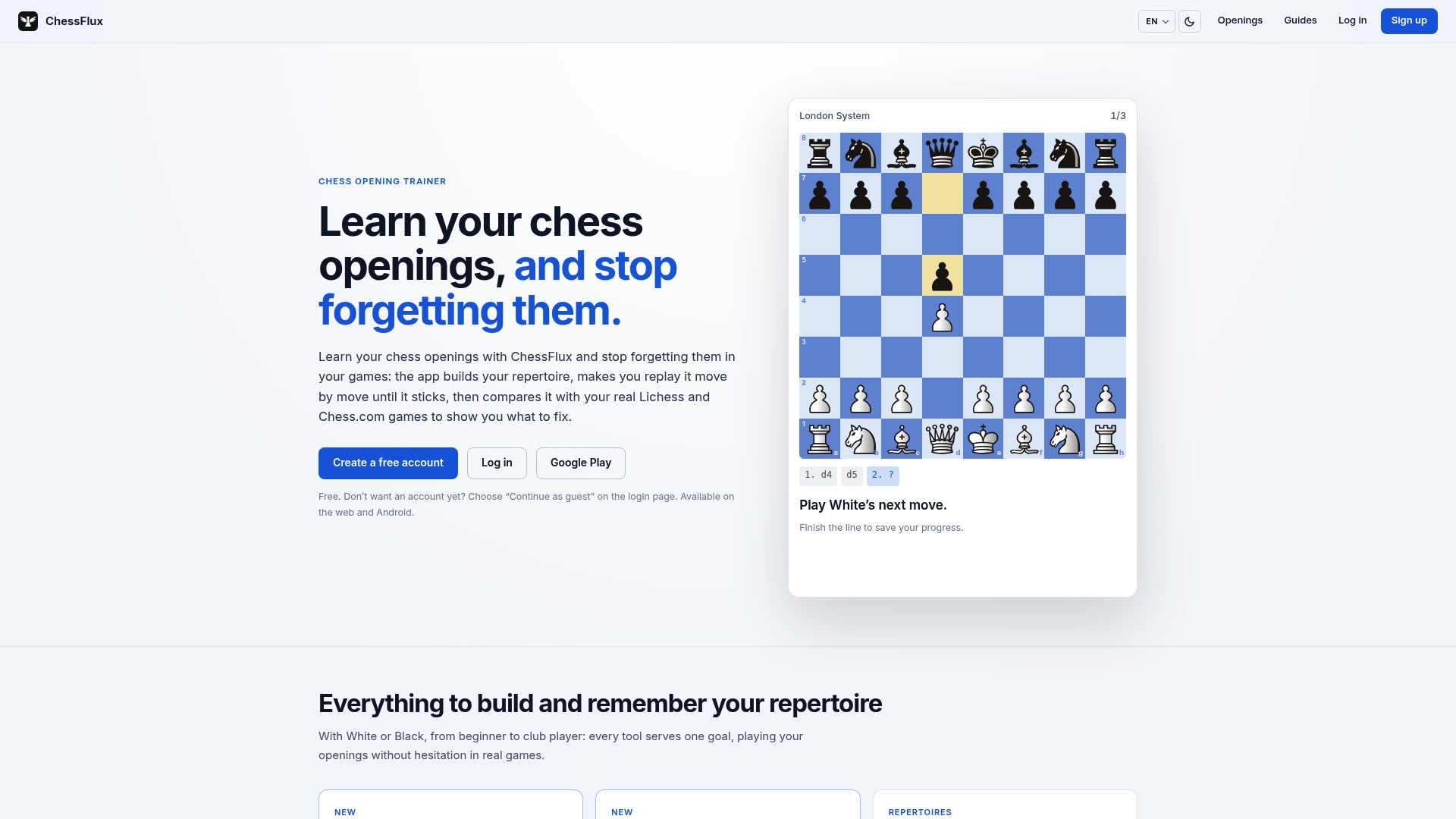
The slow part of everything above is the diagnosis: finding which patterns you miss, then finding puzzles that match them. ChessFlux builds a personalized repertoire from your last 100 games on Lichess or Chess.com, compares what you actually play against it, and points to the moves to improve. The app also includes tactics puzzles that you can browse by theme or by opening, and an opening analysis tool powered by Stockfish.
The core features are free. ChessFlux Premium unlocks options such as unlimited puzzles, advanced training and additional customization. You can start with the free version at chessflux.fr, or read how to build a repertoire from your games and how the game debrief compares your openings with your repertoire.
Our view on tactics at your level
Most intermediate players we talk about training with do not lack knowledge. They know what a fork is. What they lack is a reliable link between the games they play and the exercises they do.
That is why we start from your games. The openings you play lead to specific middlegames, and those middlegames contain specific tactical shots. Training those positions is more efficient than a random puzzle feed, because every pattern you practice is one you can meet next week.
Our approach to training is built on personalization: your last 100 games, your repertoire, your weak points, then practice aimed at them. Measurable progress comes from repeating what you actually get wrong, and from seeing it get better.
Pair that with the calculation habits in this article, scan for checks, captures and threats, calculate each line once, finish on your opponent’s move, and tactics stop being a talent you either have or do not.
Rolf
FAQ
How many tactics puzzles should an intermediate player do per day?
Quality matters more than count. A session of 10 to 20 minutes with a handful of puzzles solved completely, followed by regular repetition of the ones you missed, usually does more than an hour of fast guessing. Pick a quantity you can sustain every day, because regularity is what builds recognition.
What is the difference between tactics and strategy?
Tactics are concrete, forcing sequences that win material or deliver mate, and they depend on calculation. Strategy is about long-term plans and positional factors such as pawn structure and piece activity. In practice, strategy creates the conditions for tactics to appear, and tactics are what you cash in when they do.
How do I find a tactic during a game?
Use a repeatable scan. Check your opponent’s threats, list every check, capture and threat for both sides, look at the king and at loose or overloaded pieces, then calculate two or three candidates to the end. A tactical move is nearly always forcing, so starting with forcing moves narrows the search quickly.
Should I repeat puzzles I have already solved?
Yes. Cyclic repetition of the same positions is a well-documented training idea, popularized by the Woodpecker Method, because it turns slow calculation into fast recognition. Repeat the ones you missed or solved slowly, and aim to solve the whole set faster each pass.
How do I know which tactics I need to train?
Look at your lost games. For each one, name the tactic that decided it and keep a running tally. The themes that appear again and again are your priority. ChessFlux compares your real games to your repertoire to highlight where you go wrong, so you can target your practice.
Sources
- Tactique échiquéenne, Wikipédia
- Stratégie ou tactique aux échecs ? Echecs & Stratégie
- Masterclass FFE du 6 avril 2020 avec Kevin Terrieux
- Comment progresser en tactique aux échecs, Europe Échecs
- The Woodpecker Method, extrait du livre
- Entraînement tactique quotidien, Le Jeu de Caïssa
- L’analyse d’une partie d’échecs, Les Échecs sans Peine