Chess opening principles come down to three jobs: fight for the center, develop your pieces quickly, and get your king to safety. Everything else, from “knights before bishops” to avoiding early queen sorties, is a consequence of those three. Know them well and you can survive any unfamiliar line. Turn them into your own repertoire, built from the games you actually play, and you stop improvising on move five. That is the idea behind how we built ChessFlux, our opening trainer for Lichess and Chess.com players.
TL;DR
- Put a pawn or two in the center early (e4 or d4 as White, a direct answer as Black), then develop knights and bishops toward it.
- Move each piece once during development, avoid needless pawn moves, and keep the queen at home until the minor pieces are out.
- Castle early, usually kingside, so the king is safe and a rook joins the game.
- When the opponent leaves the book, return to the principles instead of freezing.
- Principles get you to a playable position. A repertoire built from your own games turns them into habits.
Table of Contents
- What opening principles are, and why they matter
- 1. Fight for the center
- 2. Develop your pieces quickly
- 3. Gain tempo by developing with threats
- 4. Castle early
- 5. Keep the queen at home
- 6. Avoid pawn moves that weaken the king
- 7. Know when to break the rules
- What to do when your opponent leaves the book
- How to review your openings
- From principles to a repertoire
- Where ChessFlux fits
- Our perspective
- A simple 15-minute opening routine
- FAQ
- Sources
What opening principles are, and why they matter
The opening is the first phase of the game, roughly the first ten to fifteen moves, when both sides mobilize their forces. Nobody can calculate that far in a position this open, so players rely on guidelines that tell them which moves are almost always useful. These are not laws. They are the distilled result of generations of games, and a published beginner and intermediate curriculum from the Chess Club and Scholastic Center / Illinois Chess Association teaches them as the basic framework: control the center, develop quickly, avoid wasted moves, and keep the king safe by castling early.
Why do they matter more than memorized lines at lower and intermediate levels? Because your opponent will leave your preparation, often by move four. A player who knows only moves is lost at that point. A player who knows the reasons can ask a simple question: does this move help the center, development or king safety?
Here are the seven principles in the order you should apply them.
1. Fight for the center
The four central squares, d4, e4, d5 and e5, are where pieces reach the most squares and where the game is decided. The same curriculum advises placing one or two pawns in the center within your first few moves. It describes the most common and safe first move for White as pushing the d- or e-pawn two squares, to d4 or e4, and suggests Black answer 1.e4 with 1…e5 and 1.d4 with 1…d5.
That gives you a simple starting plan:
- As White: play 1.e4 or 1.d4.
- As Black against 1.e4: play 1…e5.
- As Black against 1.d4: play 1…d5.
Control does not require occupying the center with pawns forever. Later, pieces and distant pawns can control central squares too. But at the start, a pawn on e4 or d4 does two jobs at once: it takes space and it opens lines for your bishops and queen.
If you meet 1.d4 often and feel unsure, our guide on how to defend against 1.d4 walks through Black’s main setups.
2. Develop your pieces quickly
Development means moving pieces off the back rank to squares where they do something. The curriculum’s advice is to bring them out early into positions that help fight for the center, and to normally move each piece only once while you develop. Wait to move a piece a second time until the other back-rank pieces are out, with exceptions for what it calls “freebies” (winning material) or “survival” (saving a piece).
A practical order for most openings:
- Knights toward the center (f3 and c3 for White, f6 and c6 for Black).
- Bishops to open diagonals, often aimed at the center or the opponent’s king side.
- Castle.
- Connect the rooks and put them on open or half-open files.
Knights usually come first because their best squares are clearer early on, while a bishop’s best diagonal often depends on which pawns you push. That is a habit, not a rule: if a bishop has an obviously strong diagonal, use it.
3. Gain tempo by developing with threats
A tempo is one move of time. In an open position, being one tempo ahead can decide who attacks. The same curriculum explains that developing a piece with an attack, whenever possible, can gain a tempo, because the opponent must move or defend the attacked piece instead of developing.
A simple example: a knight landing on f3 hits a pawn on e5, so the opponent must spend a move defending it. Your development move was also a demand. Look for those double-purpose moves before playing a quiet one.
The opposite also holds. Moving the same piece twice, or pushing a pawn that does not help the center or development, hands your opponent a free move.
4. Castle early
The curriculum advises castling early for two reasons: it protects the king and it helps develop a rook. It says kingside castling is easier and considered slightly better, since the king ends up farther from the center and less exposed.
In practice, ask yourself before every opening move after move six or so: could I castle now? If the answer is yes and nothing urgent is going on, castling is usually correct. If your king stays in the middle while files open, you are inviting tactics that you will not see coming.
Two habits help:
- Clear the squares between king and rook as part of normal development (knight and bishop out).
- Do not move the pawns in front of your castled king without a concrete reason. They are the king’s shelter.
5. Keep the queen at home
The queen is your most powerful piece, which is exactly why bringing it out early backfires. The curriculum says that moving the queen out too early generally wastes time, and you can even lose it. Each time your opponent develops a piece with a threat against the queen, you lose a tempo and they gain one.
A good rule: let the knights and bishops come out first, castle, then find the queen’s best square once the structure is clear. The queen will have plenty of scope after the center opens.
6. Avoid pawn moves that weaken the king
The pawns around your king cannot move backward. The curriculum warns against bringing out pawns early without good reason, and singles out the f-pawn before castling. It gives a famous example of what can go wrong: 1.f4 e6 2.g4 Qh4#. That is a deliberately extreme line, but it shows how a diagonal toward an uncastled king can be fatal in two moves.
A quick self-check for any pawn move in the opening:
| Question | If yes | If no |
|---|---|---|
| Does it fight for the center? | Probably fine | Be careful |
| Does it open a line for a bishop or the queen? | Probably fine | Be careful |
| Does it weaken squares near my king? | Only with a concrete reason | Fine |
| Does it leave a piece without a good square? | Reconsider | Fine |
The curriculum also lists blocking your own pieces during development as a habit to avoid, for instance a pawn push that shuts in a bishop, or a piece placed where it takes a square from a neighbor.
7. Know when to break the rules
The exceptions are part of the principles. Moving a piece twice is fine when it wins material or saves a piece. A queen move can be right when it makes a real threat that cannot be parried cheaply. A pawn sacrifice for a lead in development can be a strong plan, as in many gambits, provided you know why you are giving the pawn.
The test is concreteness. A rule gives you a default. If a specific, calculable reason beats the default, follow the reason. If you cannot name the reason, follow the default.
What to do when your opponent leaves the book
This is where principles pay off. When you face an unexpected move, go back to the three jobs. Is there a central pawn move that suits you? Can you develop a piece with a threat? Can you castle in the next two or three moves? That checklist keeps you moving in the right direction even when you do not recognize the position.
Capablanca, in his classic Principes fondamentaux des échecs, makes the same point: the strategic principles are identical in every opening and only their tactical application varies with circumstances. He advises beginners to practice thinking in the right direction by explaining opening moves according to these general principles, so that a new situation is less of a shock.
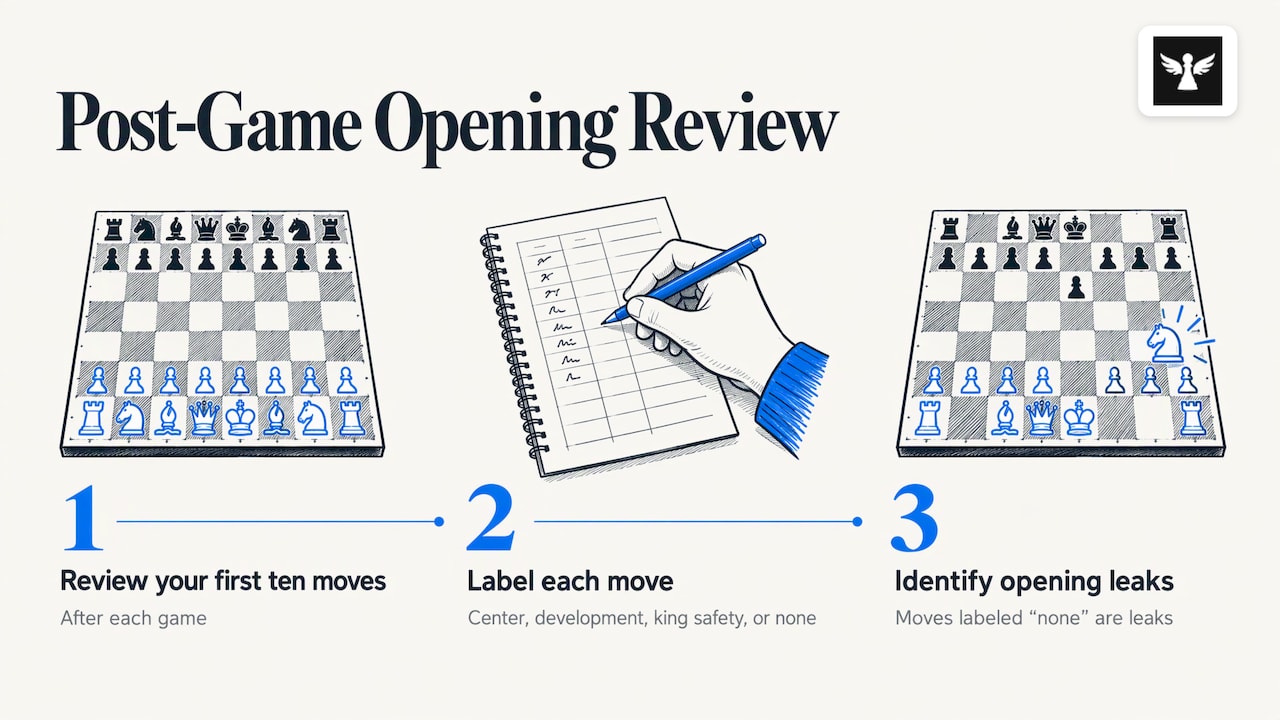
You can train this. After each game, go back to the first ten moves and label each of your moves: center, development, king safety, or none of the above. Moves in the last category are your opening leaks.
How to review your openings
A useful way to review is the one described in a French Chess Federation masterclass (8 February 2019, Sylvain Ravot). To analyze the opening of a game well, the FFE masterclass recap says to note the main theoretical alternatives, look for and cite games by grandmasters, draw up a short assessment of the opening (successful or not, for both players), and look for possible improvements.
For your own games, that translates into four questions:
- Where did I or my opponent first deviate from known theory?
- What did strong players play in this position?
- Was the opening good for me, for the opponent, or balanced?
- What would I play differently next time?
Doing this by hand across dozens of games is slow. Our guide to reviewing your chess games covers the basic routine, and our article on opening traps shows what happens when a principle is ignored at the wrong moment.
From principles to a repertoire
Principles tell you what a good opening move looks like. They do not tell you which opening to play, and they do not make you remember what to do on move eight of the Italian Game. For that you need a repertoire: a small set of lines for White, and answers to 1.e4 and 1.d4 for Black.
For a beginner, a repertoire can be tiny:
- One setup as White, for example 1.e4 followed by natural development.
- One answer to 1.e4 and one to 1.d4 as Black.
- A few typical traps to avoid in each.
The common failure is building a repertoire from a book or video and then never meeting those positions. Your opponents on Lichess and Chess.com play what they play. Your repertoire should be based on what actually occurs in your games. Our guide on how to learn chess openings lays out a method that lasts, and the one on practicing openings so they stick explains how to rehearse them. You can also browse our opening guides.
Where ChessFlux fits
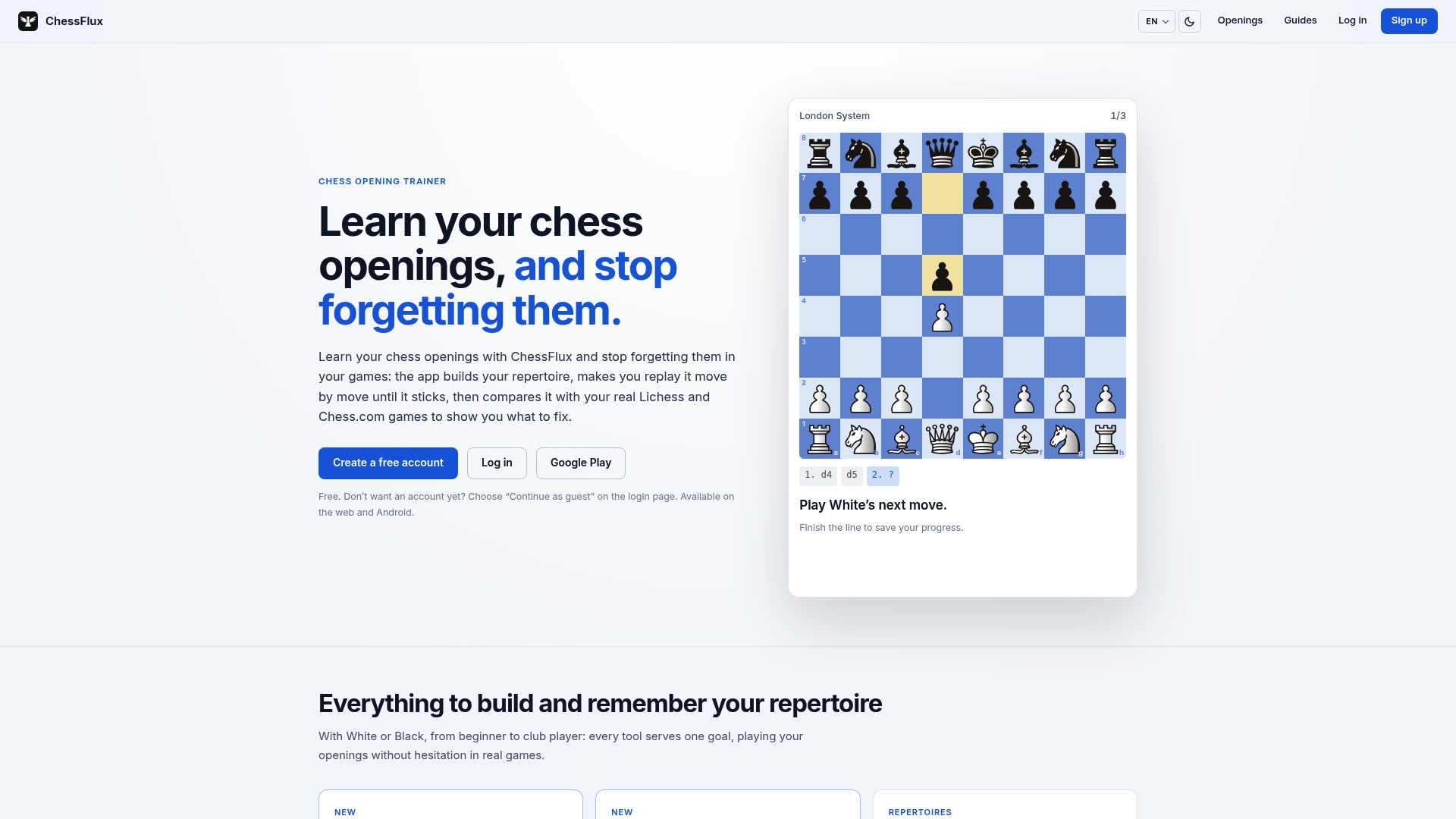
ChessFlux is an interactive opening trainer. It builds a personalized repertoire from your last 100 games on Lichess or Chess.com, so the lines you drill are the lines you really face. You then memorize them move by move, and the app compares your real-game performance with your repertoire to point out the moves that need work.
The core features are free. ChessFlux Premium is a paid subscription that unlocks options such as unlimited puzzles, advanced training and extra customization.
Other tools in the app:
- Importing your games to generate a repertoire.
- Building a repertoire with variation trees, from PGNs and studies as well.
- A game debrief that sets your openings against your repertoires.
- Active training for move-by-move memorization.
- Opening analysis with Stockfish.
- Tactics puzzles by theme or opening.
To start, create your repertoire from your own games on ChessFlux.
Our perspective
Opening principles are the best first lesson in chess, and we teach them with conviction. But we have noticed a pattern in how players learn: they read the principles, nod, and then lose the same position three weeks in a row.
The reason is that a principle is general and your games are specific. Knowing that you should fight for the center does not tell you what to play against the Caro-Kann on move three. That is why we designed ChessFlux around your own last 100 games rather than a generic course. Our approach is to build the repertoire automatically from real games, so there is no manual setup, and then to target the weaknesses that show up in your play.
We think principles and repertoire work as a pair. The principles tell you where you are heading. The repertoire tells you the exact steps for the positions you meet most. Repetition on those exact positions is what makes the knowledge stick, and measuring your progress shows whether it did.
Rolf
A simple 15-minute opening routine
Here is a routine that combines the principles with practice:
- Pick your system. One setup as White and one answer each to 1.e4 and 1.d4.
- Play your games. Use the principles as the default whenever you leave theory.
- Review the first ten moves. Label each as center, development, king safety, or other.
- Fix the repeated leak. If the same early deviation keeps costing you, drill that exact line until the right move is automatic.
- Add tactics. Many early losses are one-move tactics. Puzzles on the opening you play train the patterns you will see.
This takes about fifteen minutes a day, and it compounds. After a month you know your main lines and you have a habit of checking the principles in every unfamiliar position.
FAQ
What are the basic principles of chess openings?
Control the center with pawns and pieces, develop your knights and bishops quickly, avoid moving the same piece twice, and castle early to protect your king. These four ideas come up in standard beginner and intermediate curricula and cover most opening decisions.
What is the best first move in chess?
For White, 1.e4 and 1.d4 are the most common and safest, because both claim central space and open lines for your pieces. Neither is objectively required for a beginner. Choose the one whose resulting positions you enjoy and learn it thoroughly.
Should I castle kingside or queenside?
Kingside is usually easier and considered slightly better, because it needs fewer pieces moved and leaves the king farther from the center. Queenside castling is a legitimate choice when your position calls for it, but make kingside your default.
What should I do when my opponent plays an unfamiliar move?
Return to the principles. Look for a move that helps the center, develops a piece or prepares castling, and check for any direct threat. After the game, review where the deviation happened and add the line to your repertoire so it never surprises you again.
Sources
- Beginner & Intermediate Chess curriculum (CCF/ICA, 2015)
- Masterclass FFE du 8 février 2019 (Fédération Française des Échecs)