A forcing move is a move that leaves your opponent very few sensible replies: a check, a capture or a threat they must answer or lose something. Learning to find these moves first, and to calculate them in a fixed order, is the quickest way to turn vague “I think I’m better” positions into concrete wins. And because forcing lines start in the opening, the best place to train them is in your own games, with the positions you actually reach. That is what ChessFlux is built around: a repertoire drawn from your last 100 Lichess or Chess.com games.
TL;DR
- Forcing moves are checks, captures and threats: moves the opponent must deal with right away.
- A truly forcing move is defined by the threat it makes, not by its category. A quiet move that threatens mate can be more forcing than any check.
- Calculate in a fixed order (checks, captures, threats), and look at every reply, not just the one you hope for.
- Defend by answering the current forcing move while reducing the next one.
- Practice on positions from your own games so the patterns show up where you actually play.
Table of Contents
- What a forcing move really is
- The three families: checks, captures, threats
- Why start your calculation with forcing moves
- A calculation routine you can use in every game
- Worked example: from a check to a stable position
- Can a series of forcing moves lead to a forced mate?
- How to defend against forcing moves
- Where forcing moves begin: the opening
- Our perspective
- Train forcing moves on your own games
- A weekly routine for forcing-move skill
- FAQ
- Sources
What a forcing move really is
Most players first meet the word “forced” in the narrow sense: you are in check and only one legal move exists. That is a forced move, a rule of the board. A forcing move is something else. It is a choice you make that takes away your opponent’s freedom.
The usual definition is simple: forcing moves are checks, captures and threats, moves the opponent must answer immediately to avoid losing material or the game, as this lesson on forcing moves puts it in its own words about checks. That list is a good starting filter, but it is not the whole story.
Charles Hertan, author of Forcing Chess Moves, describes a forcing move as one that limits the opponent’s options by making a concrete threat, either mate or the win of material. He also points out that checks and captures are not always the most forcing choice. In his example from Mieses-Chigorin, the quiet bishop move 1.Be5! threatens a double-discovered mate (2.Rb8# or 2.Rc7+ Kb8 3.Rc8#), and that is more forcing than any check or capture on the board. The source is the publisher’s excerpt of Forcing Chess Moves.
So the working definition for your games is this: a move is forcing in proportion to how few good answers it leaves. A check usually leaves two or three. A mate threat can leave one.
The three families: checks, captures, threats
Checks
A check attacks the king, and the opponent has exactly three ways out: move the king, capture the checking piece, or block the line (when the check comes along a line and a block is legal). That makes checks the narrowest category, which is why they come first in any calculation.
A check is also the engine of many tactics. When a check attacks the king and another piece at once, the opponent has no time to save the second one. The French Chess Federation beginner workbook explains that a double attack is almost always unstoppable when the enemy king, in check, is one of the attacked units, and it defines the skewer as an attack by a long-range piece on an enemy piece standing in front of another: if the front one moves, the one behind is captured. The example given there is 2.Rxe8!. You can read it in the FFE workbook on tactics and first combinations.
Checks are not always good, though. A check that merely pushes the king to a safer square, or throws away your attacker, is noise. Before you play one, ask what the king’s best square is afterward and whether your next move is stronger than the check itself.
One check deserves its own study: the check you give by moving a different piece. We cover it in our guide to discovered check.
Captures
A capture changes the material balance and often changes which of your opponent’s pieces are protected. It is forcing because the opponent has to decide whether to recapture, and the recapture may pull a defender away from somewhere else.
For each capture, run through a short checklist:
- Can the opponent recapture, and with which piece?
- If that piece recaptures, what does it stop guarding?
- Does the exchange open a line toward the king or toward an undefended piece?
The third question is where most tactics are born.
Threats
A threat is a move that does not capture or check now, but will do something painful next turn: win a piece, deliver mate, fork two pieces. It is the most flexible forcing move, and the hardest to spot, because nothing on the board has changed yet apart from your intention.
The strongest threats combine with another purpose. A move that develops a piece and threatens mate gains a tempo, which means you advance your position while the opponent is busy answering. If you are still learning the basic patterns, start with five tactical patterns beginners should learn first, because every threat you will ever make is a variation of a small set of motifs.
Why start your calculation with forcing moves
Hertan gives three reasons for examining the most forcing moves first. They can transform the game (mate or a material win). They save time when they work. And they limit the opponent’s replies, which lowers the risk of a calculation error. In the same text he calls the deep study of forcing moves probably the most important task on the road to mastery, since it builds analytical accuracy and board vision. This is from the New In Chess excerpt already cited above.
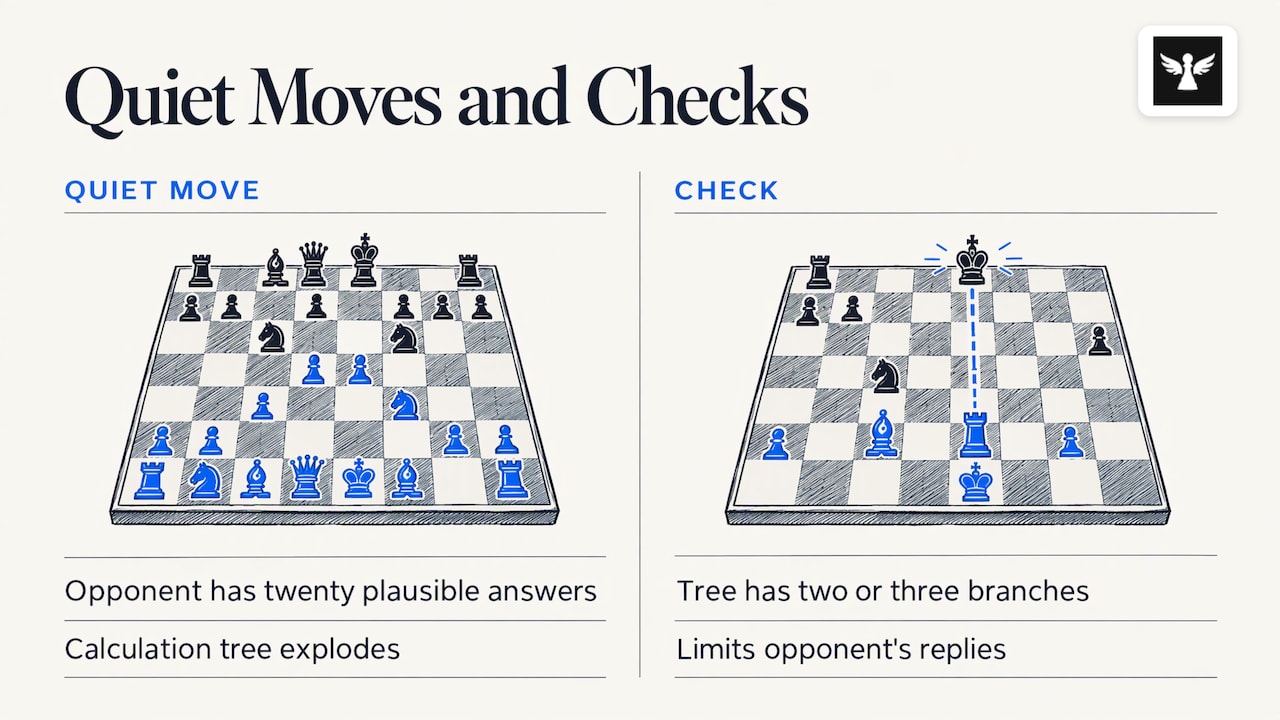
The third reason is the one beginners underestimate. When you calculate a quiet move, your opponent has twenty plausible answers and your tree explodes. When you calculate a check, the tree has two or three branches. Forcing lines are the only lines you can calculate to the end with confidence at club level.
A calculation routine you can use in every game
Here is a step-by-step method. It is deliberately mechanical, because under time pressure, mechanical wins.
Step 1: List every forcing candidate
Scan the position and write down, mentally, every check, every capture and every threat you could make. Do it in that order. Include the ugly ones, such as a check that loses a piece. You are building a list, not choosing yet.
Where it goes wrong: you stop at the first attractive move. Players who find a good-looking check often never look at the quiet threat that was stronger.
Step 2: Look at all the replies, in order
For each candidate, list your opponent’s replies using the same ranking you used for yourself: forced answers first, then checks, then captures, then threats. Your opponent is also looking for forcing moves, and a counter-check can refute your idea in one move.
Where it goes wrong: calculating only the reply you want. A line that works against one defense is a hope, not a calculation.
Step 3: Check the safety of each move you play
For every move in the line, ask three things: can the piece be captured, is it protected, and does it abandon the protection of another piece? Many blunders happen on the second or third move of a combination, when you stop checking what the moved piece was guarding.
Step 4: Go to a stable position
Do not stop in the middle of an exchange. Follow the line until the position is quiet: no pending captures, no pending checks. Then count material and judge the king. If the end position is better for you, the line is good.
Step 5: Compare, then play
If several forcing lines work, take the one that leaves the opponent the fewest options. If none works, you have lost nothing, and you can switch to a quiet move with a clear head. Our guide on chess calculation training goes further into building this habit, and visualization exercises help you hold the final position in your head without moving the pieces.
Worked example: from a check to a stable position
Imagine your opponent has castled short and moved the knight from f6 to attack your queen, leaving the king with a rook on f8 and a queen on d8. You hold a rook on the e-file and your bishop on the long diagonal.
- Candidates. A check with the rook on e8. A capture of the knight. A quiet bishop threat on the h7 square.
- Replies to the check. Rook takes rook is forced if the rook is protected, or the queen takes. Both replies drag a defender away from the back rank.
- Safety. Is your rook on e8 protected? If yes, the check is a real option. If not, it is just a gift.
- Stable position. After the exchanges, count material and ask whether a second check is available. If it is, you are ahead; if not, the line only simplified.
The point of the example is not the squares, it is the order: forcing candidates, all replies, safety, quiet position. Run it ten times a day on your own positions and it becomes automatic.
Can a series of forcing moves lead to a forced mate?
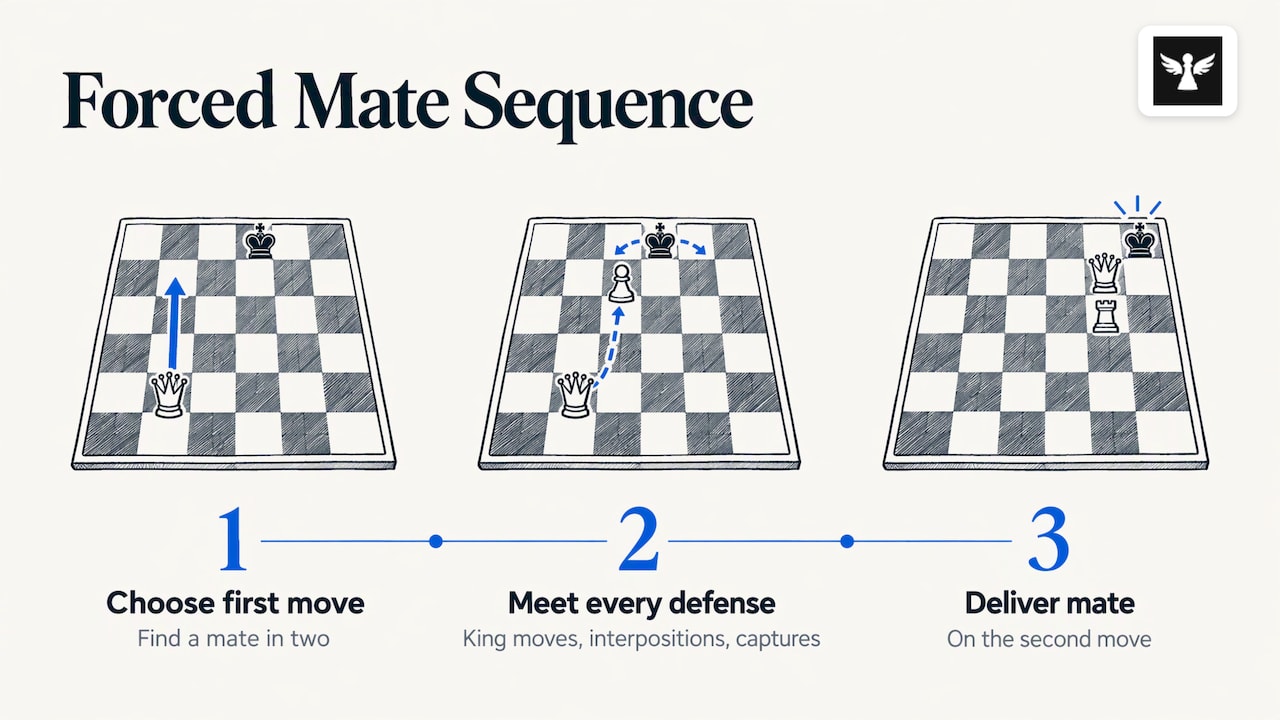
Yes, and that is the best-case scenario. A forced checkmate means that, whatever the opponent does, you deliver mate within a known number of moves. A mate in two, for instance, works when you find a first move after which every defense still allows mate on the second.
In practice, forced mates are chains of checks and threats where each opponent reply is already limited: king moves, interpositions, captures of the checker. The skill is to account for all of them. If your line contains an opponent reply you cannot answer, it is not forced; it is a gamble. Practicing short mating puzzles, with the rule that you must find an answer to every defense before moving, is the cleanest way to build this skill. See our chess puzzle strategy for a method.
How to defend against forcing moves
When your opponent makes a forcing move, panic is the real enemy. Run this sequence:
- Answer the immediate forcing move. If it is a check, you have the three options: move the king, capture the checker, or block. Look at all three; the obvious one is not always the best.
- Reduce the next forcing move. A good rule from a guide to checks and forcing moves is to meet the current check while also reducing the attacker’s next checking resource. Very often the best reply blocks a file, covers an entry square or trades a key attacker.
- Look for your own forcing reply. A counter-check or a capture that comes with a threat can turn the position around in one move.
- Do not automatically take material. A free pawn or piece offered with a check may be the bait for a longer combination. Calculate the follow-up before you capture.
The defensive version of the calculation routine is the same as the attacking one: list the opponent’s forcing moves for the next turn, then choose the move that leaves none of them working.
Where forcing moves begin: the opening
Most players think of forcing moves as a middlegame topic. They are not. Many opening traps are forcing sequences: a capture that looks free but opens a file, a check that wins a pinned piece, a threat that appears after one slip in move order. If you know your opening line well, you recognize the moment when your opponent’s last move allows a forcing reply. If you do not, you play the move that looks natural and miss it.
This is the link between opening memory and tactics. Memorizing a line is not only about remembering moves; it is about remembering where the forcing moves live in that line: which check is available after which deviation, which capture wins material if the opponent errs.
Our perspective
We think forcing moves are the most trainable skill in chess, and the most neglected one. Players study theory, then study tactics as a separate topic, and never connect the two.
In our experience of designing ChessFlux, the useful question is not “what is the best move in general?” but “what happens in the positions I actually reach?” That is why the app builds your repertoire from your last 100 Lichess or Chess.com games and compares your real results against it. The positions you meet again and again are the ones where a forcing move, yours or your opponent’s, decides the game.
The app also includes tactics puzzles by theme or by opening, and Stockfish analysis for any position in your repertoire. So you can memorize a line, drill the tactics that arise from it, and check a critical forcing sequence with the engine, all in one place. That, to us, is how a measurable improvement in openings and tactics happens: repeated, targeted, and based on your own games.
Rolf
Train forcing moves on your own games
ChessFlux is a freemium app: the core features are free, and a Premium subscription unlocks options such as unlimited puzzles, advanced training and additional customization. It imports your last 100 games from Lichess or Chess.com, builds your personal repertoire, and shows where your real games leave it, so you can see which opening positions deserve your attention.

If you want to start with the opening side, see how to build a repertoire from your Lichess or Chess.com games and how to memorize your openings with active training. You can also check any critical line with Stockfish analysis in the app, or start free from the ChessFlux home page.
A weekly routine for forcing-move skill
Skill comes from short, regular sessions rather than one long weekend. A simple weekly plan:
- Three tactics sessions of 15 minutes. Pick puzzles and, before moving, say out loud your forcing candidates in order. Our daily tactics routine shows how to structure this, and the French-language guide to tactical training covers the same ground.
- One game review. Go through your last game and mark every moment where a forcing move existed, for you or for your opponent. The method in how to analyze your chess games fits well here.
- One opening session. Drill the lines where you lose most often and note the forcing moves in them.
For the bigger picture, our practical plan to improve at chess places this routine inside a full training week.
FAQ
Is a forcing move the same as a forced move?
No. A forced move is the only legal move a player has, for instance when a check leaves one escape. A forcing move is a move you choose that leaves your opponent few good options, such as a check, a capture or a mate threat.
Are checks, captures and threats always the best moves?
No. They are the moves to examine first, because they are the easiest to calculate. A check that wastes your attacker or a capture that opens your own king can be worse than a quiet move. Calculate the end position before deciding.
Can a quiet move be more forcing than a check?
Yes. In the Mieses-Chigorin example from Hertan’s book, a quiet bishop move that threatens a double-discovered mate is more forcing than any check or capture available. What matters is how few acceptable replies the opponent has.
How do I get better at calculating forcing lines?
Use a fixed order (checks, captures, threats), look at every opponent reply, check the safety of each moved piece, and follow the line to a quiet position. Practice with puzzles and with positions from your own games, a few short sessions a week.
Sources
- Forcing Chess Moves, publisher’s excerpt (New In Chess)
- Tactique et premières combinaisons, FFE beginner workbook
- Chess Check Capture Threat Trainer & Guide