A sacrificial move gives up a pawn or a piece on purpose to get something worth more: a mating attack, faster development, an open file, a safer draw. It only works when you can name what you are buying and see the opponent’s best reply. The reliable way to sacrifice well is to know your openings so deeply that the typical sacrifices of your own lines are familiar patterns. That is the kind of memorization ChessFlux builds from your last 100 games on Lichess or Chess.com.
TL;DR
- A sacrifice is a deliberate loss of material for compensation. Losing material by overlooking a threat is a blunder, not a sacrifice.
- Compensation can be tactical (mate, a fork, regaining material) or positional (open lines, king safety, space, development).
- Before you play one, name the target, the forcing sequence and the opponent’s best defense, including simply declining.
- Many sacrifices begin in the opening: gambits trade a pawn for center and tempo.
- Memorized opening lines turn risky guesses into familiar ideas you can recognize at the board.
Table of Contents
- What counts as a sacrifice, and what is just a blunder
- Real and sham sacrifices
- What a sacrifice can buy you
- When is a sacrifice justified?
- A checklist before you sacrifice
- Sacrifices that start in the opening
- Common mistakes when sacrificing
- Practice the sacrifices of your own openings
- Our perspective
- FAQ
- Sources
What counts as a sacrifice, and what is just a blunder
A sacrifice is a move that gives up a pawn or piece to gain tactical or positional compensation. Any piece except the king can be offered, as the Wikipedia article on chess sacrifices explains.
The word “deliberate” matters. If you leave a knight hanging because you did not notice the attacker, or capture a pawn that turns out to be protected, you have not sacrificed anything. You have blundered. The difference is not the material lost but the plan behind it: in a real sacrifice you can say, before you move, what you get in return.
A simple example is the classic rook sacrifice for mate: you give up a rook so that the enemy king is dragged to a square where a queen or minor piece delivers checkmate. The material loss looks huge, but the game ends. Nobody calls that a gamble once the final position is on the board.
Real and sham sacrifices
Rudolf Spielmann split sacrifices into two families, and the distinction is very useful for club players:
- Sham (or pseudo) sacrifices. The material is soon regained, or mate is forced. These are combinations. If you can calculate every line to the end, you are not taking a risk.
- Real (or speculative) sacrifices. You play on with less material for quite some time. The compensation is positional or based on an attack whose outcome you cannot fully calculate.
This is described in the same Wikipedia entry. The practical lesson: treat the two differently. For a sham sacrifice, calculate until the end. For a real one, you judge the position by features, such as king safety and piece activity, because the lines run too deep to calculate fully.
If you want to sharpen the calculating side, our guides to chess tactics for beginners and chess tactics for intermediate players cover the patterns that make sham sacrifices work: forks, pins, discovered attacks and back-rank mates.
What a sacrifice can buy you
Material is only one currency in chess. A sacrifice can pay you back in several ways:
| Compensation | What it looks like |
|---|---|
| Checkmate | A forced sequence ends the game, even at the cost of a rook or queen |
| Draw by perpetual check or stalemate | You save a lost game by giving up material |
| Material regained later | A fork or promotion wins back more than you gave |
| Attack on the king | Lines open, pawn cover is damaged, the king is stuck in the center |
| Development | A gambit pawn buys tempi to mobilize your pieces |
| Strategic assets | An open file or diagonal, a weakness in the enemy pawn structure, a blockade |
This list follows the French Wikipedia classification of sacrifices. The English article gives the canonical attacking example: the Greek gift sacrifice Bxh7+, which tears open the cover in front of the castled king.
A quieter example comes from a US Chess Sales guide on using pawns. A key pawn seems to hang, but if Black captures it, White plays Ne5+ forking king and rook. That is a tactical pawn sacrifice. The same guide shows a positional one: White gives up the f5 pawn to open lines toward the enemy king while White’s pieces are massed on the kingside.
In a game you often feel the difference immediately. A tactical sacrifice has a concrete payoff a few moves away. A positional sacrifice leaves you a pawn or the exchange down, and what you own instead is activity, space or targets that the opponent cannot easily remove.
When is a sacrifice justified?
Grandmaster Maxime Lagarde, in a French Chess Federation masterclass recap, summarizes the test: a material sacrifice is justified if it brings good long-term positional compensation or short-term tactical compensation. He also notes that sacrificing on the opponent’s castled king increases your attacking chances, can create a dynamic position with active pieces, and can have a psychological side that helps you escape a compromised position.
Turn that into three practical triggers:
- The enemy king is the target. It is castled with weakened pawns, or stuck in the center with open lines nearby.
- Your pieces are ready and theirs are not. If your pieces are aimed at the target and the defenders are far away, a sacrifice has a better chance of working.
- The advantage is lasting. For positional sacrifices such as giving the exchange (a rook for a minor piece), the opponent should not be able to restore the position in a few moves.
The last point deserves emphasis. A pawn sacrificed for a lead in development is worth little if the opponent can return the pawn at the right moment and neutralize everything.
A checklist before you sacrifice
On a chess.stackexchange.com answer to “How do you judge a sacrifice?”, the contributor lists six positive signs for an attack:
- You have two more pieces attacking the king than the opponent has defending it.
- More of your pieces are actively participating than the opponent’s.
- It is hard for the opponent to bring pieces back to defend.
- It is hard for the king to escape, for instance because it is bottlenecked on f8.
- You have powerful piece setups, such as a knight on the sixth rank supported by a pawn, or doubled rooks on an open file.
- The king’s pawn cover is broken, or the king is stuck in the middle.
The same answer says that three of these in a piece-for-pawn sacrifice is a good sign, and that there is no reliable formula such as “an exposed king is worth two pawns”. Long-term sacrifices come down to judgment that improves with experience.
So use the signs as a prompt, then run this routine at the board:
- Name the target. Which king, square or weakness are you attacking?
- Write down the forcing line. Checks, captures and threats first. Can you follow it one move beyond the sacrifice? A sacrifice often reveals its purpose only one move further along.
- Find the best defense. Not the move you hope for, the one a strong opponent would play.
- Check that the opponent cannot just decline. If they can ignore the offer and stay safely ahead, you have simply lost time. A sound sacrifice should work whether it is accepted or not.
- Scan again. Before you play, look at all checks, captures and threats for both sides. The most common beginner errors are failures of process, not of knowledge.
Sacrifices that start in the opening
Many players meet their first real sacrifice in the opening, as a gambit: a pawn offered for development or space.
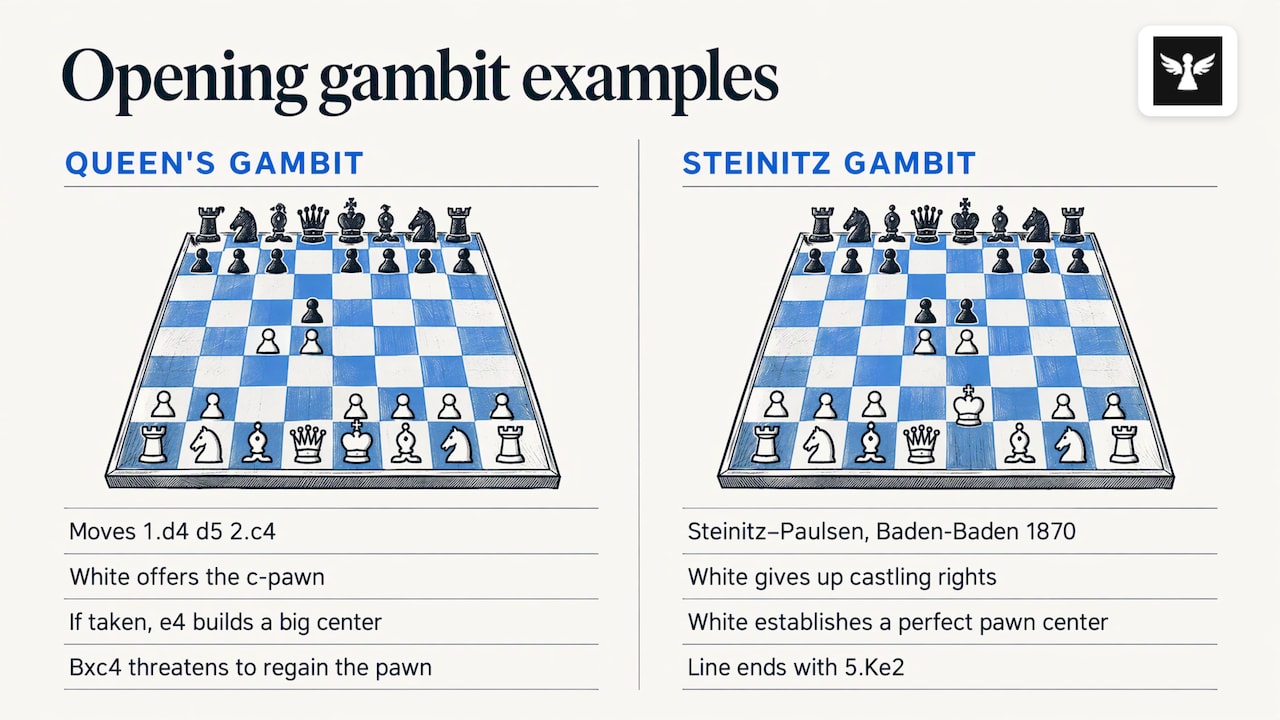
The Queen’s Gambit (1.d4 d5 2.c4) is the best-known case. White offers the c-pawn, and if Black takes it, White can build a big center with e4 and threaten to regain the pawn with Bxc4, as the US Chess Sales guide explains. You can explore the plans and traps in our page on the Queen’s Gambit.
A sharper historical example is the Steinitz Gambit, annotated in a New In Chess excerpt on positional sacrifices. In Steinitz–Paulsen, Baden-Baden 1870, the moves were 1.e4 e5 2.Nc3 Nc6 3.f4 exf4 4.d4 Qh4+ 5.Ke2. White gives up castling rights to establish a perfect pawn center. The excerpt notes that the King’s Gambit (2.f4) and the Queen’s Gambit are both based on a material investment to gain that kind of center.
The point for you: in the opening, a sacrifice is rarely a surprise. It is a known idea with known follow-ups. If you do not know them, you will either decline gambits out of fear or accept them and get run over. Our guides to the Stafford Gambit and the Budapest Gambit show how the compensation works in each line, and the opening principles article explains why development and the center decide whether a pawn offer is worth it. For a wider view, browse our chess openings library; if you play the French, the French Defense page covers the typical plans and traps, including where sacrifices on e5 or in the center appear.
Common mistakes when sacrificing
- Sacrificing to look active. Trainer Tryfon Gavriel, quoted in the French Wikipedia entry, advises against sacrificing just to seem active, or while behind in development unless the move is forcing or solves a concrete problem right away.
- Ignoring the best defense. Beginners often lose with sacrifices because they only look at the reply they want.
- Forgetting the decline. The same article points out that a sacrifice can be declined without risk.
- Mixing up the two types. Treating a sham sacrifice as an intuitive gamble wastes a calculable win. Judging a real one by calculation alone can mislead you, since the lines are too long.
- Not following the sequence one move further. A sacrifice often shows its purpose only a move later, so stop your calculation too early and you misjudge it.
The cure for most of these is a process: target, forcing line, best defense. Write it into your routine, and practice it with puzzles. Our daily tactics practice routine and the French-language guide on tactical training show how to structure it.
Practice the sacrifices of your own openings
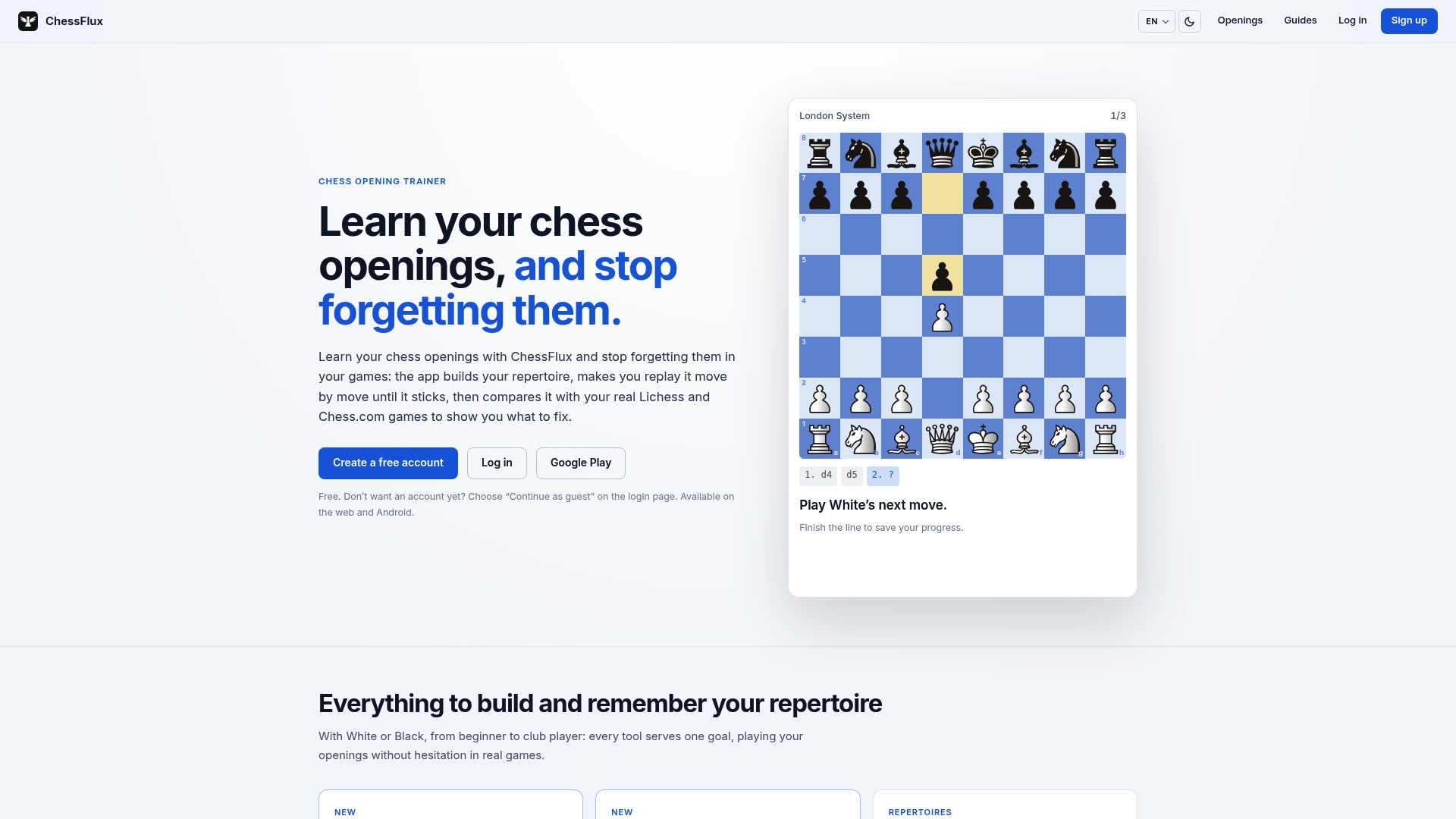
If you play online, the sacrifices that matter most are the ones that arise in your own games. ChessFlux builds a personalized repertoire from your last 100 games on Lichess or Chess.com, then lets you drill it move by move. It compares your real results with that repertoire to point out the moves that need work. You can also build variation trees, import PGN files and studies, solve tactics puzzles by theme or opening, and analyze positions with Stockfish.
The core features are free, and Premium unlocks extras such as unlimited puzzles, advanced training and more customization. You can start on the ChessFlux app.
That combination is the useful one for sacrifices: you learn the lines where your pawn offer is sound, then you practice the tactical patterns that follow it.
Our perspective
Most players think of a sacrifice as a flash of inspiration. In our experience of building ChessFlux, it is much closer to recognition. The player who sacrifices well has usually seen the structure before, knows which square the knight lands on and which defense the opponent will try.
That is why we start from your own games. A generic course teaches the Greek gift or the Queen’s Gambit in the abstract. Our approach builds the repertoire from your last 100 games on Lichess or Chess.com, so the lines you drill are the lines you actually reach, and the moves to improve come from comparing your real play with that repertoire.
Memorize the line, understand the idea, then use puzzles by theme or opening to make the tactic automatic. When a sacrifice finally appears on your board, you are not guessing. You are remembering.
Rolf
FAQ
What is the forbidden move in chess?
There is no single forbidden move, but some moves are illegal: leaving your own king in check, moving through check when castling, or moving a pinned piece so that it exposes your king. Your app or site will not let you play them. A move that merely loses material is legal, and if it is deliberate and compensated, it is a sacrifice.
How do I know when to sacrifice?
Sacrifice when you can name the compensation: a mating attack, an open file, a lasting initiative or a favorable simplification. Check that your pieces are ready to use it and that the opponent cannot decline and stay safely ahead. If you cannot name the target, the forcing line and the best defense, keep the material.
Is a sacrifice the same as a gambit?
A gambit is a sacrifice made in the opening, usually a pawn, to gain development, space or a better center. The Queen’s Gambit and the King’s Gambit are the classic examples. Not every sacrifice is a gambit, since many happen in the middlegame.
Can the opponent refuse a sacrifice?
Yes, and a sound sacrifice should still give you a good game when it is declined. Always look at what happens if your offer is ignored. If the opponent can decline and be safely ahead, the idea is not yet ready.
Sources
- Sacrifice (chess), Wikipedia
- Sacrifice (échecs), Wikipédia
- Masterclass FFE du 10 avril 2020 par le GMI Maxime Lagarde
- How do you judge a sacrifice?, chess.stackexchange.com
- How to Best Use Your Pawns in a Game of Chess, US Chess Sales
- Mastering Positional Sacrifices, New In Chess