The best way to respond to 1.e4 is the defense you can play, remember and understand under pressure, not the one with the best reputation. For most players that means picking one reply (1…e5, 1…c5, 1…e6, 1…c6 or 1…d5), learning its first ten moves and the plans behind them, then training it on the positions your own games actually reach. Below you will find what each defense is trying to do, how to choose between them, and how to memorize your pick so it holds up on move 8, not just move 3.
TL;DR
- After 1.e4, Black’s job is to stop White from building a strong pawn center on e4 and d4, by controlling d4, hitting e4, or preparing …d5.
- 1…e5 is the open, classical answer; the Sicilian (1…c5) is sharp and theory-heavy; the Caro-Kann (1…c6) and French (1…e6) are solid counter-punching setups; the Scandinavian (1…d5) is the most direct.
- Beginners do best with a low-theory defense whose plans are easy to explain. Intermediate players should pick by the type of position they enjoy.
- Understanding the ideas matters more than memorizing every variation, but you still need to drill the early moves until they are automatic.
- Your own recent games show which lines you actually face, so train those first.
Table of Contents
- What 1.e4 asks of Black
- The main defenses against 1.e4
- How to choose: a practical filter
- What to do after White’s common replies
- Memorize ideas first, then lines
- Use your own games as the syllabus
- Where ChessFlux fits
- Our perspective
- FAQ
- Sources
What 1.e4 asks of Black
With 1.e4, White opens lines for the queen and the king’s bishop and starts fighting for the center, as the Wikibooks opening theory chapter on 1.e4 explains. Black’s goal in reply is to keep White from establishing or keeping a pawn center on e4 and d4. The same source lists the usual ways to do it: control the d4 square, attack the e4 pawn, prepare …d5, or undermine the center later.
That gives you a simple way to sort every defense:
| Black’s idea | Typical first move | What it means in practice |
|---|---|---|
| Mirror and occupy the center | 1…e5 | Develop quickly, fight for d4 with pieces |
| Fight for d4 from the side | 1…c5 | Unbalanced position, queenside counterplay |
| Prepare …d5 with a pawn | 1…e6 or 1…c6 | Solid structure, strike at the center on move 2 |
| Challenge e4 at once | 1…d5 | Immediate contact, queen comes out early |
Every defense below is one of these four ideas wearing different clothes. If you remember which idea you chose, you can find the right move even when your memory of the exact line fails.
The main defenses against 1.e4
1…e5: the open game
Black takes space in the center and develops pieces naturally. After 2.Nf3 Nc6 White chooses between the Italian Game (3.Bc4), the Ruy Lopez (3.Bb5), the Scotch (3.d4) and others. The plans are clear: develop, castle, and contest the center with …d5 or …d6 when the moment is right.
The upside is that the ideas are the ones every chess book teaches first. The cost is that White has many ways to steer the game, so you need a small answer to each: the Italian, the Ruy Lopez and the Scotch cover most of what you will meet online. If you want to see the other side of a popular line, our guide to the Scotch Game from White’s point of view shows what you will be up against.
1…c5: the Sicilian
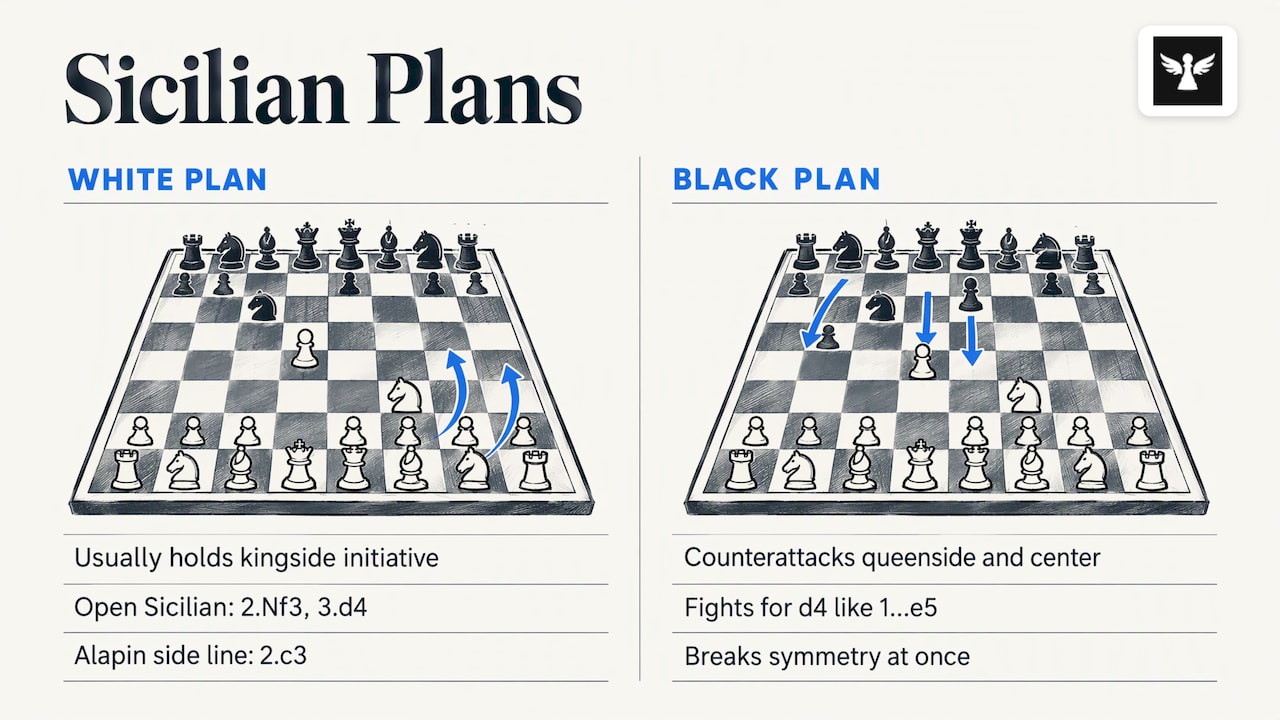
The Sicilian fights for d4 like 1…e5 does, but it breaks symmetry at once, which often leads to dynamic and sharp positions. White usually holds the initiative on the kingside while Black counterattacks on the queenside and in the center. It is a fighting choice with a lot of branches: the Open Sicilian (2.Nf3 and 3.d4) alone splits into several major systems, and White also has side lines such as the Alapin (2.c3).
It suits players who like imbalance and are ready to put in the repetition. If you pick it, narrow the field early by choosing one setup against the Open Sicilian and one against each common side line.
1…c6: the Caro-Kann
The idea is to support …d5 with the c-pawn. After 2.d4 d5 Black has a sound structure, and unlike in the French, the light-squared bishop is not shut in behind its own pawn. The Wikibooks chapter makes exactly this comparison: the Caro-Kann prepares …d5 without blocking that bishop.
White’s main tries are the Advance (3.e5), the Exchange (3.exd5), and the classical 3.Nc3 dxe4 4.Nxe4. In most lines Black develops the bishop outside the pawn chain, usually with …Bf5, then plays …e6 and the …c5 break. It is a good choice for players who want clear plans and few surprises.
1…e6: the French
The French also prepares …d5, this time with the e-pawn. The structure is sturdy and the counterplay is easy to name: attack the base of White’s pawn chain with …c5, and sometimes with …f6. The long-term issue is the light-squared bishop on c8, which can end up hemmed in behind the e6 pawn, so a good French player knows how to trade it or free it.
We cover this opening move by move, including the Advance, Winawer, Tarrasch and Exchange variations, in our French Defense guide.
1…d5: the Scandinavian
Black challenges the e4 pawn immediately: 2.exd5 Qxd5 3.Nc3 Qa5 (or 3…Qd6 or 3…Qd8) and the queen sits on a safe square while Black develops pieces behind it. The early queen move bothers some players, but the structure is healthy and the plans are simple: develop with …Nf6, …c6 and …Bf5, and castle.
The theory load is lighter than in many Sicilians, which is why a beginner repertoire excerpt on My First Chess Opening Repertoire for Black recommends the Scandinavian to newer players. Our Scandinavian Defense page walks through the moves, variations and plans.
Other replies worth knowing
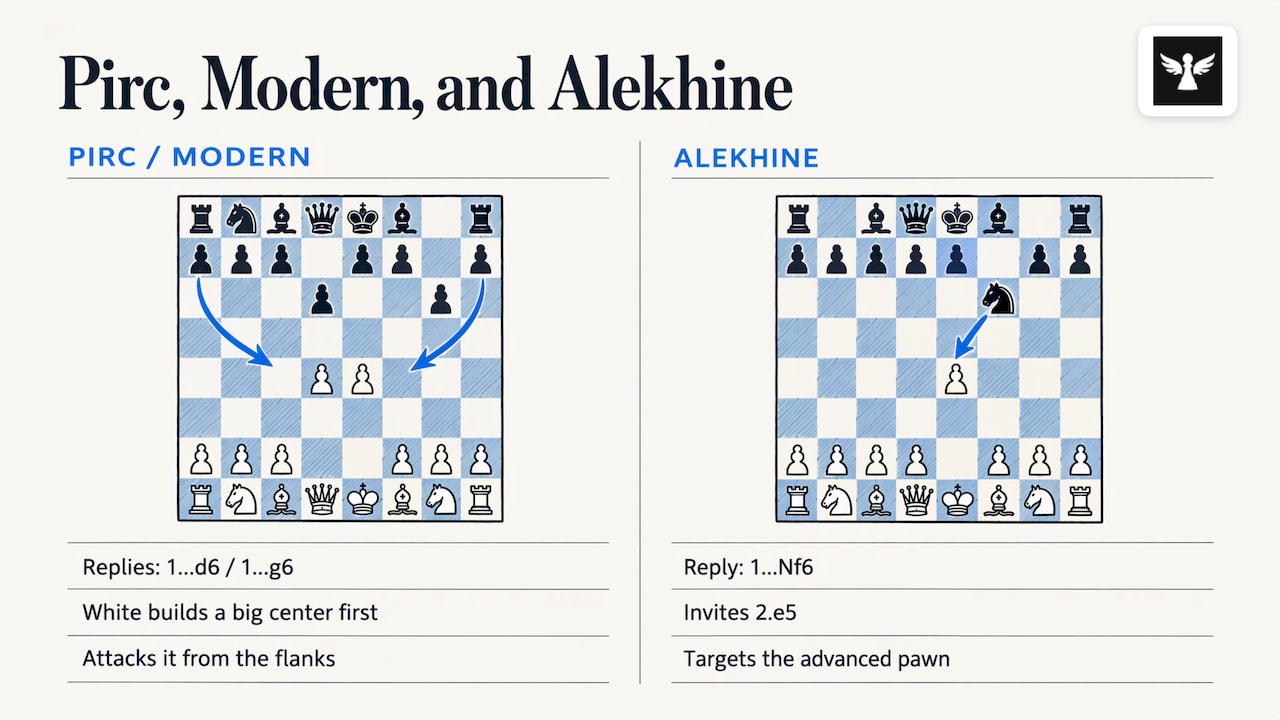
The Pirc and Modern (1…d6 and 1…g6) let White build a big center first and attack it from the flanks. The Alekhine (1…Nf6) invites 2.e5 and tries to prove the advanced pawn is a target. These are more specialized choices. They are playable, but you need to understand pawn-center play well before they feel comfortable.
How to choose: a practical filter
The same beginner excerpt describes the Sicilian as theoretically demanding, the French as strategic and potentially hard for beginners, and the Caro-Kann as solid but sometimes passive. Those are fair labels for a decision, and you can combine them with your own taste in four questions.
- How much time can you give to memorizing? If you have two or three hours a week, a defense with lighter theory (Scandinavian, Caro-Kann, a simple 1…e5 setup) will give you more return than a Sicilian you half-know.
- What positions do you enjoy? Open and tactical points to 1…e5 or the Sicilian. Quiet maneuvering points to the French or Caro-Kann.
- What do you face most often? At club and online level, many opponents have a favorite side line instead of the main line. Your repertoire should handle those first.
- Can you explain the plan in one sentence? “Trade my light-squared bishop and break with …c5” is a plan. “Remember move 11 of line B” is not.
Here is how that looks as a quick decision guide:
| If you are… | Start with | Why |
|---|---|---|
| A beginner who wants natural development | 1…e5 | Teaches general principles |
| A beginner who wants minimal theory | 1…d5 (Scandinavian) | Few main lines, clear piece placement |
| Looking for a solid, no-nonsense structure | 1…c6 | Clear plans, bishop stays active |
| An intermediate player who likes strategy | 1…e6 | Rich pawn-break play |
| An intermediate player who wants winning chances as Black | 1…c5 | Unbalanced positions, but plan on real study |
One more point from the same guidance: with Black, one defense against 1.e4 and one against 1.d4 cover most of your early decisions. If you want to complete the pair, read how to defend against 1.d4 or its French version, Répondre à 1.d4 : quel répertoire choisir avec les Noirs.
What to do after White’s common replies
Whatever you choose, the early skirmishes follow the same pattern: White tries something other than the main line, and you need a sensible answer, not a long one. Here is how to think about it.
- White grabs space (Advance lines like 3.e5 in the French and Caro-Kann). Attack the pawn chain. In the French that means …c5 and …Qb6; in the Caro-Kann, free the bishop with …Bf5 before playing …e6.
- White simplifies (Exchange lines). The position is more symmetrical. Do not relax: develop every piece, find the active squares for your bishops, and look for the first pawn break.
- White attacks early (queen or bishop raids, Bc4 and Qh5 ideas). Check the threat on f7 first, then develop with tempo. Most early traps work only if you play on autopilot.
- White plays a side line (2.c3, 2.Nc3, 2.f4). Use principles: control the center, develop, castle. A calm setup you understand beats a rare, sharp line you half remember.
The pitfall common to every defense is the same: moving a piece twice in the opening, grabbing a pawn that opens the center when you are behind in development, or castling late. A good rule is to ask on each move: what does my opponent threaten, and which of my pieces is still asleep?
Memorize ideas first, then lines
Grandmaster Parimarjan Negi makes a point in the introduction to his repertoire book, available as a sample excerpt: for most readers, understanding themes and ideas matters more than memorizing every variation. The ideas ground you in the resulting positions, and they help you find your own moves when the opponent leaves the book.
That does not remove the need for repetition. It tells you what to repeat. A good routine looks like this:
- Write down the first 8 to 10 moves of your defense, with the one-sentence plan for each major branch.
- Add one answer for each common sideline, not three.
- Drill positions, not move lists. Start from a position where you must find the move, not from the initial board.
- Review your losses. A game where you left your line on move 6 is more useful than ten games where you followed it.
- Retest after a few days. Spaced repetition turns shaky knowledge into a reflex.
Our guides on how to learn chess openings and how to practice them so they stick go deeper into this method, and our opening strategy overview shows how repertoire choices fit the rest of your game.
Use your own games as the syllabus
A published repertoire covers every line equally. Your games do not: you meet the same handful of replies again and again, and you leave book in the same places. That is the material that deserves your time.
ChessFlux is built on that idea. It builds a personalized repertoire from your last 100 games on Lichess or Chess.com, then lets you train it move by move. It compares what you really played with your repertoire and points out the moves to improve, so your practice goes to the lines that cost you points. You can read how this works in the guide to building a repertoire from your Lichess or Chess.com games and in the game debrief, which sets your openings against your repertoires.
If you prefer to build the tree yourself, the app also supports repertoire building with variation trees and imports from PGNs and studies. The repertoire building guide shows how. To test a line you are unsure about, you can run an opening analysis with Stockfish: see how to analyze chess openings with Stockfish.
A typical week for a player who has chosen the Caro-Kann might look like this:
- Import the latest games and see which White setups came up.
- Train the two or three lines where you left your repertoire.
- Do a few tactics puzzles tied to the opening, such as the typical shots against …Bf5 setups.
- Play, then review the debrief and adjust.
Worked example. Suppose your last 100 games show that you answered 1.e4 with 1…c6, and 30 of them reached the Advance variation (3.e5). Training the Advance for a week will likely help you more than polishing a rarely seen Panov line. Frequency in your own games sets the priority.
Where ChessFlux fits
ChessFlux is free to start, with core features available at no cost, and a Premium plan adds options such as unlimited puzzles, advanced training and further customization. You can try the free version, import your Lichess or Chess.com games, and see which of your 1.e4 replies need work. Start at chessflux.fr.

If you want a broader overview of what is available before you commit to a defense, the opening guides collect the pages for each opening.
Our perspective
Most players who struggle against 1.e4 do not lack an opening. They lack a repertoire that matches the games they actually play. They pick a fashionable defense, learn a few lines, and then leave the book on move 6 against a side line they never prepared.
We built ChessFlux around the opposite order. Start from your real games, find the positions where you drift away from your repertoire, and train exactly those. Whether you play the Sicilian, the Caro-Kann or the French, that way each session targets a weakness you have already shown, not a generic course.
Choose the defense whose plans you can say out loud, then let your own games tell you what to practice next. Progress becomes measurable: the same lines come up, and you handle them better each week.
Rolf
FAQ
What is the best response to 1.e4 for a beginner?
A reply with clear ideas and manageable theory. 1…e5 teaches general principles, the Caro-Kann gives a solid structure, and the Scandinavian has fewer main lines than most Sicilians. Pick one, stick with it for a few months, and judge it on results and enjoyment, not on its reputation.
Is the Sicilian the best defense against 1.e4?
It is one of the most popular and gives Black real winning chances, because it creates an unbalanced position from move one. It also demands the most study, with many variations to learn. If you have limited time, a lower-theory defense can serve you better until your understanding grows.
How many moves of a defense should I memorize?
Aim for the first eight to ten moves of your main line and one reliable answer to each common side line. Beyond that, concentrate on the plans: where your pieces go, which pawn break to play, and which trades help you. Add depth only where your own games show you leave the book.
How can I practice my defense against e4 using my own games?
Review which positions came up after 1.e4 in your recent Lichess or Chess.com games, note where you left your preparation, and drill those positions first. ChessFlux does this automatically from your last 100 games and compares your real moves with your repertoire.
Sources
- Chess Opening Theory/1. e4, Wikibooks
- Sicilian Defence, Wikipedia
- My First Chess Opening Repertoire for Black (excerpt)
- Parimarjan Negi, repertoire book excerpt on 1.e4