The way to memorize chess openings is to memorize less, but from the right place: the positions your own games actually reach. Learn the ideas behind each move, put the lines in a file you can test yourself on, review them at growing intervals, and after every game fix the first move where you went wrong. Lines picked from your real games stick because you have already met them over the board.
This guide gives you that routine step by step, for beginners and for intermediate players on Lichess or Chess.com who keep forgetting their theory after a week.
TL;DR
- Memorize only what your games reach. Start from your last 100 games, not from a theory book.
- Attach every move to an idea: what it threatens, what setup it builds, what the opponent wants.
- Review at growing intervals (one day, three days, one week) and keep daily sessions short.
- Test yourself from a blank board. If you can’t rebuild a line, you don’t know it yet.
- After each game, find the first move you were unsure of and fix only that.
Table of Contents
- Decide what deserves a place in your memory
- Understand the moves before you memorize them
- Start from your own games, not from a book
- A step-by-step routine to memorize an opening
- Where memorization goes wrong
- Test your recall in real games
- Add tactics so the lines have teeth
- How much of your study time should openings take?
- A sample week for an intermediate player
- Try it on your own games
- FAQ
- Sources
Decide what deserves a place in your memory
Most players who struggle to memorize openings are trying to memorize too much. A French master’s thesis on repertoire building, published through the French chess MOOC, says the repertoire should match the player’s level, style and available time. Success depends on knowing the aims of the opening, understanding move-order nuances and recognizing typical positions.
The same document quotes the trainer Mark Dvoretsky on memory. Players with limited memory or study time should lean toward opening “schemes”: logical systems with little theory, where understanding matters more than recall. Players with a big memory and lots of time can take on heavily analyzed lines such as the Najdorf Sicilian.
For most club players that means a simple filter:
- One system with White, for example the same setup against most replies.
- One answer to 1.e4 and one to 1.d4 with Black.
- Only the side lines your opponents actually play. If nobody at your level plays a gambit, it does not need a file yet.
The French Chess Federation’s masterclass summary with GM Xavier Bédoin defines a repertoire as a tree of variations for White or Black that accounts for the opponent’s replies at each move. Its goal is to reach a playable middlegame, not to win on move 12. That is a useful limit: you memorize until the position is understood and playable, then you stop.
A quick sizing exercise
Open your last 20 games and write down, for each, the move where you left your preparation. Most players find the same five or six branches again and again. That list is your first memorization target. Anything not on it can wait.
Understand the moves before you memorize them
Rote memory fails when a single move order changes. Understanding survives it. Before you commit a line to memory, ask three questions of every move:
- What does this move threaten or prevent?
- What setup am I building (which squares for which pieces)?
- What is my opponent trying to do in reply?
This is the approach recommended in the French thesis above: know the aims of the opening and the typical positions it leads to, not just the sequence. If you are new to the idea, our guide to chess opening principles covers the basics that make most first moves predictable: fight for the center, develop pieces, castle early, avoid moving the same piece twice without a reason.
Players who write a short sentence beside each move memorize faster, because the sentence becomes the cue. “Bishop to c4 aims at f7” is easier to recall than “4.Bc4”. When you reach a move that you cannot explain, stop adding lines. Nate Solon, a chess writer who has written at length about this problem, warns in his guide to remembering openings that lines you do not understand need explanation, not simply more repetition.
How much memorization is enough?
If you are a beginner, very little. A training program for 1000 to 1500 rated players, relayed in French by the blog Les échecs sans peine, says that at first the general principles are enough: don’t move a piece twice, control the center, remember that a pawn move is not a development move, keep your king safe. From around 1300, it suggests working on typical opening positions with a training partner, to understand development and tempo rather than to learn theory by heart.
So a sensible target is this:
| Level | What to memorize | What to understand |
|---|---|---|
| Beginner | The first 4 to 6 moves of one setup | Principles: center, development, king safety |
| Intermediate | 8 to 12 moves of your main lines, plus your most frequent opponent deviations | Pawn structures, typical plans, typical tactics |
| Stronger club player | Deeper branches in the lines you play most | Move-order nuances and the ideas behind the sidelines |
The numbers are a guide, not a rule. The point is proportion: the line you know should be shorter than the plan you understand.
Start from your own games, not from a book
A theory book shows you what strong players choose. Your games show you what your opponents choose against you, which is the only theory you will face this month.
That is the idea behind how we built ChessFlux. The app builds a personalized repertoire from your last 100 games on Lichess or Chess.com, so you begin with the positions you really reach. It then compares your real performance with that repertoire and points out the moves worth improving. You can read how the import works on our page about building a repertoire from your Lichess or Chess.com games.
Doing the same thing by hand is possible but slow: you export games, sort them by opening, find where each one left theory and write it all down. Most players quit at the sorting stage. Having the app do the sorting means your first study session can already be spent on memorizing.
If you prefer to assemble the file yourself, our guide to building a chess opening repertoire explains how to organize lines as a tree of variations, and ChessFlux also lets you import from PGN files and studies.
A step-by-step routine to memorize an opening
Here is a routine that fits in about 15 minutes a day. It works with any opening.
Step 1: Pick one line and cap it
Choose a single branch, for example one reply to a common move. Cap it at eight to ten moves. The temptation is to add everything the opponent might do; resist it. Adding material too quickly is the most common reason a review pile becomes unmanageable.
Step 2: Study a model game
Play through one strong game in that line and notice where the pieces end up. A model game gives the line a story: the plan, the typical pawn break, the typical mistake. Moves attached to a story are far easier to recall than a bare list.
Step 3: Write it down, with a reason for each move
Put the line in a file. Solon’s piece on common opening mistakes says an opening file should record the opening play you plan to use, and that reviewing a line without documenting it did not help him retain it. In ChessFlux you build this as a variation tree and then go through it move by move.
Step 4: Rebuild it from a blank board
This is the drill that exposes what you really know. Solon’s blank-slate exercise asks you to spend 10 to 30 minutes reconstructing a line from an empty study without hints, then fill the gaps and explain the moves. A companion article describes it as a 30-minute timed exercise, followed by checking the gaps and adding arrows or verbal explanations.
The discomfort is the point. Recognizing a move on screen is easy. Producing it with no help is what you need at the board.
Step 5: Schedule the reviews
Use spaced repetition: review a line, then again after a growing delay. Solon’s example is a first review after a day, another three days later, then a week. The software you use matters less than the habit: short, frequent sessions beat one long weekend.
A practical test: if your scheduled reviews cannot be finished in about 10 minutes a day, you are probably adding new lines too fast. Slow down the intake, not the review.
Step 6: Play it, then fix one move
Play the line in real games. After each game, find the first move where you felt unsure and update your file for that move only. We cover the drills in more detail in six chess opening drills that make lines stick and in our guide to practicing chess openings so they stick.
Where memorization goes wrong
Three habits explain most forgotten openings.
Learning in the wrong order. Players start with sharp theory and no feel for the resulting positions. Start with the plan, then add the precise move orders.
Passive review. Clicking through a line you can see is not recall. Cover the next move, say it aloud or play it, and only then check.
Never closing the loop with real games. A line you never use at the board decays. A line you play weekly stays. This is why the best list of what to learn is the list of what you actually play.
There is also a fourth, quieter problem: a repertoire that never changes. As the chess teacher Sylvain Ravot points out, new games and ideas appear every day, so a repertoire is never finished. Revisit it regularly and fill the biggest gaps first, meaning the replies most often played against you.
Test your recall in real games
A clean memory in training can vanish when the opponent plays something odd. Prepare for that moment on purpose.
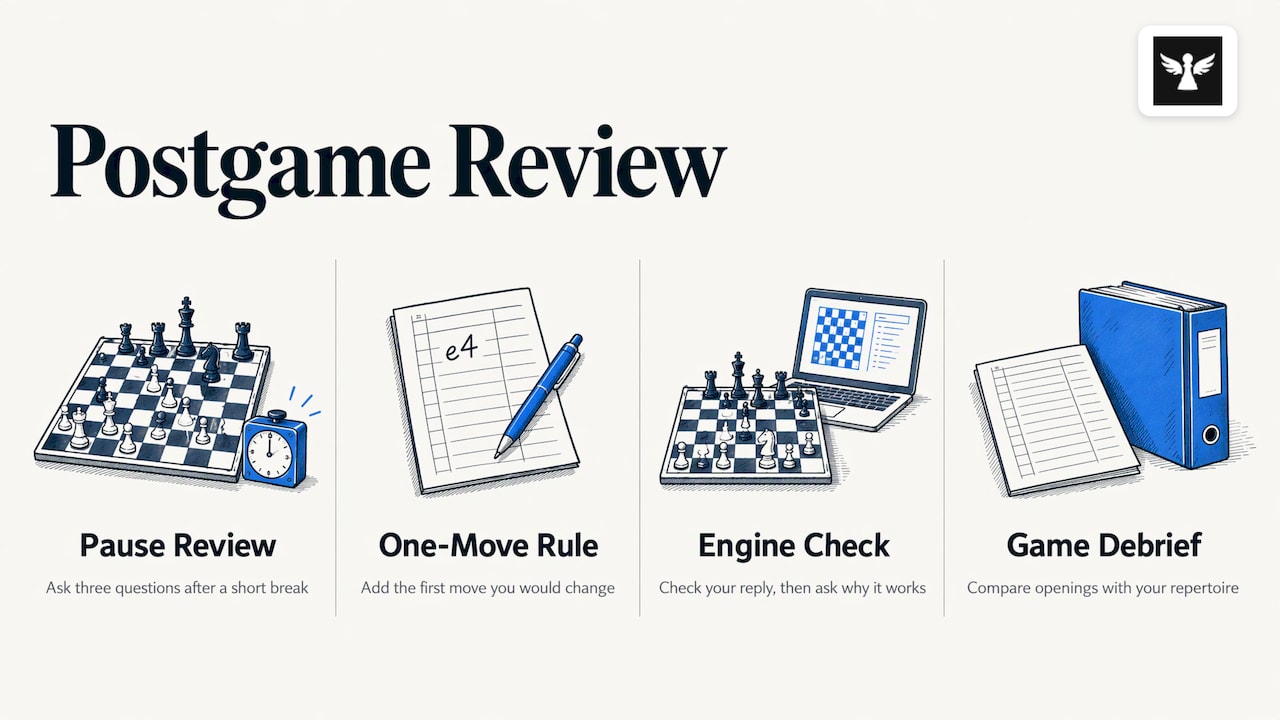
Review after a pause. After a game, take a short break, then ask: which was the first move I felt uncertain about? Was the line I played actually good? What will I do next time? These three questions come from GM Noël Studer’s guide to learning a new opening, which also advises learning in stages: basic ideas first, then games, then deeper study of the lines that really occurred.
Use the one-move rule. Solon’s rule is simple: after each opening game, add to your file the first move you would change. One move a game keeps the file manageable and keeps it relevant.
Check the engine, then the idea. When an opponent leaves your preparation, run the position through an engine to see whether your planned reply is sound. ChessFlux includes opening analysis with Stockfish, so you can check a new line without leaving the app. Then ask why the engine’s move works, because the idea is what you will remember next time.
Match training to your results. The game debrief in ChessFlux compares your openings against your repertoires, so you see which lines you reached, where you followed your preparation and where you left it. Our page on the game debrief explains what it shows. If you prefer to review games by hand, our method for analyzing your chess games walks through it.
Add tactics so the lines have teeth
An opening you remember but cannot exploit is only half useful. Many opening traps and typical middlegame shots come from a handful of patterns. Practicing tactics by theme or by opening ties the memorized moves to the points they are designed to reach. ChessFlux has tactics puzzles by theme or opening, and the Premium plan unlocks unlimited puzzles.
How much of your study time should openings take?
Less than most players think. The French teacher Sylvain Ravot, in his document on building an opening repertoire, argues that below 2000 Elo openings are the area to work on least among the four (tactics, strategy, endgames, openings), and suggests around a quarter of study time for the repertoire itself. He quotes Steve Giddins on why: memorizing variations is only a small element, and understanding positional and tactical themes matters far more.
That is not a reason to skip openings. It is a reason to make them efficient: a small, well-chosen repertoire, reviewed in short daily sessions, leaves time for tactics, endgames and game review. If you want the wider picture, see our overview of chess opening strategy and our method for learning chess openings in a way that lasts.
A sample week for an intermediate player
Here is how the routine can look in practice for someone who plays 1.e4 with White and defends against 1.e4 and 1.d4 with Black.
- Monday: import your latest games and list the three branches where you left theory most often. Choose one.
- Tuesday: study a model game in that branch and add the line to your file, with a short reason beside each move.
- Wednesday: blank-slate drill for 15 minutes, then fill the gaps.
- Thursday: quick review of the line, then ten puzzles in that opening.
- Friday: play two or three rapid games and aim for the line.
- Saturday: review those games, find the first uncertain move and update the file.
- Sunday: rest, or a ten-minute review of the older lines that are due.
The next week you add a second branch only if the first one felt solid. If it didn’t, you repeat it. Speed is not the goal; permanence is.
What we think about memorizing openings
We built ChessFlux on one observation: players forget openings because they study positions they never reach. A generic course teaches the theory of the whole opening, but your games only use a few branches of it.
So our approach starts from your real games. The app builds a repertoire from your last 100 games on Lichess or Chess.com, lets you train it move by move, and compares your actual results with your repertoire to point at the moves that need work. The memorization effort goes where your games need it, not where a book happens to be thick.
We also think understanding and memory belong together. That is why you can build variation trees, import from PGNs and studies, check lines with Stockfish and train tactics by theme or opening in the same place. A line you can explain, test and then use in a game is a line you keep.
Rolf
Try it on your own games
ChessFlux is a freemium app: the core features are free, and the Premium subscription adds options such as unlimited puzzles, advanced training and more customization. Connect your Lichess or Chess.com account, and it builds your repertoire from your last 100 games so you can start memorizing the lines you actually play.
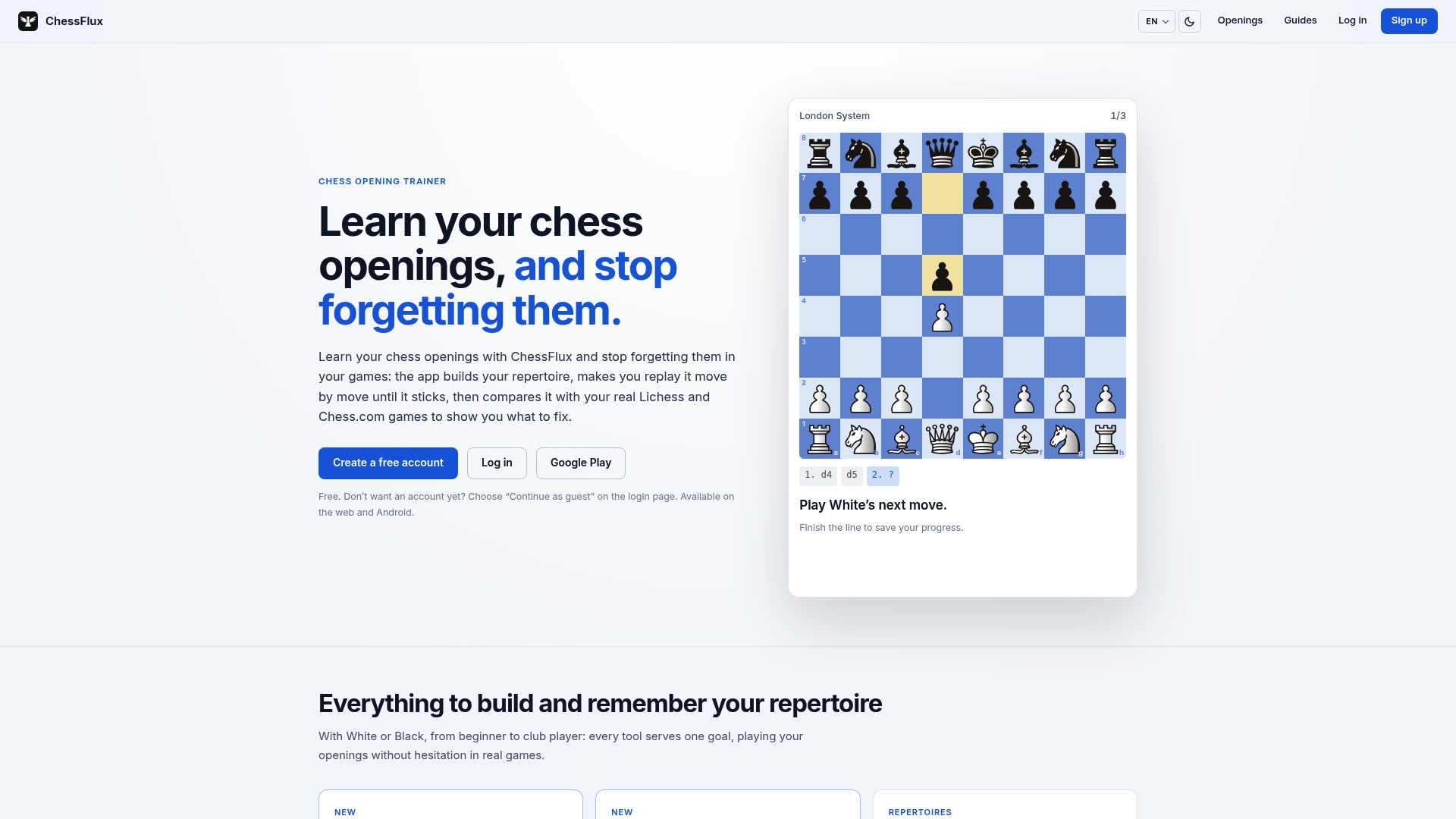
Start on the ChessFlux home page and pick your first line. Or explore our opening guides if you want to choose the opening first.
FAQ
What is the best way to memorize chess openings?
Start from the positions your own games reach, and tie each move to an idea. Rebuild the line from a blank board, review it at growing intervals and fix the first uncertain move after each game. This combination of understanding, active recall and real play is what keeps lines in memory.
How long should I spend on opening review each day?
About 10 minutes is a good ceiling for scheduled reviews. Solon suggests that if you cannot finish due reviews in that time, you are adding new material too quickly. Cut the number of new lines, not the review.
How many moves deep should I memorize?
Beginners can stop after the first four to six moves of a setup, as long as they understand the principles behind them. Intermediate players can go further in the lines they play most, until they reach a position they understand and can play. The goal is a playable middlegame, not the longest possible line.
Do I need to memorize openings below 1200 rating?
Principles matter more than long variations at that level. A short setup, a few typical plans and tactics practice will serve you better than deep theory. Once you meet the same structures often, add memorized lines gradually.
What should I do when my opponent leaves my prepared line?
Fall back on the plan: develop, fight for the center, keep the king safe. After the game, find the first move where you were unsure and add the correct reply to your file. Over a few games, the common deviations become part of your repertoire.
Sources
- Choix et construction du répertoire d’ouvertures (mémoire DEFFE)
- Masterclass FFE du 20 avril 2020 avec Xavier Bédoin
- How to Remember Your Openings, Nate Solon
- How to stop forgetting your openings, Nate Solon
- Common Mistakes and How to Fix Them, Nate Solon
- ChessDojo 1000-1500 Elo, Les échecs sans peine
- The simple way to learn a new opening, Next Level Chess
- Comment construire son répertoire d’ouvertures, Sylvain Ravot