The best opening drills start from the games you actually play. Drill the lines your opponents reach, test yourself without hints, and review what went wrong in real games. ChessFlux builds a repertoire from your last 100 Lichess or Chess.com games and trains you move by move on it, so every drill below targets your own gaps instead of a generic course.
This guide covers six opening exercises, from simple recall to reconstructing a whole tree from memory. It also shows how many lines to drill and how to check that the work shows up in your results.
TL;DR
- An opening drill forces you to produce the move before you see it. Reading a line again and again does not do that.
- Start from your own games: the lines you reach most often and the moves where you left your preparation are the ones worth drilling.
- Mix three kinds of work: move-by-move recall, a blank slate reconstruction, and practice against opponents’ deviations.
- Fewer lines, drilled deeper, go further than a wide repertoire you never revisit.
- Close the loop after each game: compare what you played with your repertoire and drill the first move where they differ.
Table of Contents
- What opening drills are and why they work
- Start with your own games, not a generic list
- Drill 1: Move-by-move recall
- Drill 2: The blank slate drill
- Drill 3: The deviation drill
- Drill 4: Learn from a model game
- Drill 5: Puzzles built from your openings
- Drill 6: The post-game debrief
- How many lines should you drill?
- A weekly routine that fits real life
- Putting it together in ChessFlux
- Our view on opening drills
- FAQ
- Sources
What opening drills are and why they work
An opening drill is a short, repeatable exercise in which you recall opening moves, instead of reading them. You see a position, you play the move you believe is correct, and you get immediate feedback. Chess opening exercises are the same idea under another name: any task where you must retrieve a move from memory under realistic conditions.
The reason this works is simple. In a game, nobody shows you the next move. Knowing a line when you read it on a page is a different skill from recalling it at move 8 with a clock running. A drill trains the second skill.
One French coaching thesis, Simon Le Marec’s study of training methods (2009), found that players memorized complete games more easily than bare lines and enjoyed reviewing them more. His advice: pick a line, find a game that illustrates it, annotate it, then add it to your database. We will use that idea in drill four.
Start with your own games, not a generic list
Before choosing exercises, decide what to drill. Most players pick an opening from a book and then discover that their opponents never play the main line. A better starting point is your last 100 games on Lichess or Chess.com:
- Which openings do you reach most often as White and as Black?
- At which move do you typically leave your preparation?
- Which positions repeat in your losses?
Those answers give you a short, high-value drill list. This is what ChessFlux does automatically: it imports your last 100 games from either site, builds a personalized repertoire, and compares your real games with it to flag the moves worth improving. You can also build a repertoire from your Lichess or Chess.com games and skip the manual setup. If you already keep opening files elsewhere, ChessFlux imports PGNs and studies too.
Drill 1: Move-by-move recall
This is the base drill. You are shown a position from your repertoire and you play your next move. If you are right, the line continues. If you are wrong, you see the correct move and the position comes back later.
How to do it well
- Work in short sessions, ten to fifteen minutes, on one opening at a time.
- Say the idea behind the move before you play it: which square it controls, which piece it develops, which plan it prepares.
- Repeat the lines you missed the same day, then again a few days later.
Where it goes wrong: players recognize the move from its shape on the board and click without thinking. If you are answering instantly but cannot explain the move, slow down and name the idea first.
ChessFlux’s active opening training works this way, move by move on the lines of your own repertoire. For a deeper look at making long lines stay put, see our guide on memorizing long opening lines.
Drill 2: The blank slate drill
Move-by-move recall tests individual moves. The blank slate drill tests the whole structure. Writer Nate Solon describes it as a timed exercise: set a timer for 10 to 30 minutes, open an empty study or file, and rebuild everything you know about a given line, for both sides, without hints. He also notes the exercise is deliberately uncomfortable, and that it is the difficulty that makes it effective.
His forest comparison is useful: repeated single-move questions test the trees one by one, but to find your way through the forest you need to see how the branches connect.
Steps
- Pick one opening and one side, for example the Caro-Kann as Black.
- Start a blank board or empty study. No book, no engine, no database.
- Enter every move and every opponent reply you remember, including the replies you expect from weaker players.
- When the timer ends, compare with your repertoire and mark every gap.
- Drill the gaps with Drill 1, then repeat the blank slate a week later.
The gap list is the real product. It tells you exactly where your memory is thin, which is more useful than any feeling of confidence.
Drill 3: The deviation drill
Sooner or later, your opponent leaves your preparation. Opening exercises that only follow your main line leave you helpless at that moment. This drill prepares you for it.
- For each position in your repertoire, list the three most common opponent moves you have actually faced. Your game history gives you this list for free.
- For each one, decide on a reply and the idea behind it.
- Drill these branches as seriously as the main line.
This is also where variation trees help. A repertoire stored as a tree, not a flat list of lines, lets you drill every branch from the same starting position. You can build a repertoire with variation trees in ChessFlux and then train on exactly those branches.
If an opponent plays something you never prepared, do not panic and recall nothing: fall back on opening principles. Our article on chess opening strategy covers the principles that still work when theory runs out.
Drill 4: Learn from a model game
Le Marec’s advice, as noted above, is to work on games, not isolated lines. Here is a simple version:
- Pick the line you want to learn.
- Find one complete game in that line, ideally by a strong player and with a clear plan in the middlegame.
- Cover the moves and guess each one before you reveal it. Keep a score.
- Write one sentence per key move about the plan behind it.
- Add the line to your repertoire.
A game gives each move a story: why the knight went there, what the pawn break was for. Stories are far easier to remember than bare strings of moves. Le Marec also suggests a double repertoire, with one risky and one solid option per variation, which gives you a choice depending on the opponent and the tournament situation.
Drill 5: Puzzles built from your openings
Openings are full of tactical traps and standard shots, and many games are decided in the first fifteen moves. Drilling tactics that arise from your own openings connects memory to calculation.
Pick the tactical themes that show up in your lines: a pin on the f3 knight, a fork on c7, a sacrifice on e6. Solve puzzles with that theme until the pattern is automatic. ChessFlux includes tactics puzzles that you can filter by theme or by opening, so the exercises match what you play. See the chess tactics training and puzzles page for how they work.
Drill 6: The post-game debrief
The most personal drill happens after you play. Open your last game and find the first move where you left your repertoire. Then ask:
- Did I forget the move, or did my opponent play something new?
- If I forgot, which line goes into tomorrow’s recall drill?
- If my opponent deviated, which reply do I add to the tree?
The ChessFlux game debrief compares your openings with your repertoires and points to the moves to improve. For checking a position, you can also analyze openings with Stockfish in the app. A general method for reviewing games is in our chess game review guide.
One caution from experience with engines: use the engine after you have thought for yourself. Try to find the problem first, then let the engine confirm or correct you.
How many lines should you drill?
Beginners often try to cover everything. The evidence points the other way. A study in the journal Emerging Investigators analyzed more than 162,000 Lichess games from 1,250 players over six months. It found that playing fewer different openings was associated with larger rating gains, while playing more games per day and facing more higher-rated opponents correlated inversely with improvement. That is an association, not proof of cause, but it matches common coaching sense: depth beats breadth.
A practical size for most players:
| Level | Suggested scope | Drill focus |
|---|---|---|
| Beginner | One setup as White, one reply to 1.e4, one reply to 1.d4 | Principles, first 6 to 8 moves |
| Improving player | Same openings, with the most common deviations | Branches and move ideas |
| Intermediate | Second-line options based on your own game data | Blank slate, debrief |
On the choice itself, IM Greg Shahade writes in the US Chess Federation’s magazine that, for players up to about 1800, choosing openings for enjoyment is reasonable, gambits included. He also recommends learning main lines early, since they build knowledge that grows over time. Coaches Raluca Sgircea and Renier Castellanos suggest matching the repertoire to your style and the time you have. If you cannot revisit sharp critical lines regularly, pick a calmer setup. Matthias Wahls makes the same point, arguing that an opening you understand beats a fashionable one you do not.
For a step-by-step path, read how to build a chess opening repertoire.
A weekly routine that fits real life
You do not need hours. Here is a plan that works with a job and a few online games a week:
- Three days, 10 to 15 minutes: move-by-move recall on the lines you missed most.
- One day, 20 to 30 minutes: blank slate drill on one opening, then a list of gaps.
- After each game you play: a five-minute debrief of the opening phase only.
- Once a week: ten minutes of puzzles from the themes your openings produce.
Keep your openings in proportion. Opening study is one piece of improvement, alongside tactics, endgames and analyzing your games. Our practical plan to improve at chess shows how to balance them.
How to tell it is working
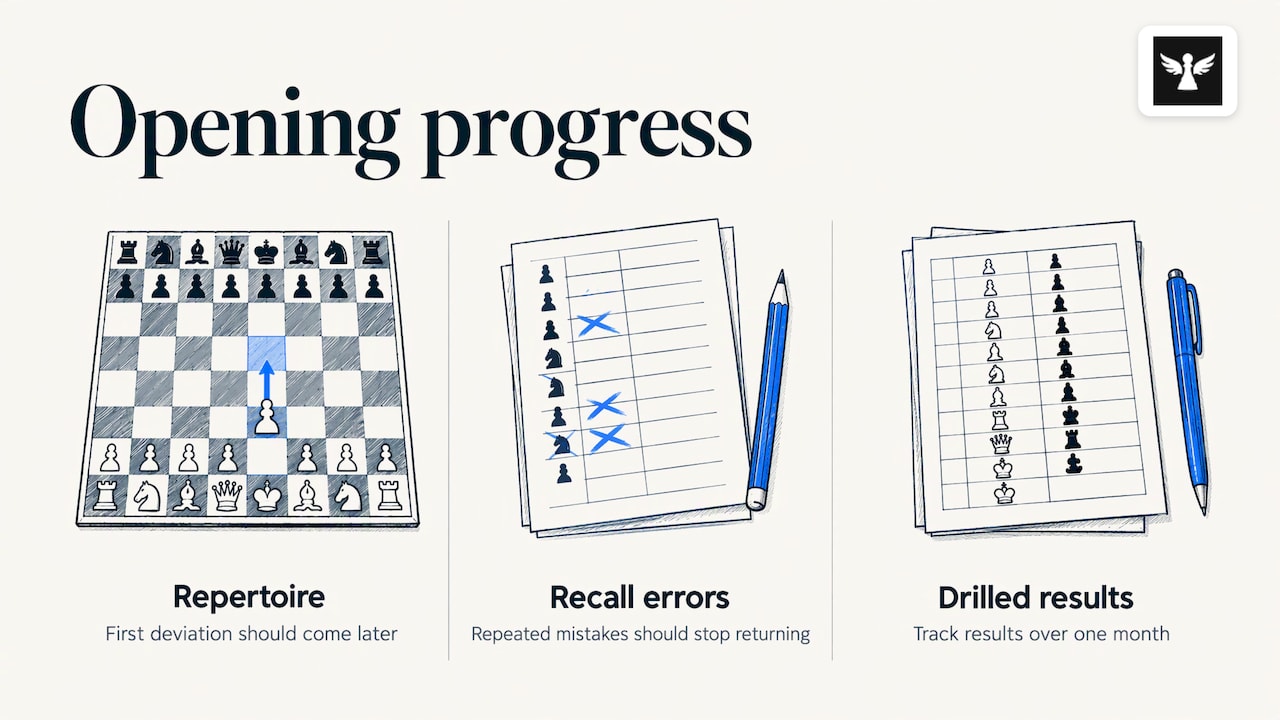
Track three things over a month: how many moves you play from your repertoire before the first deviation, how many of your recall errors repeat, and how your results look in the openings you drilled. If the first deviation is later and the same mistakes stop coming back, the drills are doing their job. The ChessFlux page on tracking opening progress covers this kind of measurement.
Putting it together in ChessFlux
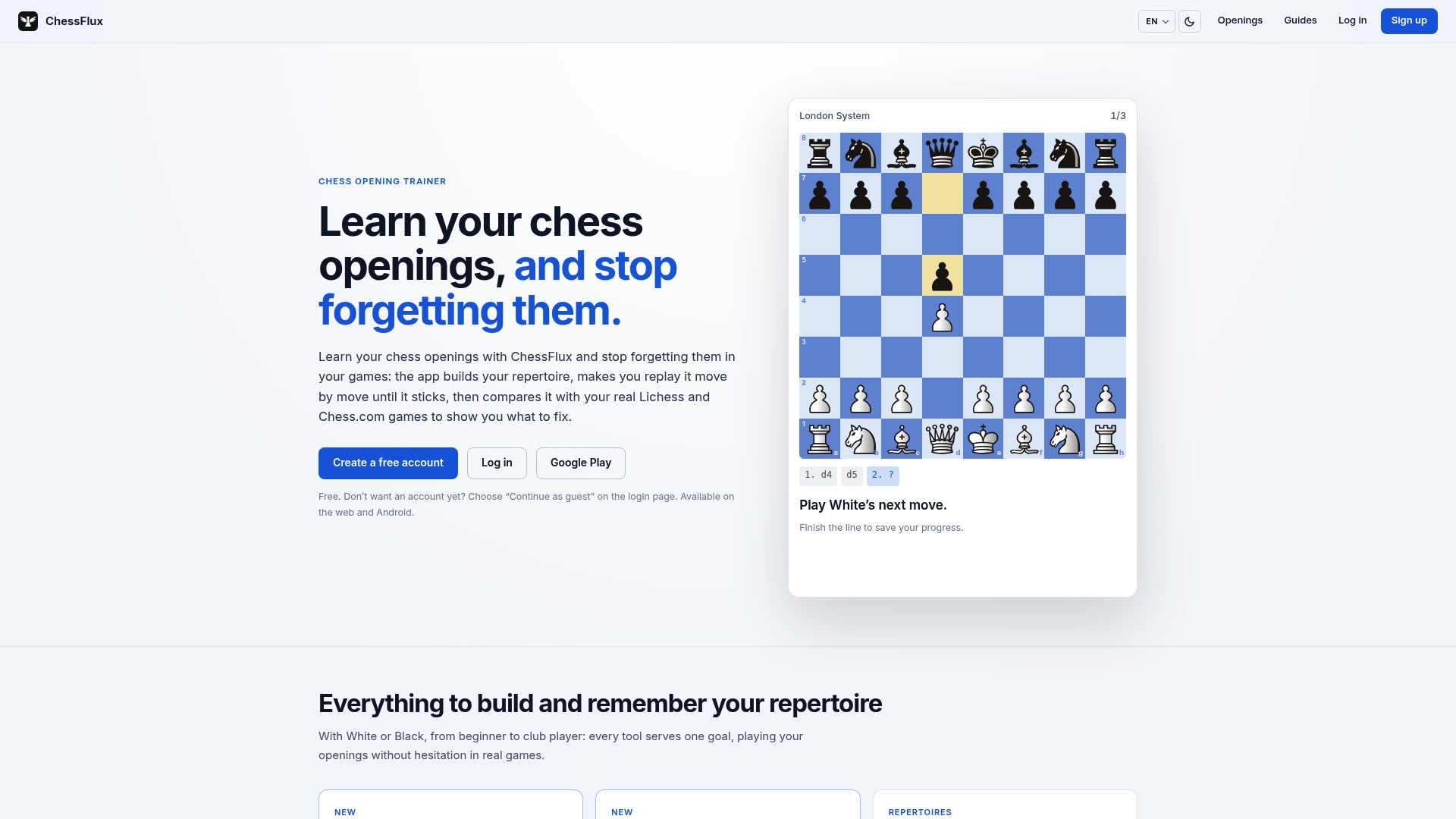
ChessFlux brings these drills into one place. It builds a repertoire from your last 100 Lichess or Chess.com games, trains you move by move, compares your real games with that repertoire, and suggests what to improve. You can add lines with variation trees or import PGNs and studies, then practice puzzles by theme or opening and analyze positions with Stockfish.
The free version covers the core features. ChessFlux Premium adds options such as unlimited puzzles, advanced training and more customization. You can start at chessflux.fr.
If you want a method for the memory side specifically, our guides on how to practice chess openings so they stick and on memorizing your openings without forgetting them go deeper.
Our view on opening drills
Most players do not have an opening problem, they have a feedback problem. They study a line once, play it a month later, forget move seven and never find out why.
That is why we built ChessFlux around your real games. Your last 100 games already show which openings you play, where you leave your preparation and which moves you keep getting wrong. A repertoire built from that data is smaller, more relevant and easier to keep alive than one copied from a book.
Drills should then be short, active and personal. Recall the move before you see it, rebuild the tree from a blank board, and review each game against your own repertoire. Do that for a few minutes at a time and the lines stop being something you read and become something you know.
Rolf
FAQ
How long should an opening drill session last?
Ten to fifteen minutes is enough for move-by-move recall. A blank slate drill can run 10 to 30 minutes, as described by Nate Solon. Short, regular sessions beat one long weekly session because you revisit lines before you forget them.
What is the difference between opening drills and opening exercises?
In practice, nothing. Both terms mean active tasks where you must produce moves from memory, such as recall quizzes, blank board reconstruction and puzzles from your lines. What separates a good drill from a poor one is that you answer before seeing the solution.
Can I drill openings from my Lichess or Chess.com games?
Yes, and it is the most efficient way to choose what to drill. Your game history shows which openings you reach and where you leave your preparation. ChessFlux imports your last 100 games from either site and builds a personal repertoire from them, ready for training.
How many openings should a beginner drill?
One setup as White and one reply each to 1.e4 and 1.d4 is a solid start. A large Lichess study found that playing fewer different openings was linked to better rating gains. Add new lines only when the current ones come back without hesitation.
Sources
- Emerging Investigators: opening variety and rating improvement on Lichess
- US Chess Federation: Greg on Building an Opening Repertoire
- TheChessWorld: A Guide to Choosing Your Opening Repertoire
- Matthias Wahls: How to build up an opening repertoire
- Nate Solon: How to Remember Your Openings
- Nate Solon: How to stop forgetting your openings
- Simon Le Marec: Méthodes d’entraînement (2009)