To analyze a chess game well, review it yourself first, check it with an engine second, and then turn every recurring mistake into a training task. Most players stop at the engine’s red marks. The players who improve are the ones who sort their errors, write down the lesson and drill the position until they play it correctly. If your mistakes keep happening in the first 10 to 12 moves, the fastest fix is to build your opening repertoire from your own games, which is what ChessFlux does from your last 100 games on Lichess or Chess.com.
This guide is written for beginners and intermediate players who play online and want a routine they can repeat after every session.
TL;DR
- Analyze a slow game on your own first, and bring in the engine last, as the French Chess Federation’s coaching material advises.
- Split the game into opening, middlegame and endgame, and ask one question per phase.
- Sort each mistake by type (opening, tactics, plan, time) and write down one lesson per game.
- Patterns across 20 to 100 games matter more than any single blunder.
- Turn repeated opening errors into a repertoire you drill move by move.
Table of Contents
- What analyzing a game actually means
- Step 1: Review the game yourself, without the engine
- Step 2: Let the engine check your work
- Step 3: Analyze each phase with its own question
- Step 4: Classify each mistake and write one lesson
- Step 5: Look across games, not just one
- Turn opening mistakes into a repertoire you can actually use
- Perspective
- Put your analysis to work with ChessFlux
- A simple weekly routine
- FAQ
- Sources
What analyzing a game actually means
Analyzing a game means going back over your moves to find where the game turned, why you played what you played, and what you will do differently next time. An engine, a program such as Stockfish that calculates the best moves, only answers the third part. The first two parts are your job.
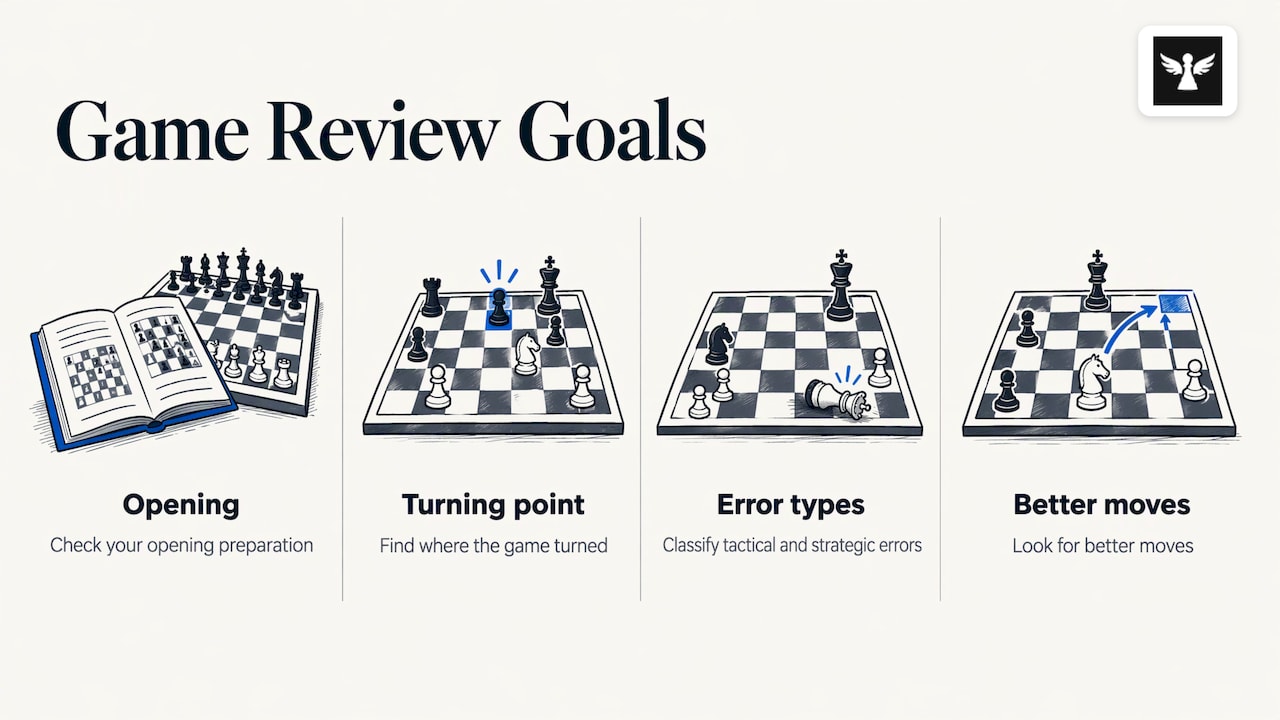
Coaching material built on the trainer Igor Khmelnitsky’s ideas, summarized in Michel Barré’s guide to game analysis, lists four goals: check your opening preparation, find the turning point of the game, classify your tactical and strategic errors, and look for better moves. Keep those four goals in mind. They give your review a shape, so you are not just scrolling through evaluation numbers.
Step 1: Review the game yourself, without the engine
The French Chess Federation’s masterclass of 8 February 2019 recommends analyzing your slow games first without a computer, and only at the very end with its help. The reason is simple: if you look at the engine first, you learn what the best move was but not why you missed it.
Do this on a game of at least 10 to 15 minutes per side. In a blitz game, you rarely had time to think, so the lesson is thinner.
- Replay the game from your side of the board. Stop at each move where you hesitated and write what you were thinking.
- Mark the moves you almost played. The same masterclass suggests noting the moves you hesitated over, because they show what you were afraid of or tempted by.
- Find the moment you felt the game change. It might be a trade, a missed threat or a clock problem. Write it down in one sentence.
- Propose better moves. Spot errors, explain their cause and suggest an improvement, still without the engine.
Write this down, even in a few lines. A blog on game analysis, Les Échecs Sans Peine, recommends putting your questions in writing and noting three lessons per game. Three lessons is a good limit: more than that and none of them sticks.
If you are a beginner, keep it light. Ask only three questions: did I leave a piece undefended, did I miss a check or capture by my opponent, and did I know my opening moves?
Step 2: Let the engine check your work
Now load the game into an engine. The simplest free route is Lichess’s computer analysis. A step-by-step guide from a French chess club explains that you request an automatic analysis and receive your accuracy, your average loss in centipawns (a hundredth of a pawn) and a list of inaccuracies, mistakes and blunders. In that guide, a mistake is roughly the loss of a pawn’s worth of advantage.
The same guide notes that you can import a Chess.com game into Lichess by downloading its PGN (the standard text file that stores a game’s moves) and pasting it into Lichess’s game import. If you need help getting your games out of Lichess in bulk, we explain every way to export Lichess games as PGN, and our page on how to import a PGN from Lichess or Chess.com covers the other direction.
How to read the evaluation bar
The evaluation is a number in pawns from White’s point of view. A tutorial by Pousseur de Bois on analyzing games with Lichess gives useful anchors: around +0.2 is equal, +1 is an advantage for White, and -3 is a huge advantage for Black. Do not chase small differences. A move that changes the evaluation from +0.4 to +0.2 is not an error you need to fix.
What to look for in the engine’s output
- Where the evaluation first fell sharply. That is your turning point. Compare it with the moment you wrote down in step 1.
- Whether the engine’s best move was a tactic you missed (a fork, a pin, a discovered attack) or a quieter positional move.
- Whether you were already worse out of the opening. If so, the game was lost before the middlegame began.
Let the engine think a while on the critical moments. Barré’s guide suggests allowing at least three minutes per move when you use analysis software to find the best candidate move or a winning combination. The instant labels are a starting point, and a deeper look at the key position is worth the wait. Independent testing of how the Lichess labels hold up, published by a developer who re-ran 300 games at greater depth, found that about one label in ten changes at higher depth. Treat borderline inaccuracies as suggestions, and spend your time on the big swings.
Also keep in mind what the engine cannot do. The club-ebt guide points out that Stockfish finds missed tactics well but gives you numbers rather than the strategic reasoning, which you must understand yourself. When the engine says a move is bad, ask: what was my opponent threatening, and what plan did the engine’s move serve?
Step 3: Analyze each phase with its own question
Analyzing the whole game as one block is why many reviews feel vague. A French chess blog, jouer-aux-echecs-en-ligne.net, advises separating the game into three phases and analyzing each one individually. Here is a version for club players.
Opening: did I know my moves?
The FFE masterclass says an opening analysis should identify the main theoretical alternatives, look at what strong players did in the same line, assess the opening for both sides and look for improvements. For you, that becomes two practical checks:
- At which move did I leave my preparation, or my opponent leave theirs?
- Was the position fine at that point, or was I already worse?
If you left theory early and were fine, great: you may just need a better plan. If you left theory by forgetting a move, you have found something you can fix permanently, which makes openings the highest-return part of the review.
Middlegame: what was my plan?
For the middlegame, the same blog recommends writing why you played each move, the alternatives you considered and, above all, the plan. It recalls a saying attributed to Botvinnik that a bad plan is better than no plan at all. A plan can be as simple as attacking a weak pawn, opening a file for your rook or pushing a pawn majority. If you cannot state your plan at move 20, that is the lesson.
Endgame: did I know the basics?
In the endgame, note the starting position and look for a path to win or draw. Look also at the decisions that took you the most time, which are visible if your game has recorded clock times. Barré adds that the endgame demands some minimum technical knowledge to know whether the game is even worth continuing. If you lost a winning endgame, note which technique you lacked (king activity, opposition, rook endgame basics) and study that one topic.
Step 4: Classify each mistake and write one lesson
A list of 12 engine errors is not useful. A list of 12 errors sorted into four categories is. Use these:
| Type of error | Typical sign | What to do next |
|---|---|---|
| Opening | You left your prepared line or forgot a move in the first 12 moves | Memorize the correct line and drill it |
| Tactical | You missed a one- or two-move threat, or a shot for you | Practice puzzles of that theme |
| Strategic | The position was equal but you had no plan | Study typical plans for that structure |
| Time | You spent minutes on easy moves, then rushed | Set a time budget per phase |
Then write one sentence per game: “In this game I lost because ___, and next time I will ___.” Les Échecs Sans Peine adds a useful safeguard, which is to avoid beating yourself up over a missed mate in 5 when a simpler mate in 7 existed. Judge decisions by what was reasonable to find over the board, not by what the engine found in seconds.
Step 5: Look across games, not just one
One game is an anecdote. Twenty games are a pattern. After a month of reviewing, you will probably notice that the same errors repeat: the same opening line where you go wrong, the same type of tactic you miss, the same time-pressure habit.
This is where manual analysis gets heavy. Counting by hand how often you reached a given position and how you scored in it takes a long time. Our guide to a practical plan to improve at chess shows how to prioritize what to fix first, and our walk-through of a free chess game review covers the single-game workflow in more detail.
Turn opening mistakes into a repertoire you can actually use
Openings are the part of a game you can prepare in advance, so every opening error you find has a concrete fix. Here is a routine:
- Collect your recurring openings. Which first moves do you play as White, and what do you answer as Black against 1.e4 and 1.d4?
- Find the first deviation in each game. The move where you or your opponent left the line you knew is the one to study.
- Choose the correct move and understand it. Ask what the idea is, not just which move to play.
- Drill it until it is automatic. Our guide to learning chess openings explains why active recall beats rereading, and our article on chess opening strategy shows how to choose lines that fit your style.
- Check the next batch of games. If the same line now goes well, the review worked.
A worked example
Imagine you play the Italian Game as White and in five of your last ten games, Black answered with an early …Nxe4 trick after you moved too quickly. In your review of the first game, you wrote “I panicked around move 6”. The engine showed an evaluation of equal until move 7, when you gave away a pawn. In the second game, the same thing happened with a slightly different move order. By the fifth game, the pattern is obvious: this one position costs you points. The lesson is not “be more careful”. It is “learn the correct answer to this exact position and rehearse it”. A single sentence in your notes, plus ten minutes of drilling, fixes it.
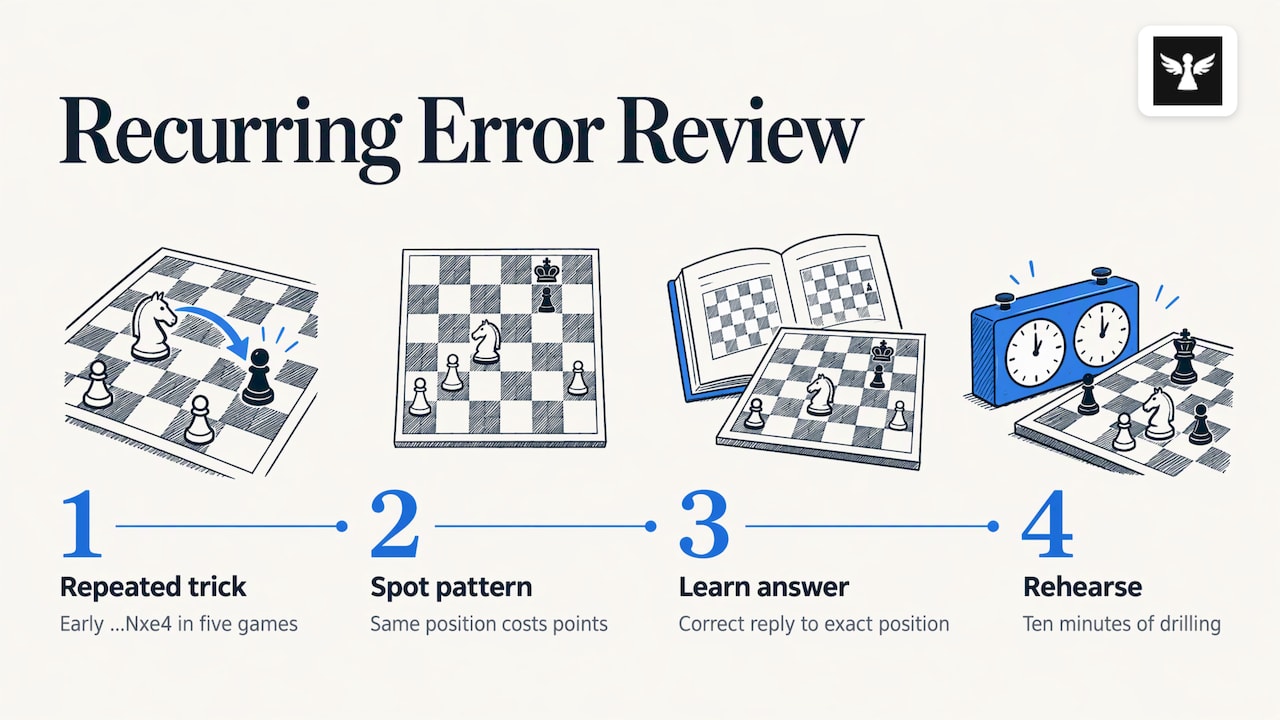
That is exactly the kind of recurring error that is invisible when you review one game at a time. It becomes obvious when you compare dozens of games with the repertoire you meant to play.
Perspective
We built ChessFlux around one observation: reviewing a game is useful, but acting on the review is what changes your results. Most players read an engine report, nod, and then repeat the same opening error three weeks later.
That is why our app starts from your real games. It builds a personalized repertoire from your last 100 games on Lichess or Chess.com, compares what you actually played with that repertoire, and points to the moves that need work. You do not set up anything by hand, and you do not train against a generic opening course that has nothing to do with the positions you reach.
We think the best analysis habit is simple: think first, check with the engine, write one lesson, then train that lesson until it is automatic. Our job is to make the last step, the training, quick to start and measurable.
Rolf
Put your analysis to work with ChessFlux
If your review keeps pointing to the same opening problems, ChessFlux gives you a place to fix them. The app builds a personalized repertoire from your last 100 Lichess or Chess.com games, lets you memorize it move by move, and analyzes your real-game performance against that repertoire to show which moves to improve. You can also build repertoires with variation trees, import PGNs and studies, work through tactics puzzles by theme or opening, and analyze openings with Stockfish.
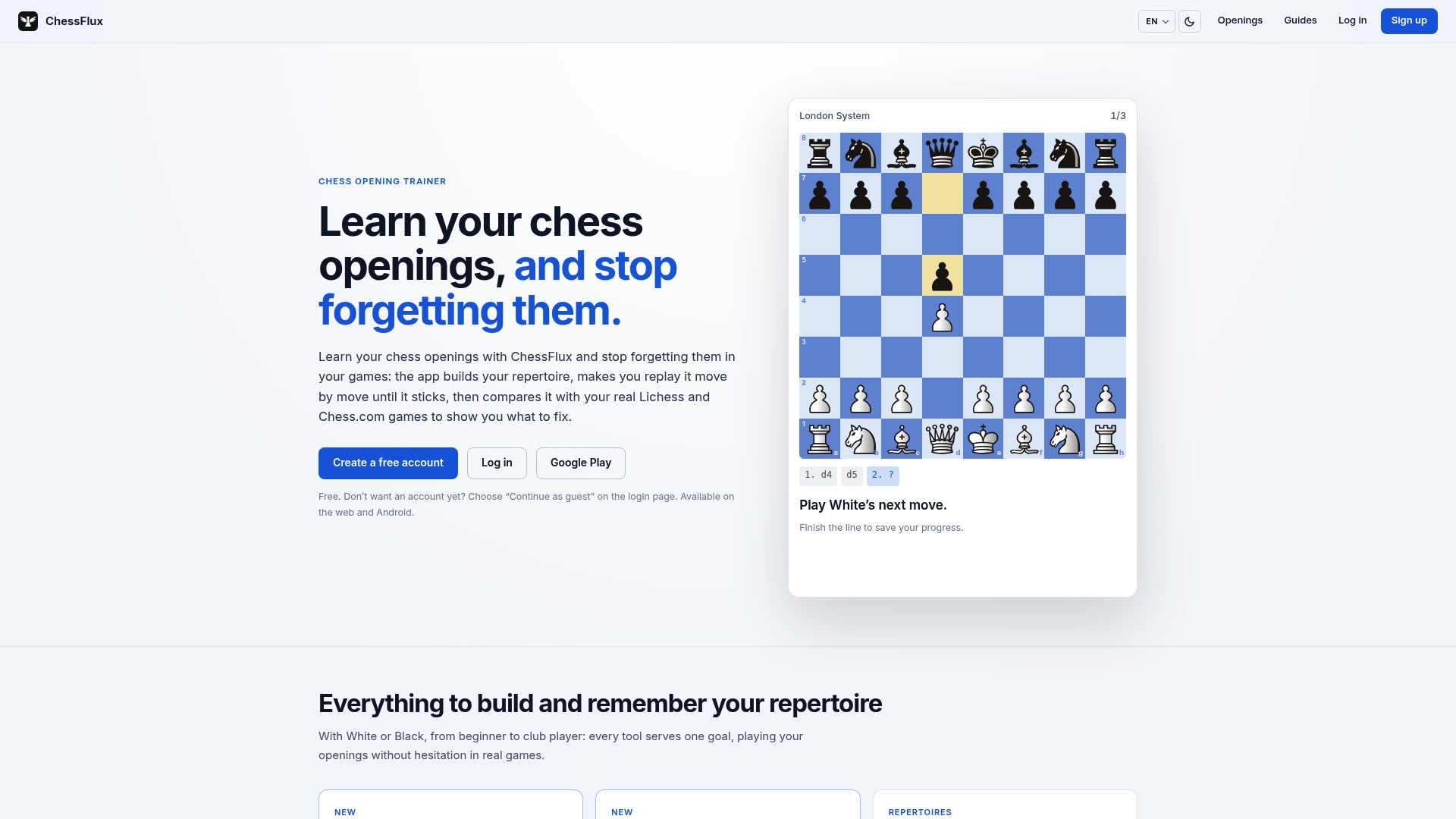
The core features are free, and a Premium subscription adds options such as unlimited puzzles, advanced training and extra customization. Start at chessflux.fr, or read how the game debrief compares your openings with your repertoires and how to build a repertoire from your Lichess or Chess.com games. For the memorization side, see how to memorize chess openings with active training, and for missed tactics, our tactics training and puzzles page.
A simple weekly routine
You do not need hours. This schedule works for most club players:
- After each slow game (10 minutes): replay it without the engine, write your hesitation moves and one sentence on the turning point.
- Once a week (30 minutes): run the engine on your two or three most important games, sort the mistakes into the four types, and write one lesson each.
- Daily (10 to 15 minutes): drill the opening lines you got wrong and a few puzzles on the theme you missed.
- Once a month: look at all your recent games together and ask what mistake appeared most often. Make that your next study topic.
If you can, show your analysis to a stronger player. Barré notes that advice from a master is remembered longer than software output, and Les Échecs Sans Peine recommends submitting your final analysis to another player to reduce your own biases. A chess club is the natural place to find one.
FAQ
How do I analyze a chess game as a beginner?
Replay the game and look for three things: pieces you left undefended, threats from your opponent that you missed, and the move where you left your opening knowledge. Then run the engine and focus on the two or three biggest evaluation drops rather than every small mark. Write one sentence on what you will do differently.
Should I use the engine immediately after a game?
It is better to think about the game first. The FFE masterclass advises analyzing slow games without the computer and only at the end with its help. That way you discover why you missed a move, rather than just seeing the right one.
Can I analyze Chess.com games on Lichess?
Yes. Download the PGN of your Chess.com game and paste it into Lichess’s game import, then request the computer analysis. A French club guide describes this method as a way to get around the limit of one full analysis per day on the free Chess.com account. Our page on importing a PGN shows the steps.
How many games should I analyze?
Quality beats quantity. Analyze your longer games in depth, and look at your shorter games only for patterns such as repeated opening errors. A pattern across 20 or more games tells you more than a deep review of a single blitz game.
How do I know if my analysis is working?
Check whether the same mistakes still appear in your next games. If the opening lines you drilled now go well, or if you stop dropping pieces to the same tactic, your review is paying off. Tracking this by hand is slow, which is why we compare your real games against your repertoire in ChessFlux.
Sources
- FFE masterclass of 8 February 2019 (Sylvain Ravot)
- Comment analyser une partie d’échecs (Michel Barré)
- L’analyse d’une partie d’échecs (Les Échecs Sans Peine)
- Comment analyser ses parties d’échecs sur Lichess (club-ebt.fr)
- Analyser ses parties d’échecs (Pousseur de Bois)
- Comment analyser une partie d’échecs ? (jouer-aux-echecs-en-ligne.net)
- What Lichess Analysis Misses