The Ponziani Opening starts with 1.e4 e5 2.Nf3 Nc6 3.c3. White prepares a big pawn center with d4 and steers the game away from the well-trodden Ruy Lopez and Italian Game. It is a sharp surprise weapon, not a beginner’s shortcut. This guide covers the idea, Black’s main replies, the traps worth knowing, and how to drill the lines until they hold up in a real game.
TL;DR
- The Ponziani is 1.e4 e5 2.Nf3 Nc6 3.c3, classified under ECO code C44. White wants d4 next, with a broad pawn center.
- The price of 3.c3 is a lost square for the queen’s knight and a slight lag in development, so Black has several decent ways to equalize.
- Black’s main answers are 3…Nf6 (the Jaenisch Variation) and 3…d5. The Ponziani Countergambit 3…f5 is a sideline you should still know.
- Tactics dominate, so it suits players who enjoy concrete calculation more than quiet plans.
- To make it stick, build a small repertoire tree, train the moves your opponents actually play, and review where you left the book.
Table of Contents
- What the Ponziani Opening is
- What White is trying to do
- Black’s main replies
- Traps and common mistakes
- Is the Ponziani good for beginners?
- How to practice the Ponziani
- A worked example of preparing one branch
- Perspective: why we train openings from your real games
- Train the Ponziani with ChessFlux
- Model games and where to find them
- FAQ
- Sources
What the Ponziani Opening is
The Ponziani is a king-pawn system for White. After 1.e4 e5 2.Nf3 Nc6 3.c3, White intends to follow with d4 and take a strong, wide center. Compare the other third moves: 3.Bb5 gives the Ruy Lopez, 3.Bc4 the Italian Game, and 3.d4 the Scotch. With 3.c3, White chooses a slower, more flexible route.
The name goes back to the Italian player Domenico Lorenzo Ponziani, who analyzed the opening in 1769. The idea is much older: the opening is one of the oldest recorded, with discussions in the literature going back to 1497. In the nineteenth century it was also known as Staunton’s Opening or the English Knight’s Game.
The position after three moves looks harmless. That is part of its appeal: your opponent has to think, and many club players have never seen the line.
What White is trying to do
The plan is simple to state. The move c3 supports d4. If White gets d4 in, the center is big and Black’s e5 pawn is under pressure. The extra c3 square also gives the queen a second diagonal, which is why Qa4 shows up so often in the theory.
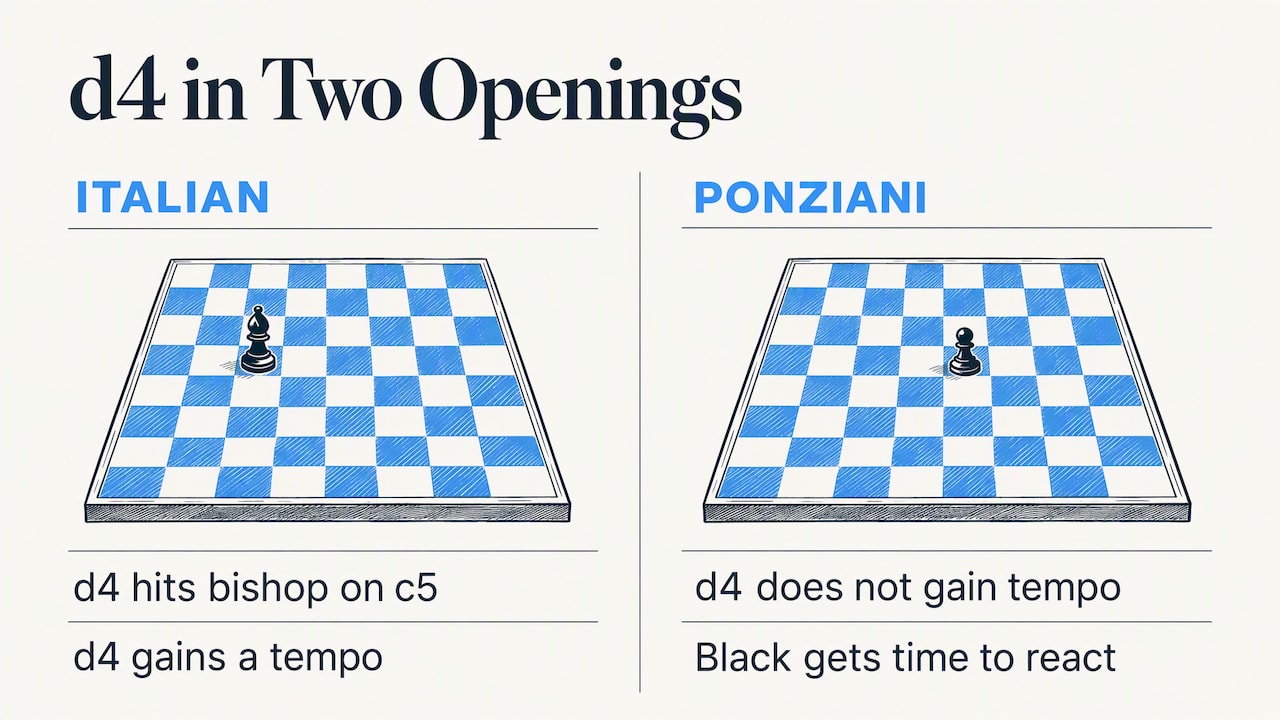
There is a catch. In the Italian Game, d4 hits the bishop on c5 and gains time. In the Ponziani, d4 does not gain a tempo, so Black gets time to react.
The honest drawbacks
The same sources list three problems with 3.c3:
- It takes away the most natural square for White’s queen’s knight.
- It temporarily creates a hole on d3.
- It develops a pawn instead of a piece, leaving White behind in development and not well placed to meet a counterattack in the center.
That is why the line is considered inferior to the Ruy Lopez and Italian Game, and why it is rarely played except as a surprise. The French Wikipedia entry makes the same point: the opening is rare and Black has several ways to equalize.
Does that make it bad? No. At club level, a prepared surprise often beats a theoretically better line you do not know well. Magnus Carlsen won with it in 2013, against Pentala Harikrishna at Tata Steel in Wijk aan Zee, in a game the database files as the Jaenisch Counterattack. One strong game is not proof of soundness, but it shows the opening can generate real winning chances.
Black’s main replies
Black has three replies you will meet most often. Know them in this order of likelihood.
| Black’s 3rd move | Name | What it aims for | White’s usual answer |
|---|---|---|---|
| 3…Nf6 | Jaenisch Variation | Safe development, counter-hit on e4 | 4.d4 |
| 3…d5 | Central counterstrike | Challenge e4 immediately | 4.Qa4 or 4.exd5 |
| 3…f5 | Ponziani Countergambit | Sharp attack on the center | Accept with care, know the theory |
3…Nf6, the Jaenisch Variation
This is generally considered Black’s safest course. It also discourages many potential Ponziani players, because the resulting positions run from chaotic to passive. White’s standard reply is 4.d4, and after 4…Nxe4 White usually plays 5.d5. Black must then move the knight to safety, or invite complications with 5…Bc5.
The key point is that the pawn on d5 kicks the knight on c6 away and gains space. Learn the knight retreat and the ideas around the e5 pawn, and you will have the backbone of this line.
3…d5, striking back
This is the other main reply. Black hits the center immediately, which is the natural way to punish a slow third move. White’s most common idea is 4.Qa4, using the queen’s new diagonal to pin the knight on c6 and add pressure on e5.
One line is worth memorizing. After 4.Qa4 Nf6, the Leonhardt Variation lets White grab material with 5.Nxe5. Theory then runs 5…Bd6 6.Nxc6 bxc6 7.d3 0-0 8.Be2 Re8, where Black has compensation for the pawn. That is a clean example of why you need move order, not just ideas: one inaccurate reply and the compensation vanishes, or never existed.
3…f5, the Ponziani Countergambit
It looks risky, and it is. The Countergambit is an aggressive sideline that is thought to give White an advantage if you know the theory. If you do not, it can be a nasty shock. Spend an hour on it once, and the shock goes away.
Traps and common mistakes
The Ponziani is tactically demanding. In its main lines tactics predominate and there are no simple strategic principles to guide you. That is the most useful sentence to remember about it. It means most traps are not gimmicks but ordinary tactical motifs that appear because pieces are loose.
Here are the recurring patterns to watch for, from both sides.
For White
- Playing d4 automatically, without checking whether Black’s pawn on e5 or a knight capture on e4 changes the tactics.
- Forgetting that the queen’s knight has no c3 square, then leaving a piece undefended after a central exchange.
- Grabbing the e5 pawn with Nxe5 without checking the recapture sequence. The Leonhardt line above works only with exact moves.
- Treating the opening as a trap-only weapon. Against a prepared opponent, you need a plan after the first ten moves.
For Black
- Answering with a quiet move such as 3…Bc5 and allowing White the d4 break on favorable terms.
- Ignoring the Qa4 pin after 3…d5, and losing the e5 pawn or a piece to a simple double attack.
- Playing the Countergambit without knowing the refutation, because it looks aggressive.
None of this requires deep theory. It requires seeing the same positions several times, which is exactly what repetition training provides.
Is the Ponziani good for beginners?
Short answer: not really. The source most players quote says it is no opening for beginners, precisely because tactics dominate and the guiding principles are thin. A beginner who plays 1.e4 e5 2.Nf3 Nc6 will usually learn more from the Italian Game, where development and a clear plan are built in. See our guide to the Italian Game or the Ruy Lopez for the main alternatives.
Who should play it?
- Intermediate players who enjoy tactics and want a surprise weapon against opponents who rely on theory.
- Players tired of the Ruy Lopez who want a different structure but still love open games.
- Anyone willing to learn a small tree well rather than a big one superficially.
Who should skip it? Players who dislike being slightly behind in development, or who prefer solid positional plans. For them, the Queen’s Gambit or the London System will feel more natural.
How to practice the Ponziani
Reading about the Ponziani is easy. Remembering it at move six, with a clock running, is the hard part. Here is a method that works for any opening, applied to this one.
Step 1: Keep the tree small
You do not need every variation. Cover 3…Nf6, 3…d5 and 3…f5, plus the one or two odd moves that appear in your own games. Our guide on how to build an opening repertoire explains how to organize those branches so they do not collide with the rest of your White repertoire.
Step 2: Look at what your opponents actually play
Theory tells you what strong players do. Your games tell you what people at your level do, and those two are often different. If most of your opponents answer with 3…d5 and almost nobody plays the Countergambit, you should spend your time accordingly. You can build a repertoire from your own Lichess or Chess.com games to see this directly.
Step 3: Drill move by move
Memorize each branch by playing it, not by reading it. Play the White moves, answer the Black replies, and repeat until the next move arrives without thinking. Short sessions on several days beat one long session.
Step 4: Check the critical positions with an engine
When a line puts you down in development, ask the engine what the real evaluation is and which moves keep the balance. Our guide on how to analyze openings with Stockfish shows how to do this without drowning in numbers.
Step 5: Add tactics
Because the Ponziani is a tactical opening, training the motifs it creates pays off: loose pieces in the center, pins on the c6 knight, and forks on e5. Themed chess tactics puzzles are a good fit here.
A worked example of preparing one branch
Take the line 3…d5 4.Qa4 Nf6 5.Nxe5 Bd6. It is a good test for your preparation, because White is a pawn up and Black has compensation.
First, play it out on a board and say why each move is forced. Why does White take on c6 and then play d3 rather than hurry? Because White is a pawn up and wants to complete development safely before Black’s pieces become active.
Second, find the position where your opponent is most likely to deviate. Black can play different sixth moves, and each needs an answer. Write them down as branches, one line each.
Third, play five or six practice games from that position against a friend, or in a training mode. You will quickly find where your memory fails, and that is the information you need.
This takes about an hour per branch, and then you own that branch.
Perspective: why we train openings from your real games
We built ChessFlux around one observation: most players do not lose games because they never studied an opening. They lose because they studied the wrong lines. A rare opening like the Ponziani makes this obvious. A 1,000-page repertoire book covers every reply, but your next ten opponents will probably play two or three of them.
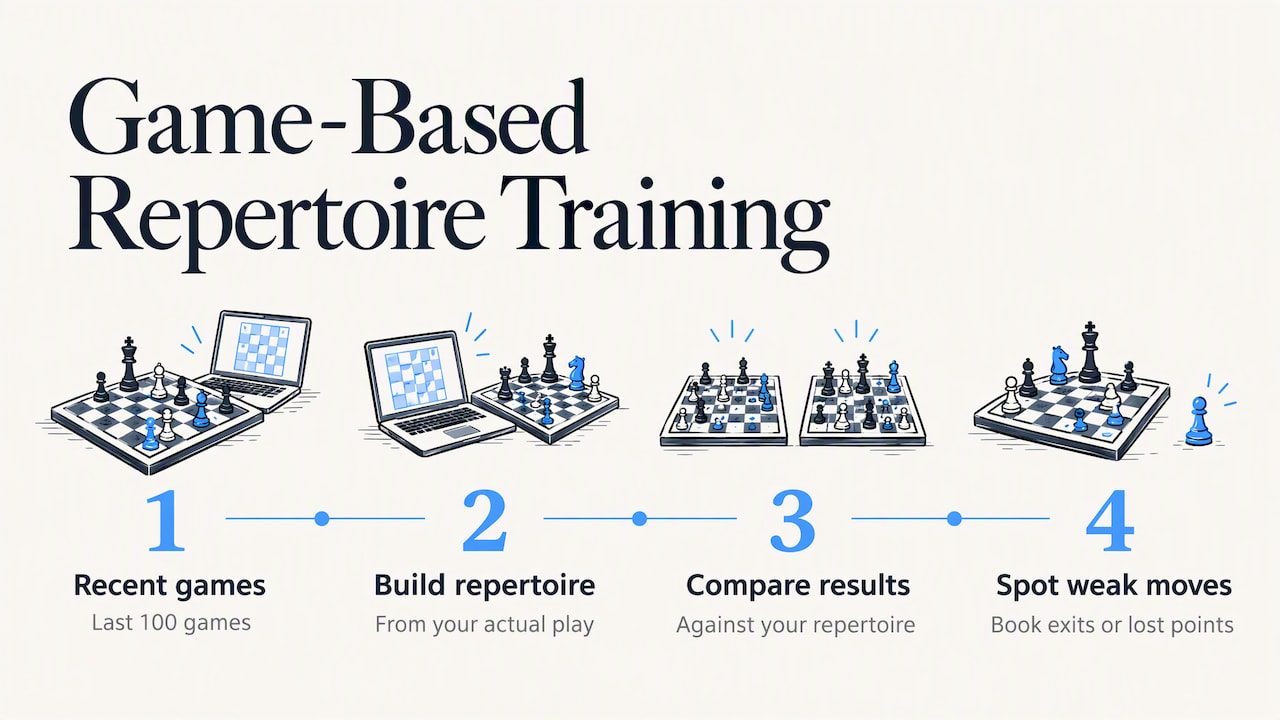
That is why we start from your last 100 games on Lichess or Chess.com, rather than from a generic course. The app builds a repertoire from what you actually play, compares your real results with it, and points to the moves where you leave the book or lose points. For an opening like the Ponziani, where one inaccurate reply can cost a pawn, that targeted repetition matters more than extra theory.
Our advice: pick a small set of lines, drill them until they are automatic, and let your own games tell you what to add next.
— Rolf
Train the Ponziani with ChessFlux
If you want to put this into practice, ChessFlux lets you import your recent Lichess or Chess.com games, build a repertoire with variation trees, and train each move interactively. The free version covers the core features, and Premium unlocks options such as unlimited puzzles, advanced training and extra customization. You can also import lines from PGN files and studies, and check any position with Stockfish.
Model games and where to find them
Seeing the opening in real games helps the plans stick. Start with Carlsen’s 2013 win against Harikrishna: it shows how a top player handles the Jaenisch Counterattack and how the tactics decide the game. Then look for games at your own rating level in your own history. Games where you or your opponent left the book are more instructive than any famous classic, because they show the mistakes you are most likely to repeat.
If you want to compare the Ponziani with other 1.e4 e5 systems, our chess openings library and opening guides are the place to start.
FAQ
Is the Ponziani Opening good?
It is playable but not objectively best. Sources describe it as inferior to the Ruy Lopez and Italian Game, and Black has several ways to equalize. Its value is practical: it takes your opponent out of theory and leads to sharp, tactical play.
What are the first moves of the Ponziani?
The moves are 1.e4 e5 2.Nf3 Nc6 3.c3. White supports a later d4 and tries to build a strong center. Black’s most common replies are 3…Nf6 and 3…d5.
How do I practice the Ponziani Opening?
Build a small tree covering 3…Nf6, 3…d5 and 3…f5, then drill it move by move until you can play it without hesitation. Review your own games to see which replies you really face. Add tactics puzzles with the typical motifs to turn the memory into results.
Is the Ponziani Opening good for beginners?
Usually not. The opening is tactically demanding and has no simple strategic principles to guide you. Beginners are better served by openings with clear development and plans, then can return to the Ponziani as a surprise weapon.
Sources
- Ponziani Opening (English Wikipedia)
- Ponziani Opening, mobile version (English Wikipedia)
- Début Ponziani (French Wikipedia)
- Chess Opening Theory: Ponziani Opening (Wikibooks)
- Magnus Carlsen vs Pentala Harikrishna, 2013 (Chessgames)