
The best openings for an intermediate player are the ones that lead to positions you understand, so there is no single winner. The Italian Game, Scotch Game, London System, Queen’s Gambit, Caro-Kann and French all work well at this level. What matters most is a small repertoire that matches your style and that you rehearse on the positions your own games actually reach. That last part is what we built ChessFlux for: it creates a repertoire from your last 100 Lichess or Chess.com games and trains you on it.
TL;DR
- Pick one setup as White and one defense against 1.e4 and 1.d4 each. Keep the tree small and go deep.
- Good intermediate choices: Italian Game, Scotch Game, London System or Queen’s Gambit as White; Caro-Kann, French or Sicilian as Black.
- Choose by style and pawn structures, not by what a top player plays. Understanding ideas matters more than memorizing moves.
- Your own recent games show which lines you really face, so train those first.
- ChessFlux builds a repertoire from your last 100 online games and drills the moves you miss.
Table of Contents
- What “intermediate” changes about opening choice
- Openings as White
- Defenses as Black
- How to choose: style, structures, time
- Learn the opening through games, not just move lists
- Use your own games to decide what to study
- Check your lines with an engine, carefully
- Add tactics from your opening
- A starter repertoire for an intermediate player
- Where ChessFlux fits
- Our perspective
- FAQ
- Sources
What “intermediate” changes about opening choice
A beginner needs opening principles: develop pieces, control the center, castle. An intermediate player already knows them and has hit a different problem. Opponents now play real theory for six to ten moves, and you lose games because you forgot a line or reached a structure you do not know how to play.
That is why a repertoire matters. The French Chess Federation (FFE) describes an opening repertoire as a tree of variations, from White’s or Black’s side, that covers the opponent’s possible replies. FFE coach Xavier Bédouin adds that its purpose is to play the opening better and, above all, to reach a playable middlegame, a formulation he attributes to GM Lajos Portisch. The goal is not to win on move 12. It is to arrive at move 15 in a position you like.
For the principles behind this, see our guide on chess opening strategy.
Openings as White
At this level, White has two broad paths: open play after 1.e4 or a slower, structure-based game after 1.d4.
Italian Game
The Italian Game starts 1.e4 e5 2.Nf3 Nc6 3.Bc4. It is old, dating back to the 15th or 16th century, and is frequently taught to beginners. It stays useful at intermediate level because the slow Giuoco Piano lines (with c3 and d3) reward planning: you build a center, reroute the knight and choose the right moment to strike with d4 or f4. You learn to play on both wings instead of hunting for traps.
Theoretical upkeep is moderate. You need a plan against 3…Bc5 and against 3…Nf6, and you should know what to do when Black goes for the Two Knights lines.
Scotch Game
The Scotch goes 1.e4 e5 2.Nf3 Nc6 3.d4. White opens the center immediately and gets space and quick piece activity. It suits players who like concrete tactics and clear piece play more than slow maneuvering. The price is that you must learn more concrete moves, since Black has several active replies such as 3…exd4 followed by 4.Nxd4 Bc5 or 4…Nf6.
London System
The London System is defined by 1.d4 and 2.Bf4 against almost any Black setup. Because the same pieces go to the same squares, the memory load is light, and many players use it to reach familiar positions quickly.
There is a trap here for intermediate players, though. A system opening is only as good as your understanding of its middlegame plans: the e4 break, the kingside attack, how to answer …c5 and …Qb6. If you only learn the setup, stronger opponents will test it and you will not know what to do. Treat it as a structure to study, not a shortcut.
Queen’s Gambit
The Queen’s Gambit begins 1.d4 d5 2.c4. It is called a gambit because White seems to offer the c-pawn, but Black cannot keep it without a disadvantage. Black’s main replies are 2…e6 (the classical Queen’s Gambit Declined), 2…c6 (the Slav) and 2…dxc4 (the Queen’s Gambit Accepted).
This opening teaches center control, pawn tension and minority-attack ideas that carry into many other d4 structures. Our page on the Queen’s Gambit: moves, variations, plans and traps walks through the main lines.
Quick comparison for White
| Opening | First moves | Character | Memory load | Best for |
|---|---|---|---|---|
| Italian Game | 1.e4 e5 2.Nf3 Nc6 3.Bc4 | Open, flexible | Moderate | Players who like clear plans and piece play |
| Scotch Game | 1.e4 e5 2.Nf3 Nc6 3.d4 | Open, direct | Moderate to high | Players who like early activity |
| London System | 1.d4 and 2.Bf4 | Solid setup | Low to moderate | Players who want a repeatable structure |
| Queen’s Gambit | 1.d4 d5 2.c4 | Strategic, central | Moderate to high | Players who like pawn structure and long plans |
Defenses as Black
As Black you need an answer to both 1.e4 and 1.d4. This is where many intermediate players are inconsistent: they play a different defense every month and never learn any of them deeply.
Against 1.e4
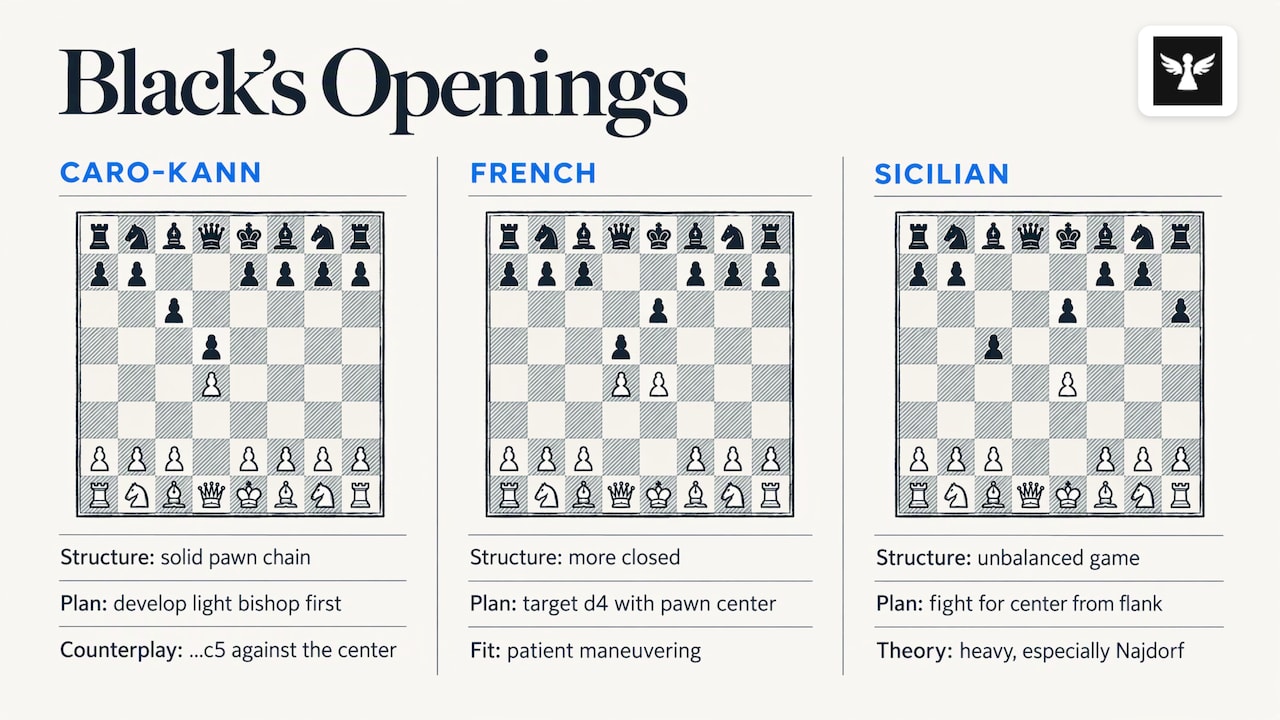
Caro-Kann (1…c6). Black prepares …d5 with a solid pawn chain and avoids many early tactical dangers. The FFE masterclass cites a small Caro-Kann repertoire as an example for protecting young learners from quick opening losses, not as a universal best choice. Its main ideas are developing the light-squared bishop before closing the pawn chain and attacking White’s center with …c5.
French (1…e6). Also solid, but the structure is more closed. Black accepts a slightly cramped position for a strong pawn center target at d4 and counterplay with …c5. It suits patient players who enjoy maneuvering and plans around pawn breaks.
Sicilian (1…c5). The most ambitious reply. Black fights for the center from the flank and creates an unbalanced game. The theory load is heavy, especially in Najdorf-style lines, so an intermediate player should pick one setup and stay with it rather than sampling several.
Against 1.d4
The Queen’s Gambit Declined (…d5 and …e6) and the Slav (…d5 and …c6) are natural choices. Both rely on the same central idea, and the Slav pairs well with a Caro-Kann because both use the …c6 and …d5 pawn setup. If you already play the Caro-Kann, that overlap lowers your study load.
How to choose: style, structures, time
The lists above show what exists. Choosing among them comes down to three questions.
What structures do you enjoy? Chess coach Le Marec, in his FFE coaching thesis, recommends matching a repertoire to the player’s style and preferred pawn structures and building a coherent whole around them. If you love open, tactical positions, the Scotch and the Sicilian fit. If you prefer slow plans, look at the London, the Queen’s Gambit or the French.
How much time do you have? A line you drill for ten minutes a day is worth more than a deep one you review twice a year. If you can study two or three hours a week, choose openings with fewer forced sharp lines.
Do the openings share ideas? A repertoire is easier when pieces connect: Caro-Kann with Slav, or London with a d4 structure you can reuse. Related pawn structures mean each hour of study pays off in more than one opening.
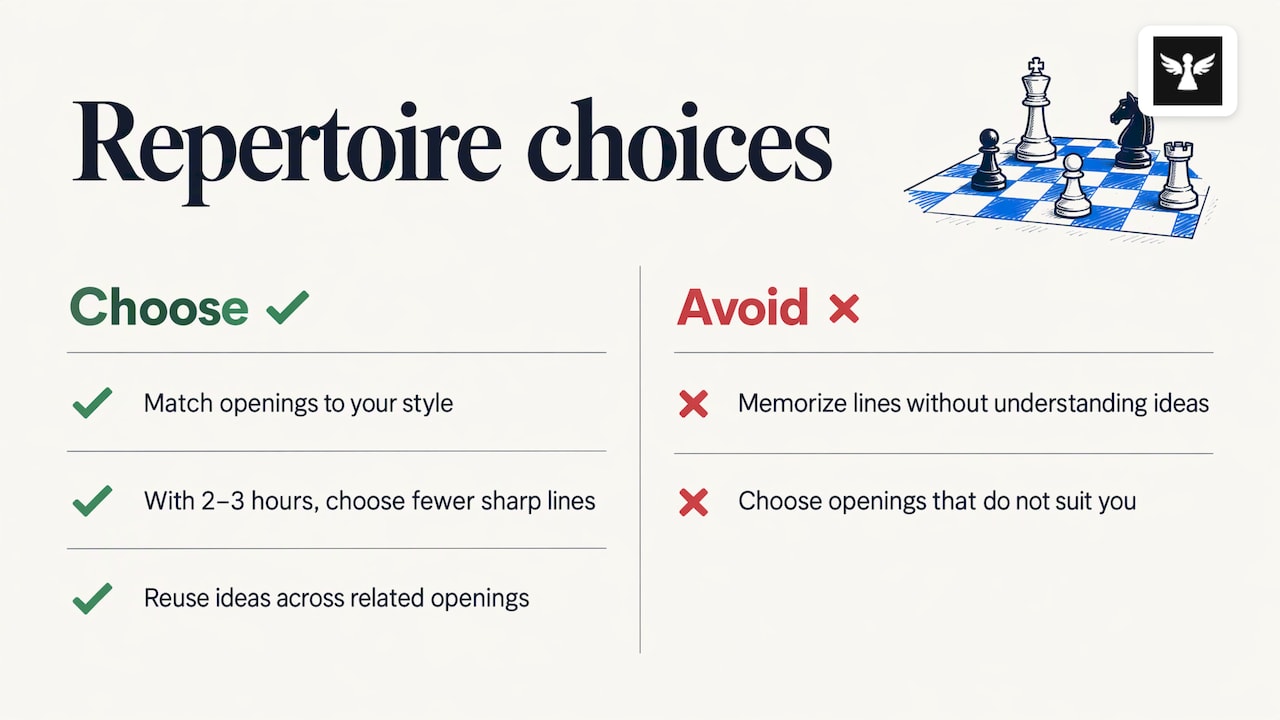
Le Marec also warns that amateurs often memorize openings without understanding their ideas and may pick openings that do not suit them. The fix is simple: for every line, be able to say in a sentence what each side wants.
Learn the opening through games, not just move lists
The same thesis recommends that opening study include complete games, which you analyze and annotate so that you see the middlegame and endgame as well as the theory. It also suggests introducing a new opening through about ten important illustrative games, then working on main variations, plans, typical positions, pawn structures and the resulting endgames (Le Marec).
In practice, a good routine for a new opening looks like this:
- Play through about ten model games and note the recurring plans.
- Write down the main branches: what Black can do on moves 3, 4 and 5 and your answer to each.
- Learn the pawn structures that result and where your pieces belong.
- Drill the moves until the first ten or twelve come without thinking.
- Play the opening in real games, then compare what happened with your prepared lines.
Step 5 is the one most players skip, and it is the one that tells you what to fix. For memory techniques, our guides on how to memorize chess openings and chess opening drills cover the exercises in more detail, and how to practice chess openings so they stick sets out a weekly rhythm.
Use your own games to decide what to study
A repertoire built from a book covers lines your opponents may never play. Your online games show the reality: the replies you meet at your level, where you leave your preparation and which lines cost you points.
A simple audit takes about an hour:
- Export or open your last 50 to 100 games as White and Black.
- Group them by opening and note the move where you first left your intended line.
- Mark the three positions where you lost the most ground.
- Study those three first, before adding anything new.
Doing this by hand works, but it is slow and it fades as soon as you play new games. That is the job we designed ChessFlux for. It builds a personalized repertoire from your last 100 games on Lichess or Chess.com and compares your real performance with that repertoire, so you see which moves to improve. Our guide on building a repertoire from your Lichess or Chess.com games shows how the import works.
Check your lines with an engine, carefully
Once you have a line, an engine helps you test it: does the move you remembered actually hold, and what does the engine suggest when you deviate? Use it to understand why a move works, not to collect evaluations. ChessFlux includes opening analysis with Stockfish, and our guide to analyzing chess openings with Stockfish explains how to read the results without just copying the top line.
Add tactics from your opening
Openings and tactics feed each other. Most opening disasters are tactical: a missed pin, a poisoned pawn, a trap you have never seen. ChessFlux offers tactics puzzles by theme or by opening, so you can practice the shots that arise in the very lines you play. Our page on chess tactics training and puzzles lists the options.
A starter repertoire for an intermediate player
Here is one coherent package that keeps theory manageable. It is a suggestion, not the only answer.
- White: Italian Game against 1…e5 with a slow c3 and d3 setup, and the Queen’s Gambit or London System against 1…d5. Pick one d4 opening and stay with it.
- Black against 1.e4: Caro-Kann.
- Black against 1.d4: Slav, which shares its pawn setup with the Caro-Kann.
This package uses a handful of recurring pawn structures, so ideas you learn in one line help in another. After three months, review your games and extend only the branches you actually met. For a broader overview of the common branching lines, read our guide to main variations.
Where ChessFlux fits
ChessFlux is a freemium app. The free core features cover training on your repertoire, and ChessFlux Premium unlocks options such as unlimited puzzles, advanced training and additional customization. Beyond the import from your last 100 games, you can build repertoires with variation trees, import from PGN files and studies, and train move by move.
If you already have a list of openings from this article, try ChessFlux and let your own games show which of those lines need the most work. You can also start from our repertoire-building guide.

Our perspective
Most intermediate players do not lack openings. They lack a feedback loop. They read about the Scotch, memorize eight moves, then meet a different reply in a blitz game and the preparation is gone.
We think the opening you should study is the one your games keep reaching. That is why ChessFlux starts from your last 100 games on Lichess or Chess.com instead of asking you to type in a repertoire by hand. Once the tree is built, the work is repetition on the moves where your real results show weakness, and understanding why each move is played.
Pick a small set of openings, learn their ideas, and let your own games tell you what to fix next. Progress in the opening is measurable that way, and it is the approach we have designed our training around.
Rolf
FAQ
What is the best opening for an intermediate player?
There is no single best one. Solid, idea-rich openings such as the Italian Game, London System, Queen’s Gambit, Caro-Kann and French suit this level. Choose the ones whose pawn structures you enjoy playing and whose theory you can keep up with.
How many openings should an intermediate player know?
One setup as White, plus one defense against 1.e4 and one against 1.d4 as Black, is enough to start. A small, coherent tree that you know deeply beats a large one you half remember. Extend it only where your games show gaps.
Should I play a system opening like the London?
Yes, if you also study its middlegame plans. The London gives you a repeatable setup, which reduces memory load, but you still need to know how to answer different Black setups and when to break with e4. Treat it as a structure to understand, not just a list of moves.
How do I memorize an opening so it sticks?
Combine understanding with repetition. Study a handful of model games, learn the plans behind each move, then drill the lines until they come automatically. Finally, play them and review where you left your preparation. Our guide on how to learn chess openings sets out a method.
Sources
- FFE masterclass recap with Xavier Bédouin, 20 April 2020
- Méthodes d’entraînement (Le Marec, DEFFE thesis)
- Italian Game
- London System
- Queen’s Gambit